 Skip to content
Think of a hardwood staircase. It’s not just a way to get from one floor to another; it's the architectural heart of many Denver homes. It connects your spaces and makes a huge design statement. For homeowners in Boulder, a professional staircase hardwood installation takes this functional feature and turns it into a stunning centerpiece, seriously boosting your home’s look and its market value. At J.R. Hardwood, we specialize in Boulder hardwood floor refinishing and installation, using our advanced UV-Cure system to deliver flawless, durable results.
Elevate Your Home with Professional Hardwood Stairs in Boulder
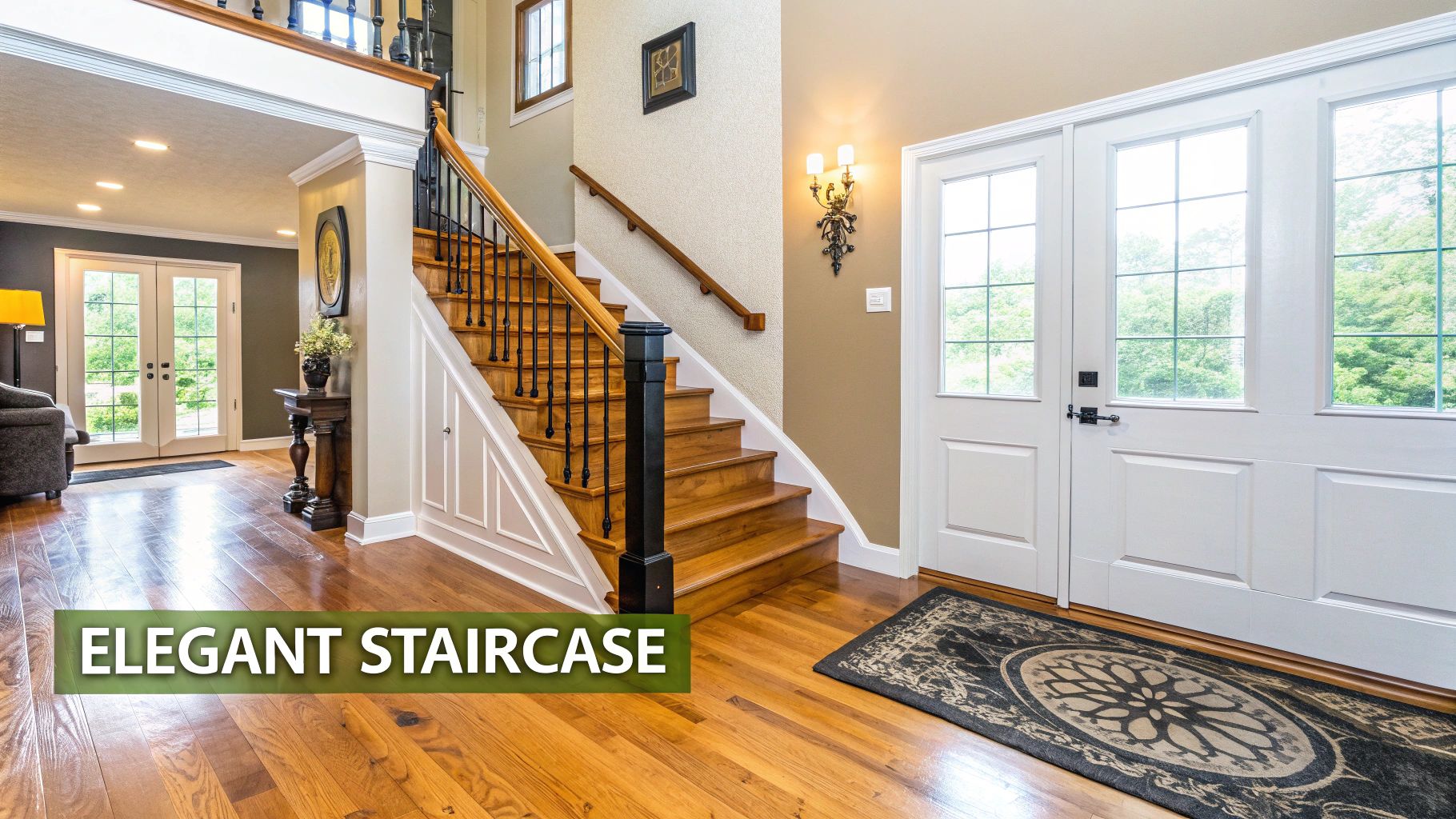
Upgrading your stairs from tired, old carpet to beautiful hardwood is one of the most impactful investments you can make in your home. This isn't just a cosmetic touch-up. It's about adding real character and serious durability to one of the highest-traffic areas you have. When done right, every single step feels solid, secure, and gorgeous, perfectly matching your Boulder home’s unique style.
The Nuances Of A Staircase Project
Installing hardwood on a staircase is a completely different ballgame than laying it on a flat floor. A staircase hardwood installation requires an incredible amount of precision. Each tread, riser, and nosing has to be custom-cut to fit flawlessly, dealing with the unique quirks and angles of your home. It's this complexity that makes professional expertise not just a good idea—it's absolutely essential for a result that's both safe and built to last.
Whether we're preserving the structural integrity of a classic Mapleton Hill home or creating a clean, modern look in a new build near the Flatirons, our team is obsessed with getting every single detail right. This commitment to excellence is a core part of our Boulder hardwood floor refinishing services and our innovative UV-Cure system.
To get you started, here's a quick rundown of the major factors you'll need to consider.
Key Factors In Your Staircase Hardwood Project
| Factor | What To Consider | Why It Matters For Boulder Homes |
|---|---|---|
| Material Selection | Prefinished for speed and durability, or site-finished for a perfect custom match. | Boulder's dry climate can affect wood. We help you choose a stable species like oak or maple that performs well here. |
| Stair Anatomy | The style of treads, risers, and nosing dramatically changes the final look. | Matching the architectural style of your home, from a historic bungalow to a modern build, is key to a cohesive design. |
| Installation Technique | Method depends on whether you have a closed, open, or curved staircase. | Each type has unique challenges. Proper technique ensures a safe, squeak-free installation that meets local building codes. |
| Finishing & Durability | Choice of stain color and finish sheen (matte, satin, gloss). | High-traffic stairs need a tough finish. Our UV-Cure system offers maximum durability for active Boulder families and their pets. |
| Safety Codes | Riser height, tread depth, and handrail requirements are non-negotiable. | We ensure your new staircase is fully compliant with Boulder and local building codes for your family's safety. |
Thinking through these elements ahead of time helps ensure the final product is exactly what you envisioned.
Why J.R. Hardwood Is Boulder’s Choice
At J.R. Hardwood, we pair old-school, meticulous craftsmanship with the latest technology to deliver results that are nothing short of perfect. Our approach to Boulder hardwood floor refinishing and installation is built to give you the highest quality with the least amount of disruption to your life.
- Dust-Free Process: We use a powerful dust containment system that keeps your home clean and breathable while we work. No lingering dust clouds to deal with for weeks.
- Instant UV-Cure System: Our game-changing UV-Cure system hardens the finish instantly. Your stairs are incredibly durable and ready for regular use almost immediately—a huge step up from traditional methods that can take days to cure.
- Local Expertise: We know Boulder-area homes. We understand the styles, the challenges, and how to make sure your new staircase looks like it was always meant to be there.
Just as a professional staircase hardwood installation elevates your home, understanding how other improvements, such as how upgraded lighting increases your home's resale value, is important for any homeowner. A well-lit, beautifully crafted staircase becomes the undeniable centerpiece of your interior. By investing in quality craftsmanship and materials, you are not just improving your daily life but also making a smart financial decision that pays dividends in home value and pride of ownership.
Planning Your Staircase Renovation For A Flawless Result
A stunning hardwood staircase doesn't happen by accident. It’s all in the prep work. Before you even think about tearing out that old carpet, a solid plan is the difference between a smooth project and a series of headaches. This is especially true here in Boulder, where older homes in neighborhoods like Whittier often have their own unique quirks.
Jumping into demolition without a clear roadmap is just asking for unexpected costs and delays. Taking the time to get this first part right—the measuring, assessing, and budgeting—is what empowers you to move forward with total confidence.
Measure Twice, Cut Once: The Golden Rule of Stairs
Accurate measurements are the absolute bedrock of your project. Unlike a flat floor, stairs are a complex puzzle of different dimensions, and they all need to be perfect for a safe, professional-looking installation. Even a tiny variation from one step to the next can throw everything off.
Don't make the mistake of assuming all your steps are identical. Trust me, they rarely are. Grab a tape measure and a notepad, and let's get specific.
- Treads (The part you step on): Measure the length and depth of each and every tread.
- Risers (The vertical part): Measure the height and length of each individual riser.
- Landings: If your staircase has a landing, measure its square footage just like you would a small room.
- Nosing: Note the length of the nosing—that little overhang at the edge of the tread—for each step.
Write everything down and number each step. This detailed map is your guide for ordering materials and making precise cuts later on.
Calculating Your Material Needs
With your measurements in hand, you can figure out how much wood to order. It's mostly simple math—calculating the square footage for treads and landings. But here comes the most important tip I can give you.
We always, always tell our clients to add 10-15% extra material to their final number. This "waste factor" is your safety net. It covers angled cuts, the occasional mistake (it happens!), and any boards with natural knots or imperfections you might not want front-and-center.
Running out of wood halfway through a project is a nightmare. It brings everything to a halt and can lead to serious color-matching issues when you try to buy a new batch. It's far, far better to have a few extra planks left over than to be one short.
Assessing Your Existing Staircase Structure
Before the beautiful new hardwood goes down, you have to know what you're working with underneath. Pulling up old carpet often reveals a few surprises that need to be dealt with to ensure a solid, squeak-free installation.
Keep an eye out for these common issues:
- Squeaks and Creaks: Walk up and down the stairs. Listen closely. Squeaks are usually caused by loose treads or risers rubbing against the stringers (the angled frame of the staircase).
- Structural Damage: Give the treads, risers, and stringers a good look. Are there any signs of rot, water damage, or cracks? Any wood that's compromised must be repaired or replaced. No exceptions.
- Uneven Surfaces: Check if the treads are level. If they're a bit off, they might need to be sanded down or shimmed before you can install the new hardwood.
Fixing these underlying problems now is non-negotiable. Building on a shaky foundation will only guarantee you'll have bigger issues down the road. While you're thinking about structure, you might find our guide on the best underlayment for hardwood floors helpful, as many of the principles apply here, too.
Setting A Realistic Budget
Finally, let's talk money. A realistic budget is what keeps a renovation from becoming a source of stress. The cost of a staircase hardwood installation is more than just the price of the wood. A smart budget accounts for everything:
- Materials: This includes the hardwood planks, but also the fasteners, adhesives, and all the finishing supplies like stain and polyurethane.
- Labor: Unless you’re a seasoned pro, the cost of professional installation is money well spent on a project this intricate.
- Contingency Fund: This is your "just in case" money. We recommend setting aside an extra 10-20% of your total budget for any surprises, like finding a rotten stringer during demolition. This fund is what lets you sleep at night.
By planning thoroughly from the start, you turn a potentially overwhelming project into a manageable—and genuinely exciting—upgrade for your home.
Choosing The Right Hardwood For Your Boulder Stairs
The wood you pick for your staircase does more than just hold you up; it sets the entire tone for your home and has to be tough enough to last for decades. This is one of those decisions where you're really balancing beauty with beast-mode performance. You need something that can handle the daily stampede of a busy Boulder household while looking incredible.
Your first big decision point is choosing between prefinished and site-finished hardwood. They both have their place, and the right call really boils down to your project's timeline, budget, and how much you want to customize the look. Getting this right is the first step to a flawless staircase hardwood installation.
Prefinished Vs Site-Finished Hardwood For Stairs
Figuring out which route to go can feel a bit overwhelming, so I've put together a simple table to lay it all out. Think of this as your cheat sheet for deciding between the speed and convenience of prefinished boards versus the custom touch of a site-finished job for your Boulder hardwood floor refinishing project.
| Feature | Prefinished Hardwood | Site-Finished Hardwood |
|---|---|---|
| Installation Time | Much faster. The boards show up already sanded and sealed from the factory, ready to go. | A longer process. We install the raw wood, then sand, stain, and finish everything on-site. |
| Durability | The factory-applied finish is incredibly tough, often packed with aluminum oxide. It's built for high-traffic stairs. | Finish durability depends on the product. Our UV-Cure system, for example, offers protection that's even tougher than most factory finishes. |
| Customization | You're limited to what the manufacturer offers in their color and finish catalog. | Absolutely unlimited. We can mix a custom stain to match your existing floors perfectly. |
| Mess & Fumes | Super clean install. No sanding dust, no finishing fumes, because all that work was done at the factory. | There's sanding dust (though we use a dustless system) and some potential odors from the finishes as they cure. |
| Best For | Projects where time is tight and you've found a standard color that fits your design perfectly. | Homes needing a flawless color match to existing floors, like those gorgeous historic Boulder bungalows. |
Ultimately, both are fantastic options. If you've got a unique floor you need to match, site-finished is the only way to get that seamless flow. If you're starting fresh and want to be back on your stairs ASAP, prefinished is a lifesaver.
Popular Wood Species For Staircases
Once you know how you want your wood finished, you can get to the fun part: picking the actual wood. Here in Boulder, with our dry climate and active lifestyles, you need a hardwood that won't back down from a fight.
When you're choosing materials, options like beautiful oak stairs are a classic for a reason—they offer that perfect blend of timeless style and serious durability.
Here are a few of our go-to choices that we recommend to clients all the time:
- Red & White Oak: This is the undisputed champ of hardwood flooring and stairs. Why? It's incredibly durable, hides minor scratches within its prominent grain, and takes stain like a dream. It can look just as good in a rustic cabin up Lefthand Canyon as it does in a sleek, modern Boulder loft.
- Maple: If you're going for a clean, contemporary vibe, maple is your wood. It has a very fine, subtle grain and a naturally light, creamy color. Plus, it's one of the hardest domestic woods out there, making it an amazing choice for stairs that see a ton of action.
- Hickory: Looking for some personality? Hickory brings it. It's even harder than oak and maple and is known for its dramatic color variations and bold, swirling grain patterns. It adds a rustic yet seriously sophisticated feel to a home.
Understanding Staircase Anatomy
Talking about your project gets a lot easier when you know the lingo. Getting familiar with these key terms helps you tell us exactly what you envision, ensuring the final result is perfect.
- Treads: These are the horizontal boards you actually step on. They’re the workhorses of your staircase, so they need to be made from a super-durable hardwood. You'll need to choose between solid and engineered wood—you can dive deeper into the difference between solid and engineered hardwood to see what fits your home best.
- Risers: This is the vertical board between each step. You can match the riser to the tread for a seamless, all-wood look, or you can paint it (usually white) for that classic, crisp contrast that really makes the treads pop.
- Nosing: That's the finished, rounded edge of the tread that hangs just over the riser. It’s not just for looks; it provides a safe, comfortable edge to step on and gives the whole staircase a polished, complete profile.
- Stringers: These are the angled support beams on the sides of the staircase that hold everything together. Most of the time they’re covered by drywall, but in some designs, they're left exposed as a cool architectural feature.
Making a smart choice on the wood now means your new staircase won't just be a stunning centerpiece—it'll be a lasting investment in your Boulder home.
The Professional Hardwood Installation Process Explained
Swapping out old, tired carpet for gleaming hardwood on a staircase is one of the most dramatic upgrades you can make to your home. But let’s be clear: this isn’t just laying down wood planks. A professional staircase hardwood installation is a blend of brute-force demolition and near-surgical precision. It’s a methodical craft that guarantees safety, durability, and a finish that looks like it’s always been there.
Understanding what goes into it shows why hiring an experienced crew is so important. Every staircase has its own quirks, whether it's a simple, straight flight in a Gunbarrel split-level or a tricky, winding set of stairs in a historic Boulder home.
Before a single tool comes out, we start with material selection. This infographic breaks down the key choices that set the stage for the entire project.
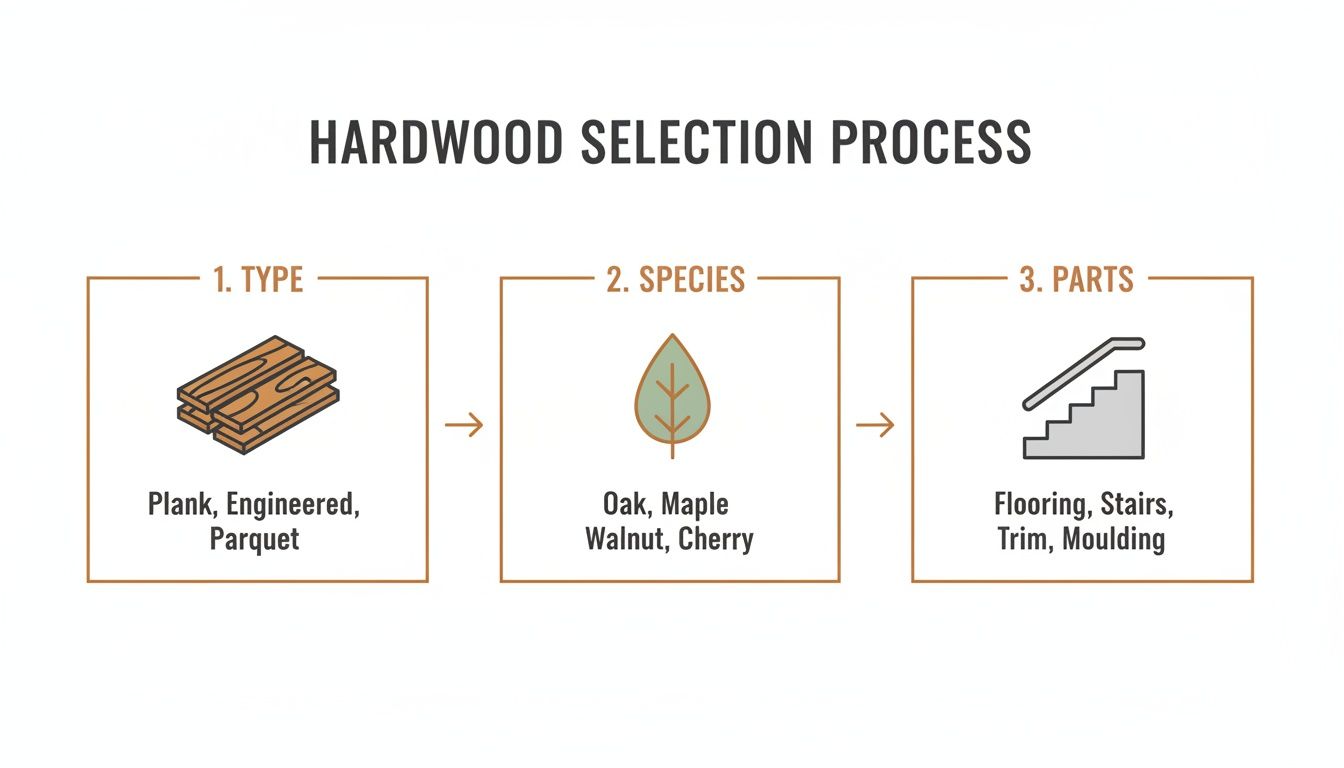
Deciding on the wood type, species, and the style of the stair parts is the foundation of a beautiful and successful installation.
Preparing The Foundation: Demolition And Assessment
The first real step is demolition, and it's where we play detective. We carefully rip out the old carpeting, padding, and all those pesky tack strips to expose the bare bones of the staircase. This is our chance to see what we're really working with. We meticulously inspect the existing sub-treads, risers, and most importantly, the stringers—the structural spine holding everything up.
Hear a squeak? See a loose board? Now's the time to fix it. We hunt down and eliminate every noise and weakness, often re-securing treads to the stringers with a powerful combination of construction adhesive and screws. Sometimes, we have to replace sections of the subfloor. A rock-solid, silent foundation isn't just nice to have; it's non-negotiable for a pro-level job.
The structural importance of stair stringers is a big deal. In fact, the global market for them is projected to hit USD 2.75 billion by 2032, with wood leading the charge because of its classic look. This growth really highlights why a well-built staircase frame is critical, and it’s a core focus of our prep work. You can learn more about these market trends and the increasing demand for wooden staircases.
The Art Of Precise Installation: Treads And Risers
Once the foundation is solid and clean, the real artistry begins. Each new tread and riser has to be custom-cut for its specific spot. There are no "one size fits all" pieces here. We typically start the installation at the bottom of the stairs and work our way up, ensuring every piece fits together as tightly as a puzzle.
Here’s a peek at how it comes together:
- Cutting Risers: We measure and cut each riser to the exact height and width it needs to be, then lock it into the stair frame with high-strength construction adhesive and finishing nails.
- Installing Treads: Next up are the treads. We lay down a bead of adhesive on the stringers and the top edge of the newly installed riser before carefully setting the tread in place. This glue-and-nail combo creates an unshakeable bond that kills movement and prevents squeaks from ever developing.
- Perfecting The Nosing: The stair nosing—that finished edge hanging over the riser—is where precision matters most. It needs to be perfectly flush and create a clean, uniform overhang on every single step. This detail is what separates an amateur job from a professional one.
For a deeper dive into the professional approach, our complete guide to professional hardwood floor installation covers a lot of the same core principles we apply to stairs.
Navigating Landings And Complex Designs
Of course, not every staircase is a straight shot up. Homes in neighborhoods like North Boulder often have landings, pie-shaped "winder" steps, or even elegant curved designs. These features demand an entirely different level of skill. On a landing, we install the hardwood just like we would in a small room, making sure the planks flow naturally from the steps.
Curved staircases? That's the final boss of hardwood installation. Every single tread and riser is a completely unique, custom-templated piece. Cutting these requires extreme accuracy to ensure the wood grain flows beautifully and the spacing stays consistent. It's meticulous, painstaking work that creates that graceful, sweeping look you simply can't get without years of experience.
Key Takeaway: A professional installation is really about systematic problem-solving. From reinforcing the structure underneath to scribing a tread perfectly against an uneven wall, every action is about anticipating challenges and executing with precision. The goal is a final product that isn't just beautiful, but is also structurally sound and meets all local Boulder building codes.
Finishing And Protecting Your New Hardwood Stairs
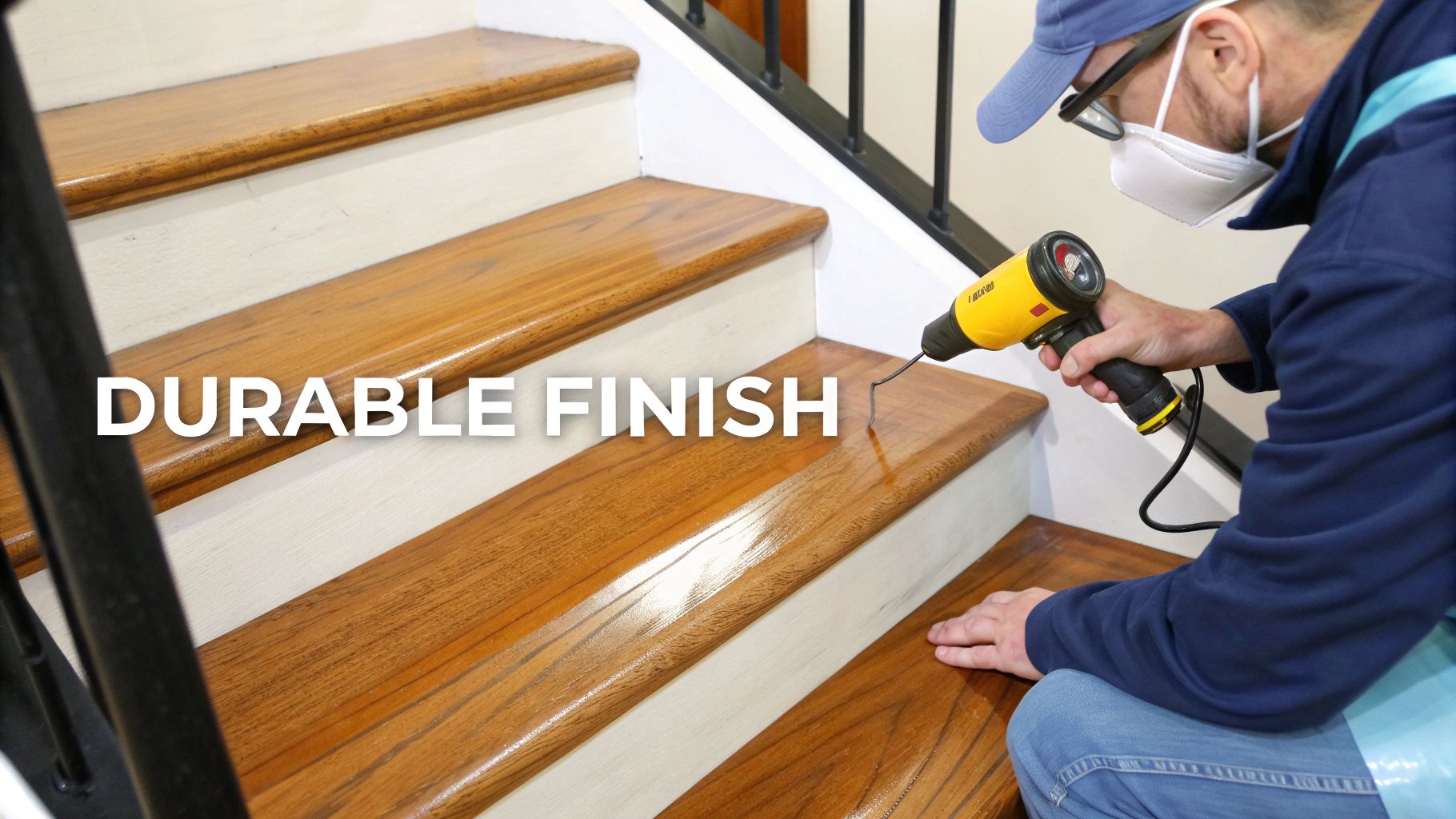
The final finish is where your new hardwood staircase truly comes to life. It's so much more than just a top coat; it’s the protective shield for your investment and the final touch that pulls out the wood's deep, natural character.
Honestly, this last step in a staircase hardwood installation is what separates a pretty good result from a spectacular one.
When we're talking about site-finished stairs, the possibilities are practically endless. You can choose from a huge array of stain colors to perfectly match your existing floors or go for something completely different. Whether you want a deep, rich espresso tone for a classic Boulder home or a light, natural finish for a modern loft, we can custom-mix the perfect shade right on site.
Choosing Your Sheen And Sealant
The sealant is what does the heavy lifting in terms of protection, but it also determines the final sheen—the level of shine your stairs will have. This choice makes a huge difference in both the look and the day-to-day maintenance of your staircase.
- Matte Finish: This gives you a modern, natural look with very little reflection. It's fantastic at hiding minor scratches and dust, making it a super practical choice for busy households with kids or pets.
- Satin Finish: There's a reason this is the most popular choice. It provides a subtle, low-luster glow that looks elegant without being overly shiny. It’s durable and easy to maintain, hitting that sweet spot between style and function.
- Semi-Gloss/Gloss Finish: Want to make a statement? A high-shine, reflective surface makes the wood grain pop beautifully. Just keep in mind that high-gloss finishes tend to show dust, pet hair, and minor scuffs a bit more readily.
The Superior Choice For Stairs: The UV-Cure System
While traditional polyurethane finishes get the job done, they have one major downside: the cure time. It can take several days, sometimes even weeks, for the finish to fully harden. That means your high-traffic staircase is vulnerable, and you’re stuck walking on eggshells.
This is exactly why we champion our advanced UV-Cure system for any Boulder hardwood floor refinishing project, especially stairs. This isn't just a slightly better finish; it's a completely different category of protection. After we apply the finish, we cure it instantly with a specialized UV light machine.
The benefits are immediate and undeniable. The finish is 100% cured on the spot. You can walk on your new stairs, move furniture back, and let your pets roam free the very same day we finish. No lingering chemical odors, no VOCs—just a healthier choice for your family.
Most importantly, the UV-cured finish is significantly harder and more durable than conventional water-based or oil-based polyurethanes. It offers unmatched resistance to the scratches, scuffs, and daily abuse that a staircase has to endure. You can learn more about all the options in our ultimate guide to hardwood floor finishes.
Long-Term Maintenance And Protection
Once your beautiful new staircase is installed and finished, a little bit of care will keep it looking pristine for decades. The demand for durable, beautiful wood isn't slowing down—in fact, the global hardwood market is projected to reach USD 1,458.63 billion by 2031. This trend really highlights the value of protecting your investment.
Follow these simple tips to make sure your stairs stand the test of time:
- Clean Smart: Use a microfiber mop or a vacuum with a soft brush attachment to get rid of dust and debris. For a deeper clean, stick to a pH-neutral cleaner made specifically for hardwood floors. Please, never use steam mops, vinegar, or harsh chemicals.
- Use Runners Strategically: A high-quality stair runner not only adds a great design element but also protects the wood right down the main path of foot traffic. It's a fantastic way to preserve the finish while adding comfort and style.
- Address Spills Immediately: Wipe up any spills as soon as they happen with a soft, dry cloth. You want to stop moisture from seeping into the wood before it has a chance.
- Protect From Furniture: If you ever need to move heavy items up or down the stairs, always use moving blankets to avoid nasty scratches and dents.
So, Why Do Boulder Homeowners Trust J.R. Hardwood?
Let’s be honest: installing hardwood on a staircase is one of the toughest, most detail-oriented projects you can tackle in a home. It's a true test of craftsmanship. While the idea of DIYing it might sound appealing, the reality is often a minefield of safety risks, building code violations, and the dreaded squeaky, poorly-fitted finish. This is one job where precision isn't just a goal—it's everything.
Homeowners all over the Front Range call us because we take that risk completely off the table. We bring a level of skill that doesn’t just look good on day one, but is structurally sound and built to last for generations. With our years of local experience, we’ve pretty much seen and solved every staircase challenge imaginable.
Local Expertise in Action
We know Boulder-area homes and their unique quirks. We’ve been the team called in to tackle the tricky geometry of a winding staircase in a Chautauqua historic home, where every single tread had to be custom-templated to create that perfect, seamless flow. In a classic Boulder two-story, we were able to custom-mix stains to match new red oak stairs perfectly to the home’s 20-year-old existing floors—making it look like it was all installed on the same day.
That kind of attention to detail is what we’re all about. A staircase is more than just a way to get upstairs; it’s the centerpiece of your home. We treat it with that level of respect, making sure every joint is tight, every surface is silky smooth, and the entire structure is rock-solid.
The J.R. Hardwood Advantage
When you work with us, you're not just hiring installers. You're getting a partner dedicated to making your vision a reality with as little disruption to your life as possible. Our dust-free sanding system keeps your home clean from start to finish.
And the best part? We use an advanced UV-Cure system that provides an incredibly durable finish that hardens instantly. No more waiting days for coatings to dry or worrying about fumes. Your stunning new staircase is ready for real life the moment we pack up our tools.
Transform your home’s central feature with the confidence that only comes from true professional craftsmanship. Schedule your consultation today and see how our expertise in Boulder hardwood floor refinishing, installation, and UV-Cure technology can create the staircase you’ve always wanted.
FAQ: Your Hardwood Staircase Installation Questions Answered
When homeowners in the Boulder area start thinking about upgrading their stairs to hardwood, a lot of the same questions pop up. It makes sense—stairs are a high-traffic, high-impact part of your home, and you want the job done right. We've heard them all, so let's tackle the most common ones head-on.
How Long Does a Typical Staircase Installation Take?
For a standard, straight staircase, you can expect the project to take about 2 to 4 days. That timeline covers everything from tearing out the old carpet to prepping the subfloor, carefully cutting and fitting each new tread and riser, and applying the finishing touches.
Of course, not all stairs are simple. If you have a curved staircase, custom landings, or intricate details, the project will naturally take a bit longer. And if we're doing a site-finish with our special UV-Cure system, the process is still incredibly efficient, but those extra steps for staining and sealing add to the overall duration.
Can You Match the New Stairs to My Current Hardwood Floors?
Absolutely. This is probably the number one thing people ask us, and frankly, it’s one of the biggest reasons to hire a pro. Creating a flawless, seamless flow from your existing floors to your new staircase is our specialty and a key part of our Boulder hardwood floor refinishing service.
To get that perfect match, we almost always recommend a site-finished installation. This gives us complete control to:
- Use the exact same wood species and grade as your floors.
- Custom-mix stains right there in your home to nail the color.
- Apply the same finish sheen—be it satin, matte, or something in between—for a look that feels like it was always there.
Is Installing Hardwood on Stairs a Messy Process?
Let’s be honest, any renovation is going to create a little disruption. But we work incredibly hard to keep your home as clean as possible.
Our team uses a powerful, dust-free sanding system that captures the vast majority of particles before they ever have a chance to float around your house. We’re also meticulous about sealing off the work area and protecting all of your surrounding floors and furniture.
What Is the Average Cost for a Professional Staircase Installation in Boulder?
This is a tough one to answer with a single number because so many things can influence the final price. The wood you choose, the complexity of your staircase (a straight flight versus one with turns and landings), and your choice between prefinished or site-finished materials all play a big role.
A flight of stairs involves a ton of detailed labor that just doesn't compare to laying flooring in a square room. To get a better sense of how these projects are priced, you can read our guide on the average cost to install hardwood floors, which is a great starting point. Before we pick up a single tool, we’ll always provide you with a clear, detailed quote so there are no surprises.