 Skip to content
When you ask what the best underlayment for hardwood floors is, the honest answer is: it depends. There’s no single magic bullet. It all comes down to your subfloor and the type of hardwood installation you’re planning. That said, a high-quality felt or cork often hits the sweet spot for homes in Parker, CO, giving you a fantastic balance of sound deadening, moisture management, and sheer durability.
This isn’t just an optional add-on; think of underlayment as the essential foundation protecting your flooring investment for the long haul. For homeowners considering a Parker hardwood floor refinishing project, starting with the right underlayment is the key to a lasting result, especially when paired with an advanced UV-Cure System.
Why Underlayment Is Your Hardwood Floor's Unsung Hero in Parker, CO
Here in Colorado, with our wild climate swings, choosing the right underlayment is probably the most important decision you'll make at the start of your project. It's the silent partner to your beautiful new floors, working behind the scenes to keep them stable and looking great. For any hardwood floor refinishing or installation project here in Parker, getting the underlayment right is step number one.
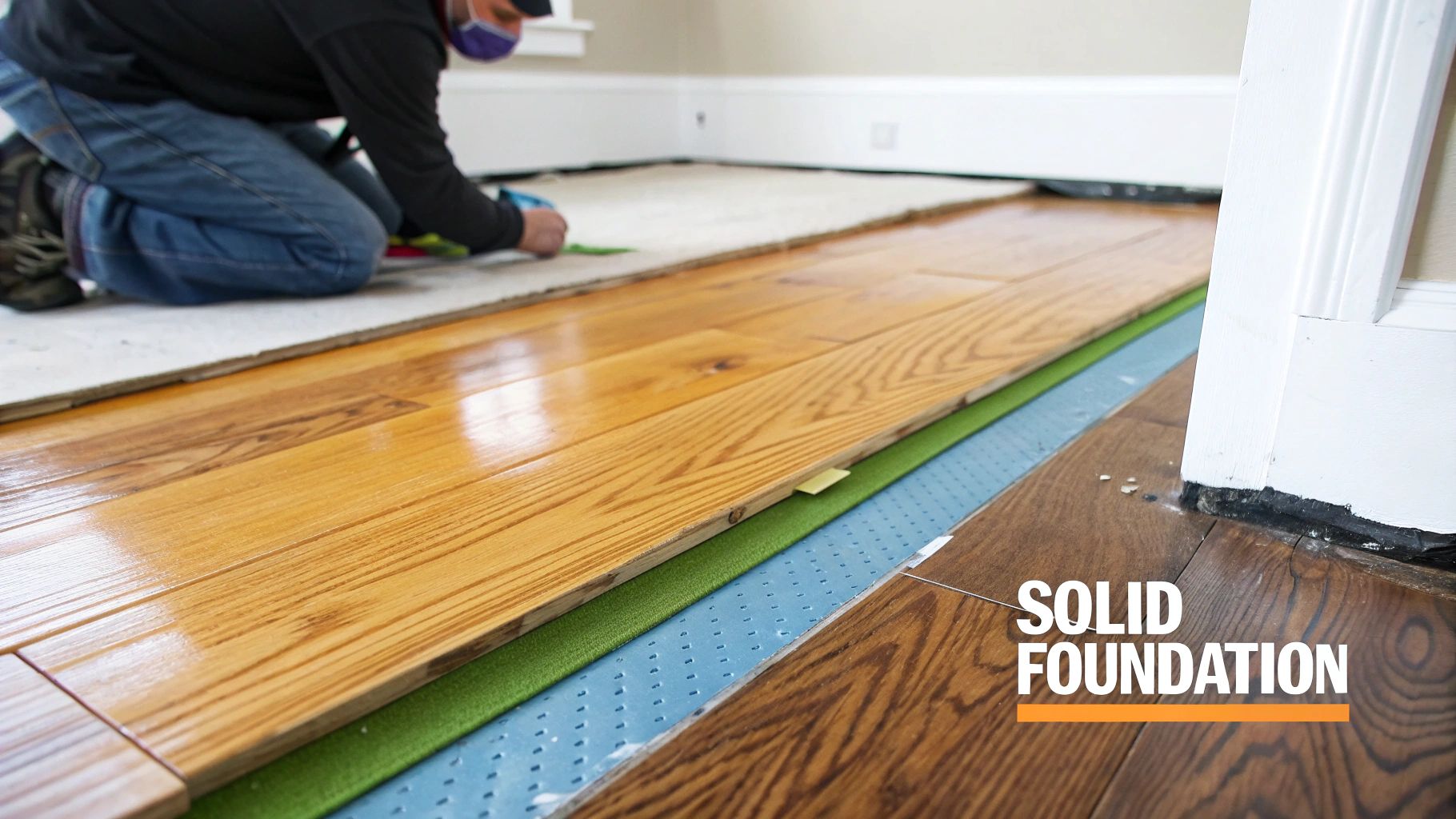
At its core, underlayment acts as a critical buffer between your brand-new hardwood and the subfloor beneath it. Its job is to handle a few key tasks that are absolutely vital for the life of your floors.
What Your Underlayment Is Actually Doing
- Fighting Moisture: Underlayment creates a shield against moisture vapor that can creep up from subfloors, especially concrete slabs. This is non-negotiable if you want to prevent ugly cupping, warping, and mold.
- Keeping Things Quiet: It makes a huge difference in sound absorption, dampening everything from the click-clack of footsteps to airborne noise. The result is a much quieter, more peaceful home.
- Adding a Touch of Warmth: It provides a bit of thermal insulation, which helps your floors feel warmer underfoot and can even contribute to your home's overall energy efficiency.
- Smoothing Things Over: Got minor bumps or imperfections in your subfloor? A good underlayment will smooth those out, creating a perfectly flat and stable surface for the hardwood planks.
It’s clear homeowners are catching on. The global market for floor underlayment was valued at around $1.497 billion in 2024 and is expected to climb to $1.911 billion by 2031. This isn't just a trend; it's a fundamental shift in understanding that a floor is only as good as the foundation it's built on.
Expert Insight: We work in a lot of homes across the Front Range, including many in Parker's Stonegate neighborhood, where subfloors can have minor imperfections. A robust underlayment is a lifesaver here. It can bridge gaps and level out common unevenness, ensuring we have a flawless canvas for our advanced UV-Cure System finishes after a dust-free sanding service.
At J.R. Hardwood Floor Refinishing & Cleaning, every single installation we do in Parker starts with us carefully selecting the right underlayment for your home. This prep work is what guarantees the stunning look and long-term durability of our dust-free sanding and hardwood floor refinishing projects. For a deeper dive, check out our guide on what homeowners need to know before installing hardwood floors.
Quick Underlayment Selection Guide
Feeling a little overwhelmed by the options? It's totally understandable. This quick guide is designed to cut through the noise and help you match the right underlayment to your specific project. Just find your installation method and subfloor type to see our top recommendations.
| Underlayment Type | Best for Nail-Down | Best for Floating | Best for Concrete Slab | Primary Benefit |
|---|---|---|---|---|
| Felt Paper | ✅ Yes | ❌ No | ✅ Yes | Moisture & Squeak Prevention |
| Foam | ❌ No | ✅ Yes | ✅ Yes (with vapor barrier) | Cushioning & Affordability |
| Cork | ✅ Yes | ✅ Yes | ✅ Yes (with vapor barrier) | Superior Sound & Thermal Insulation |
| Rubber | ❌ No | ✅ Yes | ✅ Yes | Maximum Sound Deadening & Durability |
Remember, this is a starting point. The perfect choice often involves a few more details about your home's unique conditions, which is where having a pro's eye can make all the difference.
Comparing Hardwood Underlayment Materials for Your Parker, CO Home
Picking the right underlayment for your hardwood floors isn't about finding a single "best" product. It's about making a smart match for your specific home, subfloor, and lifestyle. The underlayment you choose for a basement floor in Castle Rock is going to be very different from what’s needed to quiet an upstairs bedroom in a classic Parker ranch-style home.
Getting this layer right makes all the difference in how your floors perform for years to come. Let's break down the four most common and effective materials we work with—cork, felt, foam, and rubber—so you can see where each one really shines for a Parker hardwood floor refinishing project using our UV-Cure System.
Cork Underlayment: The Natural Champion for Sound and Comfort
Cork is a fantastic all-around performer, and it’s a favorite for good reason. Harvested from the bark of cork oak trees, it's a completely renewable resource. But its real magic is in its unique cellular structure, which is filled with tiny air pockets.
This structure makes cork an absolute powerhouse for both thermal and acoustic insulation. If you’re trying to stop noise from traveling between floors or want to make a room feel warmer underfoot, cork is one of the best investments you can make.
Key Benefits of Cork:
- Superior Sound Absorption: Its density is incredibly effective at muffling impact noise (like footsteps) and airborne sound (voices or music).
- Excellent Thermal Insulation: Those natural air pockets help block the cold that rises from concrete slabs, making it a perfect choice for basements.
- Naturally Antimicrobial: Cork inherently resists mold and mildew, a huge plus in potentially damp areas.
- Durable and Resilient: It stands up to pressure without crushing, ensuring your floor stays stable and supported for decades.
While cork has good moisture resistance, it isn't completely waterproof. For any installation over a concrete subfloor, we always pair it with a 6-mil vapor barrier to give your beautiful hardwood floors total protection.
Felt Underlayment: The Traditional Choice for Nail-Down Floors
Felt underlayment has been the go-to for flooring pros for generations, and it's not just out of habit. Premium felt, typically made from recycled fibers, is dense, durable, and does an excellent job dampening sound. It gives a plush, substantial feel underfoot while providing serious noise reduction.
One of felt's most important jobs in a traditional nail-down hardwood installation is to act as a slip sheet. It creates just enough of a buffer between the wood planks and the subfloor to reduce the friction that causes those annoying squeaks to develop over time.
Expert Insight: For multi-story homes in Parker, we almost always recommend a high-density felt underlayment. It is simply unmatched for deadening the sound of footfalls, which is a huge quality-of-life improvement for any family. Its ability to smooth over minor subfloor imperfections also helps us achieve a flawless final surface for our hardwood floor refinishing and UV-Cure System applications.
Felt offers a bit of moisture protection on its own, but just like cork, it needs a separate vapor barrier when installed over concrete. It’s the ideal partner for solid hardwood floors that need consistent, reliable support.
Foam Underlayment: The Versatile and Cost-Effective Solution
Foam is easily one of the most common and versatile underlayment options out there, especially for floating floor installations like engineered hardwood. It’s lightweight, incredibly easy to install, and provides good cushioning, which can make floors feel much more comfortable to walk on.
You'll find foam in various densities and thicknesses, and many modern foam products are designed as all-in-one solutions. These often come with an integrated vapor barrier, which really simplifies the installation process over concrete slabs or in moisture-prone areas.
Types of Foam Underlayment:
- Standard Polyethylene Foam: An affordable, basic option that provides cushioning and a decent amount of sound reduction.
- Combination Foam: These products have a pre-attached vapor barrier, making them a fantastic choice for DIY projects or any job where speed is a factor.
- Premium Foams: Higher-density foams offer better sound absorption and durability, bridging the gap between standard foam and heavier-duty materials like cork or rubber.
While foam is a solid choice, especially if you're on a budget, it doesn't offer the same level of soundproofing or thermal insulation as denser materials like cork or felt. Homeowners often weigh the simplicity of a prefinished floor installation against a more involved, site-finished project. You can explore those differences in our detailed guide on prefinished vs. site-finished hardwood floors.
Rubber Underlayment: The Ultimate in Sound Deadening and Durability
When maximum sound reduction is the number one priority, rubber underlayment is the undisputed champion. Period. Made from recycled tires, it's incredibly dense and resilient, offering the highest IIC (Impact Insulation Class) and STC (Sound Transmission Class) ratings you can get. This makes it the premier choice for condos, apartments, commercial spaces, and second-story rooms where noise transfer is a major headache.
Rubber is also extremely durable and completely waterproof, providing an impermeable shield against moisture from concrete subfloors. Its density ensures it won't compress or break down over time, even under the heaviest foot traffic or furniture.
Of course, this premium performance comes at a premium price. Rubber is generally the most expensive underlayment option. Its weight and density can also make it a bit more challenging to install than lighter materials like foam. But for homeowners who need the absolute best in acoustic performance and moisture protection, the investment in rubber is almost always worth it.
Detailed Comparison of Hardwood Floor Underlayment Types
To help pull all this information together, we've created a simple side-by-side comparison. Looking at these materials across the key performance metrics will help you zero in on the right choice for your project.
| Material | Moisture Protection | Sound Reduction | Best Subfloor | Cost Per Sq. Ft. | Durability |
|---|---|---|---|---|---|
| Cork | Good (Vapor barrier needed for concrete) | Excellent | Plywood, Concrete | $0.75 – $1.50 | Very High |
| Felt | Good (Vapor barrier needed for concrete) | Very Good | Plywood, OSB | $0.20 – $0.60 | High |
| Foam | Varies (Look for integrated barrier) | Good | Plywood, Concrete | $0.30 – $0.75 | Moderate |
| Rubber | Excellent (Waterproof) | Superior | Plywood, Concrete | $1.00 – $2.50 | Extremely High |
Choosing the right foundation is just as important as the beautiful wood that goes on top. The right underlayment ensures your investment is protected from moisture, feels great underfoot, and gives you the peace and quiet you deserve.
Matching Underlayment To Your Parker Installation Method
How you install your hardwood floors—nailing them down or floating them—is the number one factor that decides which underlayment you should use. These two methods have totally different requirements, and grabbing the wrong material can lead to anything from annoying squeaks to a voided warranty. This is exactly where professional expertise in hardwood floor installation makes all the difference for your Parker hardwood floor refinishing project.
For a classic nail-down solid hardwood floor, the whole point is to fasten the planks tight to the wooden subfloor. In that scenario, you need an underlayment that’s thin and dense. A thick, squishy underlayment would create a gap between the nail and the subfloor, meaning the fastener can't get a solid grip. The result? A loose, noisy floor.
This is why pros stick to the tried-and-true materials like 15lb felt paper or rosin paper. They’re just thick enough to provide a bit of moisture resistance and act as a "slip sheet," which stops the wood-on-wood rubbing that causes most squeaks. They do their job perfectly without getting in the way of the nails, ensuring a solid, stable floor for years to come.
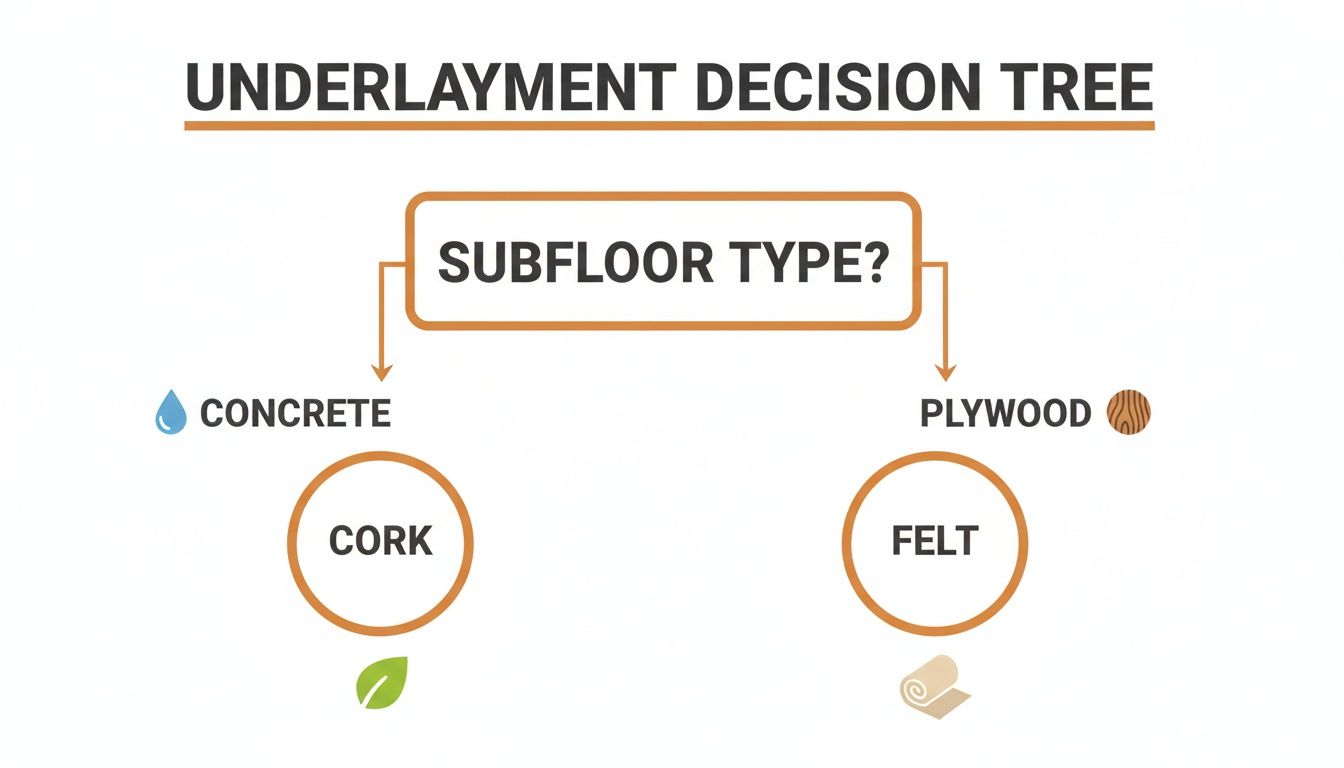
This decision tree shows how your subfloor type is the first big choice, pointing you toward cork for concrete or felt for plywood to get the best outcome. The main takeaway here is that the foundation determines everything, ensuring your beautiful hardwood floors stay stable and protected.
Underlayment For Floating Floor Installations
Floating floors, like most engineered hardwood and luxury vinyl plank (LVP), are a completely different animal. The planks aren't nailed down at all; they click together to form one solid surface that "floats" over the subfloor. For these floors, the underlayment plays a much bigger role.
Since you don't have to worry about nails, you can pick an underlayment with more bells and whistles:
- Cushioning: A slightly thicker foam or cork underlayment adds a noticeable comfort underfoot.
- Sound Dampening: These materials are fantastic at absorbing footstep noise, making them a must for condos or any second-story room.
- Moisture Barrier: Many underlayments for floating floors come with a built-in vapor barrier—a non-negotiable feature for any installation over a concrete slab.
The explosive popularity of engineered wood flooring has made these multi-function underlayments more common than ever. In fact, as of 2024, engineered wood now accounts for 50.5% of the total U.S. wood flooring market revenue, becoming the top choice thanks to its great performance against moisture and temperature swings. You can dig deeper into this trend by checking out the full market analysis on GrandViewResearch.com.
A Parker Project Example: We recently restored a nail-down red oak floor in a classic two-story home right here in Parker. The original floor had no underlayment, and the homeowners were fed up with the constant squeaking. As part of our dust-free sanding and hardwood floor refinishing job, we laid down 15lb felt paper before applying our durable UV-Cure system. The result was a stunningly beautiful floor that was also blissfully quiet.
Getting these details right is the secret to a successful project. Whether your floor needs a simple slip sheet or a heavy-duty acoustic barrier, the choice you make is fundamental to how your floor will perform and feel for decades.
Solving Parker Subfloor And Climate Challenges
Living in Colorado means dealing with a unique semi-arid climate that throws some real curveballs at hardwood floors. Homeowners in other parts of the country just don't get it. Our dry winters, intense sun, and wild humidity swings demand a smart approach to underlayment, especially when it comes to moisture.
Getting this right isn't just a suggestion; it’s fundamental to the long-term health of your floors. This is where local expertise in Parker hardwood floor refinishing truly makes a difference. A high-quality moisture barrier is your floor's first line of defense against warping, cupping, and those dreaded gaps that can appear out of nowhere. This is especially true for the many homes in Highlands Ranch and Centennial built on concrete slab foundations, which can be a constant source of sneaky moisture vapor.
Protecting Your Floors Over Concrete Slabs
By its very nature, concrete is porous. It’s like a sponge, always wicking a certain amount of moisture up from the ground below. An effective underlayment is the only thing standing between that moisture and your beautiful hardwood.
If you let that moisture go unchecked, you’re asking for trouble. We've seen it lead to serious issues, and you can learn more about how to spot problems like black mold on hardwood floors in our detailed guide.
When you're installing over concrete, you really have two solid options:
- All-in-One Underlayment: A lot of modern foam, cork, and rubber underlayments now come with a vapor barrier built right in. This definitely simplifies the installation, rolling protection and cushioning into one easy step.
- Separate Vapor Barrier: The old-school method is often the best. Laying down a separate 6-mil polyethylene (poly) film before the underlayment creates an impermeable shield that moisture just can't get through.
Honestly? We almost always recommend a separate 6-mil poly film for maximum protection. It's especially critical in basements or areas where you know moisture might be a concern. It provides a more robust, continuous barrier than most all-in-one products, giving you real peace of mind.
Managing Radiant Heat Systems
Radiant heating systems are fantastic—who doesn't love warm floors on a chilly morning? But they require a very specific type of underlayment. If you use the wrong material, you could end up trapping heat, making your system inefficient, and even damaging your hardwood over time.
You absolutely must choose an underlayment that is specifically rated for radiant heat. These products are designed to be thin and thermally conductive, letting that cozy warmth transfer efficiently into your room. Perforated foam and certain types of cork are great choices here, as they provide the support and moisture protection you need without blocking the heat.
Local Climate Insight: Here in Colorado, managing your home's internal environment is just as important as the physical barriers under your floor. You have to control the overall indoor climate to keep your hardwood happy. This means managing humidity levels and maintaining indoor air quality, which is a big deal in our challenging climate.
By carefully thinking through your subfloor type and Colorado's climate, you can pick the best underlayment for hardwood floors that will protect your investment for decades. At J.R. Hardwood, we live and breathe these local conditions. It’s how we ensure every job we do in Parker, from the subfloor all the way up to our advanced UV-Cure System finish, is built to last.
How Thickness And Sound Ratings Impact Your Parker Home
Beyond just moisture-proofing and adding a little cushion, there are two details that can make or break your new hardwood floor: thickness and sound ratings. It’s easy to overlook these specs, but getting them right is the secret to a professional, comfortable, and blissfully quiet floor. Let’s get into why they matter so much for your Parker hardwood floor refinishing and UV-Cure System project.
Why Underlayment Thickness Matters for Transitions
The thickness of your underlayment, usually measured in millimeters (mm), directly sets the final height of your new hardwood. This might sound like a tiny detail, but it becomes a huge deal where your beautiful new wood floor meets another surface, like the kitchen tile or the carpet in the hallway.
Pick an underlayment that’s too thick, and you’ll end up with a clumsy, raised lip—a trip hazard that just screams "amateur job." On the other hand, one that’s too thin creates an awkward drop-off. The goal is a perfectly smooth, seamless flow between rooms. That’s why we always measure the heights of existing floors to choose an underlayment that makes your new hardwood sit flush and look like it was always meant to be there.
Decoding Sound Ratings for a Quieter Home
If you live in a condo, townhome, or a two-story house here in Parker, soundproofing is probably high on your list. Nobody wants to hear every single footstep from the floor above. This is where sound ratings become your best friend.
There are two key ratings you need to know:
- IIC (Impact Insulation Class): This number tells you how well the underlayment blocks impact sounds—think footsteps, dropped toys, or scooting chairs. A higher IIC rating means better sound absorption and a much quieter space for anyone below.
- STC (Sound Transmission Class): This one measures how well a material blocks airborne sounds, like voices, music, or the TV. Just like with IIC, a higher number means it does a better job.
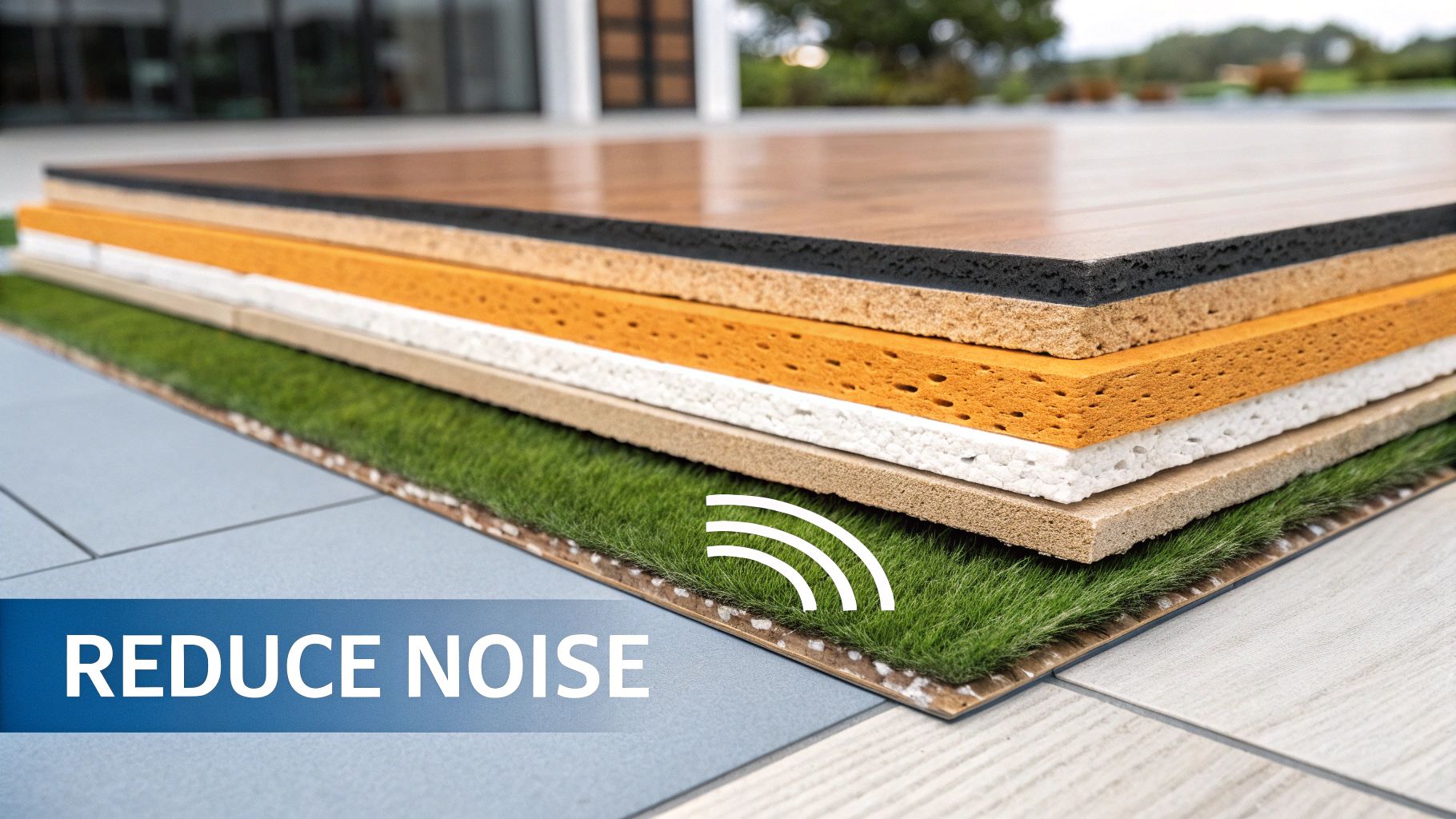
When your top priority is peace and quiet, we always point clients toward underlayments with high IIC and STC ratings, like dense rubber or premium acoustic felt. These materials are engineered to soak up vibrations and muffle noise, making a world of difference in multi-level homes.
This focus on the entire flooring system—from the subfloor up—is central to how we work. We believe a great hardwood floor refinishing project in Littleton should look stunning and make your home more comfortable. Our dust-free sanding and advanced UV-Cure System are just one part of a process that considers every detail.
Convenience is also a huge factor for homeowners today. It's no surprise that prefinished wood flooring has taken over, now making up about 85% of the hardwood market in 2024. This trend shows that people want products that cause less disruption, since factory-cured finishes are ready to use right away. You can read more about this market shift in a recent industry analysis on FCNews.net. By choosing the right underlayment, you ensure that even these convenient flooring options are installed for maximum acoustic performance and long-term comfort.
Why Professional Installation Is Non-Negotiable in Parker, CO
Knowing the difference between cork and felt is one thing, but getting that flawless, long-lasting hardwood floor? That comes down to the installation. You can pick the absolute best underlayment for your hardwood, but if it’s not put down correctly, all that research goes right out the window. Trust me, even a tiny mistake can turn into a huge headache later on.
Improper installation is the #1 reason floors fail. We've seen it all—persistent squeaks that drive you crazy, moisture seeping in and wrecking your beautiful hardwood, and uneven spots that wear out way too fast. Even worse, a simple DIY blunder can instantly void your flooring manufacturer’s warranty, leaving you completely on your own.
Securing Your Investment with Expert Service
This is exactly why bringing in a pro is so critical. For homeowners tackling a Parker hardwood floor refinishing project, hiring an experienced team isn't a luxury—it’s the best insurance policy you can buy for your investment.
At J.R. Hardwood Floor Refinishing & Cleaning, we live and breathe the details. Our job is to make sure every single layer of your floor is perfect, from the subfloor all the way to that final top coat.
- Expert Hardwood Floor Installation: We don't just lay floors; we match the right underlayment and installation method to your home's unique needs.
- Dust-Free Sanding: Our system preps your floors for a perfect finish without coating your home in a layer of fine dust.
- Advanced UV-Cure System: We use durable, gorgeous finishes that cure instantly. No waiting around—you get your home back the same day.
Choosing a professional means you're not just buying a product; you're investing in craftsmanship and peace of mind. A properly installed floor performs better, looks better, and lasts significantly longer.
If you’re still weighing your options, our guide on DIY vs. professional hardwood floor refinishing breaks down the real risks and rewards. It's also smart to know what sets true experts apart from the rest—you can see examples of effective website design and development for wood flooring companies to get a feel for what real professionalism looks like online. Don't leave your beautiful new floors to chance; let us build your floor on a flawless foundation.
Your Top Hardwood Floor Underlayment Questions, Answered
When you're getting ready for a new flooring project, it's the little details that make a huge difference. Homeowners ask us all the time about underlayment, and we've got the straightforward, no-nonsense answers to help you get it right.
Do I Really Need Underlayment for Hardwood Floors?
Yep, you absolutely do. Any professional installation worth its salt includes underlayment—it’s not an optional extra. For floating engineered floors, it’s non-negotiable; underlayment provides the necessary cushion and stability. With traditional nail-down solid hardwood, even a thin layer like rosin paper is critical. It stops that annoying wood-on-wood friction that leads to squeaks down the road and manages minor moisture.
Can I Just Use the Same Underlayment for Solid and Engineered Hardwood?
Not a good idea. The right choice is always dictated by how the floor is being installed. A nail-down solid floor needs a thin, firm underlayment that won’t get in the way of the fasteners. You can't have nails popping through a thick, squishy pad. On the other hand, floating engineered floors need an underlayment that provides cushioning, absorbs sound, and often includes a built-in moisture barrier.
What’s the Best Underlayment to Stop Noise?
If you’re trying to minimize sound, especially between floors in a multi-story home, you need to look at the Impact Insulation Class (IIC) rating. A higher number means better sound blocking. For serious noise reduction, we always steer clients toward dense materials like acoustic felt or premium rubber. These are engineered specifically for superior sound absorption and are, hands down, the most effective options you can get.
I Have a Concrete Subfloor. How Does That Change Things?
This is a big one, especially for homes and basements here in Colorado. A vapor barrier is absolutely critical when you’re installing over a concrete slab. Concrete is like a sponge—it naturally wicks moisture from the ground, and that moisture will destroy a hardwood floor from below.
We handle this in one of two ways:
- Use an all-in-one underlayment that has a vapor barrier built right into it. This is a great, efficient solution.
- Install a separate 6-mil poly film first, then lay the underlayment on top for maximum protection.
Our installation teams are experts at reading subfloor conditions. We’ll figure out the best moisture-proofing strategy to make sure your Parker hardwood floor refinishing project is built on a solid, dry foundation that’s made to last.
Homeowners in Parker trust J.R. Hardwood Floor Refinishing & Cleaning to restore the natural beauty of their hardwood floors with our dust-free sanding system and advanced UV-curable finishes. Unlike traditional methods, our UV technology cures instantly, so you can move furniture back the same day with no lingering odor or downtime. Choose the perfect refinishing service to match your needs and home traffic. Our dust-free process ensures a clean, beautiful finish every time.
📞 Phone: 720-327-1127
🌐 Website: jrhardwoodfloorrefinishingandcleaning.com
📍 Service Area: Parker, Castle Rock, Lone Tree, Centennial, and surrounding communities.
📺 YouTube: Watch Our Work!