 Skip to content
If you're a homeowner in Parker, CO, you've probably asked the big question: solid or engineered hardwood? The real difference between solid and engineered hardwood comes down to their construction, and that single detail changes everything. For any Parker hardwood floor refinishing project, understanding this is step one, especially when considering advanced options like our UV-Cure System.
Solid hardwood is exactly what it sounds like—a single, solid piece of beautiful lumber from top to bottom. It's the classic choice, offering a timeless look and the ability to be refinished over and over again. On the other hand, engineered hardwood is a bit of a modern marvel, featuring a layered core of plywood with a genuine wood veneer on top. This construction gives it incredible stability, especially against the wild climate swings we get here in Colorado.
Choosing Your Hardwood Floor: A Guide for Parker Homeowners
Picking the right hardwood flooring is a huge decision for any Parker homeowner. Our distinct seasons and roller-coaster humidity levels mean you need to think beyond just looks. The choice you make impacts not just the style of your home—whether it's a classic ranch in The Pinery or a modern design in Stonegate—but also how well your floors will hold up over the years.
At J.R. Hardwood Floor Refinishing & Cleaning, we've walked countless homeowners through this decision, making sure they get a floor that fits their life and their home's specific needs. Our expertise in Parker hardwood floor refinishing, paired with our advanced UV-Cure System, ensures a stunning and tough-as-nails finish, no matter which type of wood you choose.
Solid vs. Engineered Hardwood Key Differences
To help you see how these two stack up side-by-side, we’ve put together a simple breakdown of what really sets them apart. This table cuts right to the chase, summarizing the core differences.
| Feature | Solid Hardwood | Engineered Hardwood |
|---|---|---|
| Construction | Milled from a single, solid plank of wood. | A core of multiple plywood layers with a real hardwood veneer on top. |
| Refinishing Potential | Can be sanded and refinished multiple times (5-7+). | Can be refinished 1-2 times, depending on the veneer thickness. |
| Climate Stability | More susceptible to expansion and contraction with humidity changes. | Highly stable; resists warping and gapping in fluctuating climates like Colorado's. |
| Installation Areas | Best for on or above-grade rooms with a wood subfloor. | Versatile; can be installed on any level, including basements and over concrete. |
As you can see, the right choice really depends on where you're putting the floor and what your long-term goals are.
This little guide can help you visualize the decision based on your home's unique conditions.
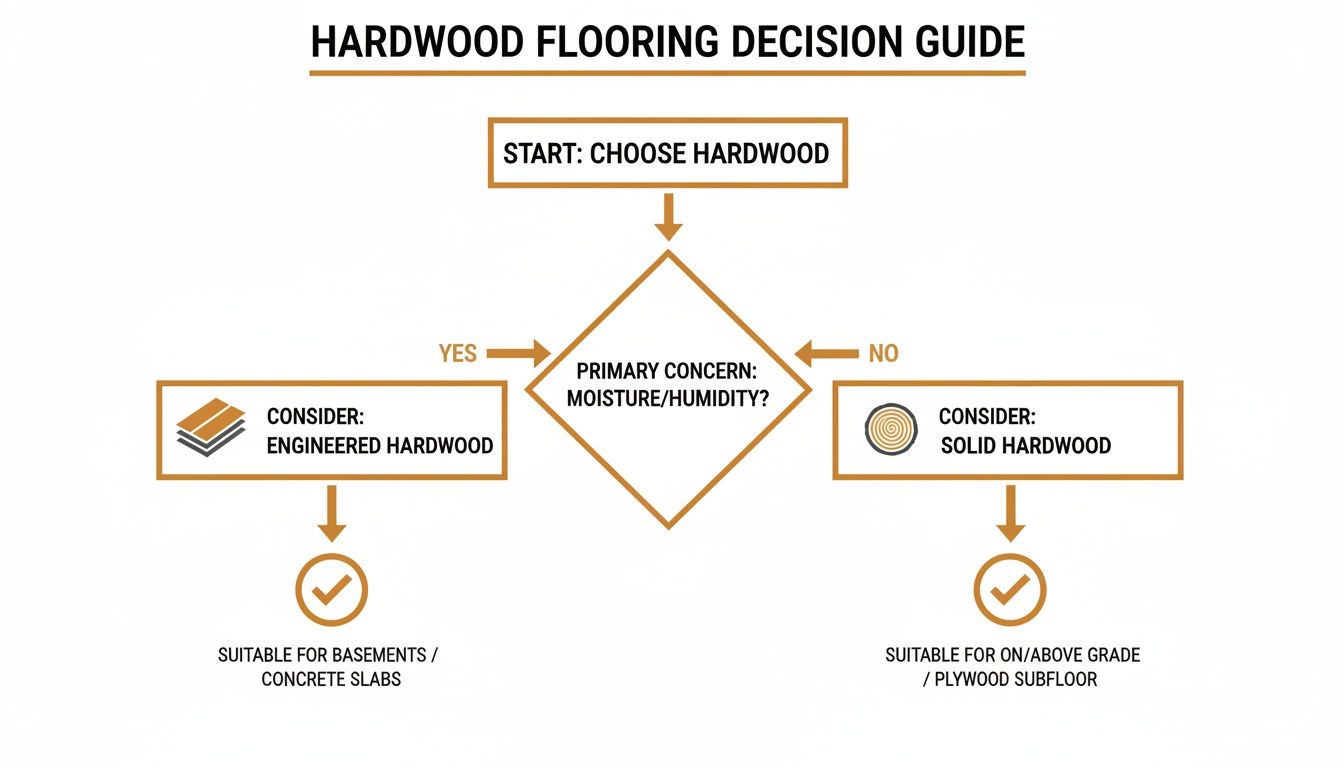
As the infographic shows, the biggest deciding factor often boils down to moisture and where in the house the floor is going.
Key Takeaway: The multi-layer construction of engineered hardwood makes it inherently more stable and better suited for Colorado’s dry, variable climate, especially in basements or areas with potential moisture. Solid hardwood, however, offers unparalleled longevity and the ability to be restored to new condition many times over.
Whether you're putting in brand-new floors or just thinking about a refinishing project, getting these basics down is the first step. For a deeper dive, check out our guide on what homeowners need to know before installing hardwood floors. Our team is always here to help clear things up, from picking the right wood to applying that final, instant-cure finish.
How Your Floor is Built (And Why It Matters for Parker Hardwood Floor Refinishing)
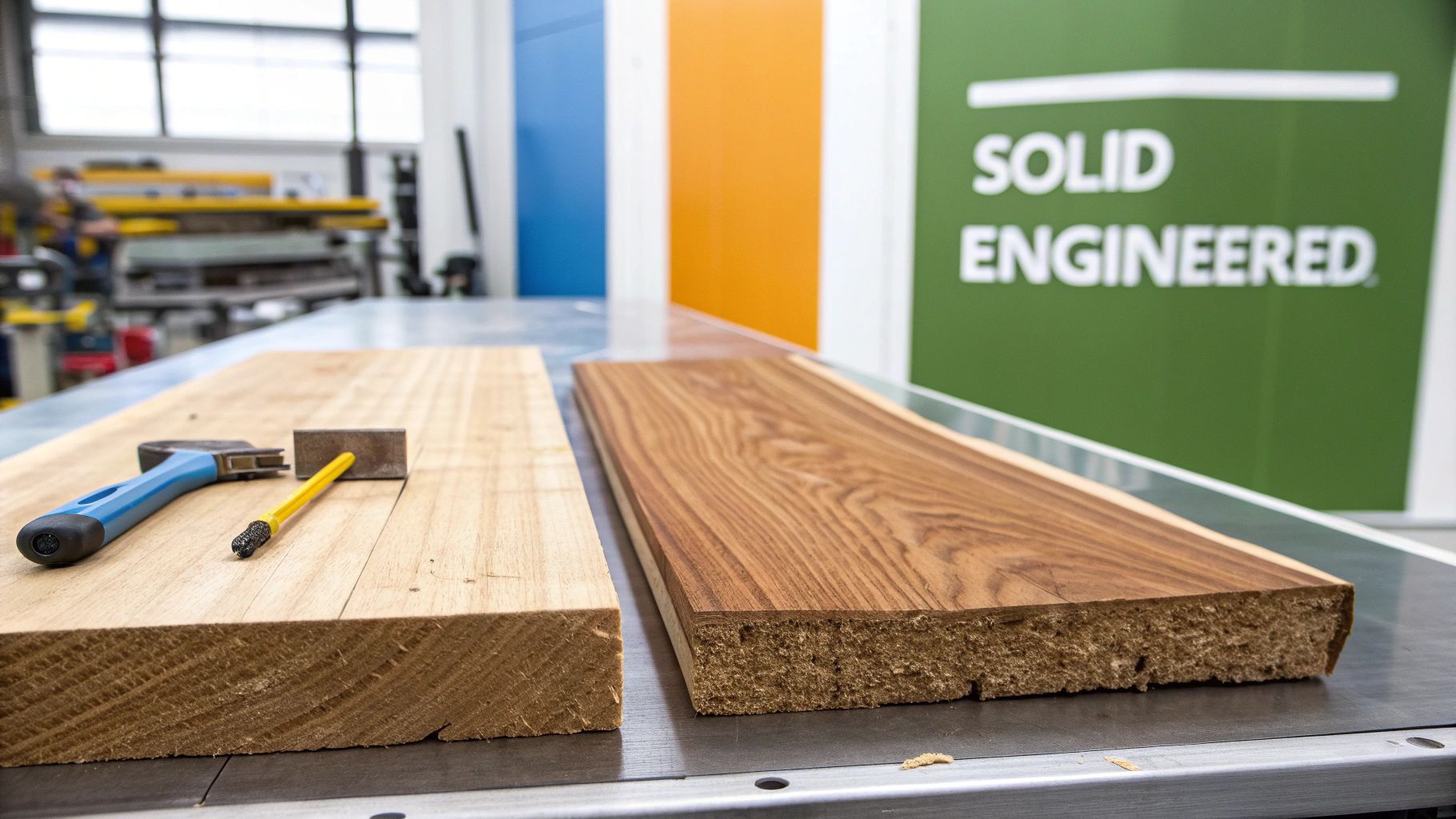
The real difference between solid and engineered hardwood boils down to how they're made. This isn't just a technical detail—it's the core factor that dictates how your floor will perform, how stable it will be, and how long it'll last. Getting this right is the key to choosing a floor that will actually thrive in your home.
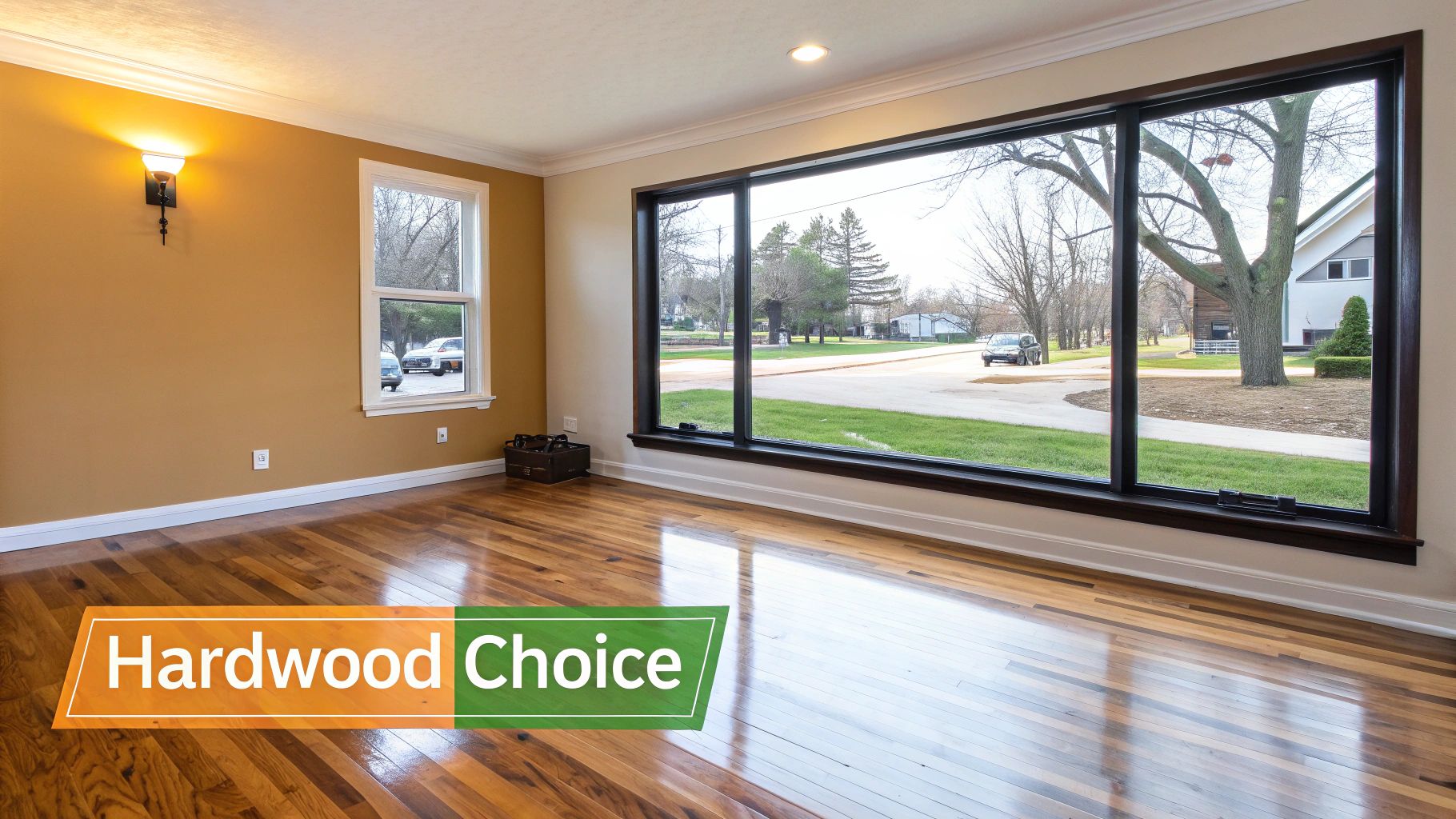
Solid hardwood is the classic, the gold standard. Each plank is cut from one single, solid piece of lumber, whether it's red oak, maple, or another species. It’s wood, top to bottom. This straightforward, beefy construction gives it an unmatched structural integrity and that authentic, substantial feel under your feet.
Its biggest selling point? Longevity. Because the plank is solid wood all the way through, we can sand it down and give it a complete refresh multiple times over its life. This is the whole idea behind our dust-free Parker hardwood floor refinishing, a process that can make a floor from the 1970s look like it was installed last week.
The Engineering That Beats Our Climate
Engineered hardwood is the smart, modern response to solid wood’s inherent weaknesses. It’s a composite product—think multiple layers of high-quality plywood or fiberboard fused together with heat and pressure. The secret is that the grain of each core layer runs in the opposite direction from the one above and below it, creating a crisscross pattern.
This cross-layered core is what makes it so incredibly stable. It actively fights against wood's natural urge to swell, shrink, or cup with the wild humidity and temperature swings we see along the Front Range. While a solid wood floor might develop gaps during a dry Colorado winter, an engineered plank is up to 50% more dimensionally stable, holding its shape with incredible reliability.
And just to be clear, the top layer of engineered flooring is 100% real hardwood. You’re still getting the genuine grain and beauty of your chosen wood species, but with a super-stable core that's built for our challenging climate.
Durability Isn't About the Wood—It's About the UV-Cure System Finish
While the core construction determines stability, the durability—how well your floor stands up to scratches, dog nails, and daily life—is all about the protective finish. This is where the lines between solid and engineered hardwood blur completely. The wood itself doesn't take the abuse; the topcoat does.
For Parker families with kids, pets, or just a busy household, the quality of that finish is everything. That's why we don't mess around, offering advanced options for both types of flooring:
- Diamond Traffic Plus: Our top-tier finish. It's fortified with a nano wear oxide additive that gives it unbelievable resistance to scratches and scuffs. At $5.50 per sqft, it provides unmatched wear and scratch resistance.
- Instant UV-Cure System: This is the real game-changer. After applying our best finishes, we cure them on the spot with powerful ultraviolet light. The process creates an intensely hard, durable surface that’s ready for furniture and foot traffic the very same day we leave.
With this technology, we can give both solid and engineered floors a level of protection that old-school, air-dried finishes just can't touch. To see how different woods perform, check out our guide on the different types of hardwood flooring we see in local homes. Ultimately, a fantastic finish applied by a pro is what protects your investment, no matter what kind of core it has.
Comparing Refinishing Potential and Lifespan
When you're deciding between solid and engineered hardwood, one of the biggest questions I get is, "How long will it last?" The real answer comes down to how many times you can refinish it. This is the key to long-term value and determines whether your floor is a 20-year feature or a century-long investment.
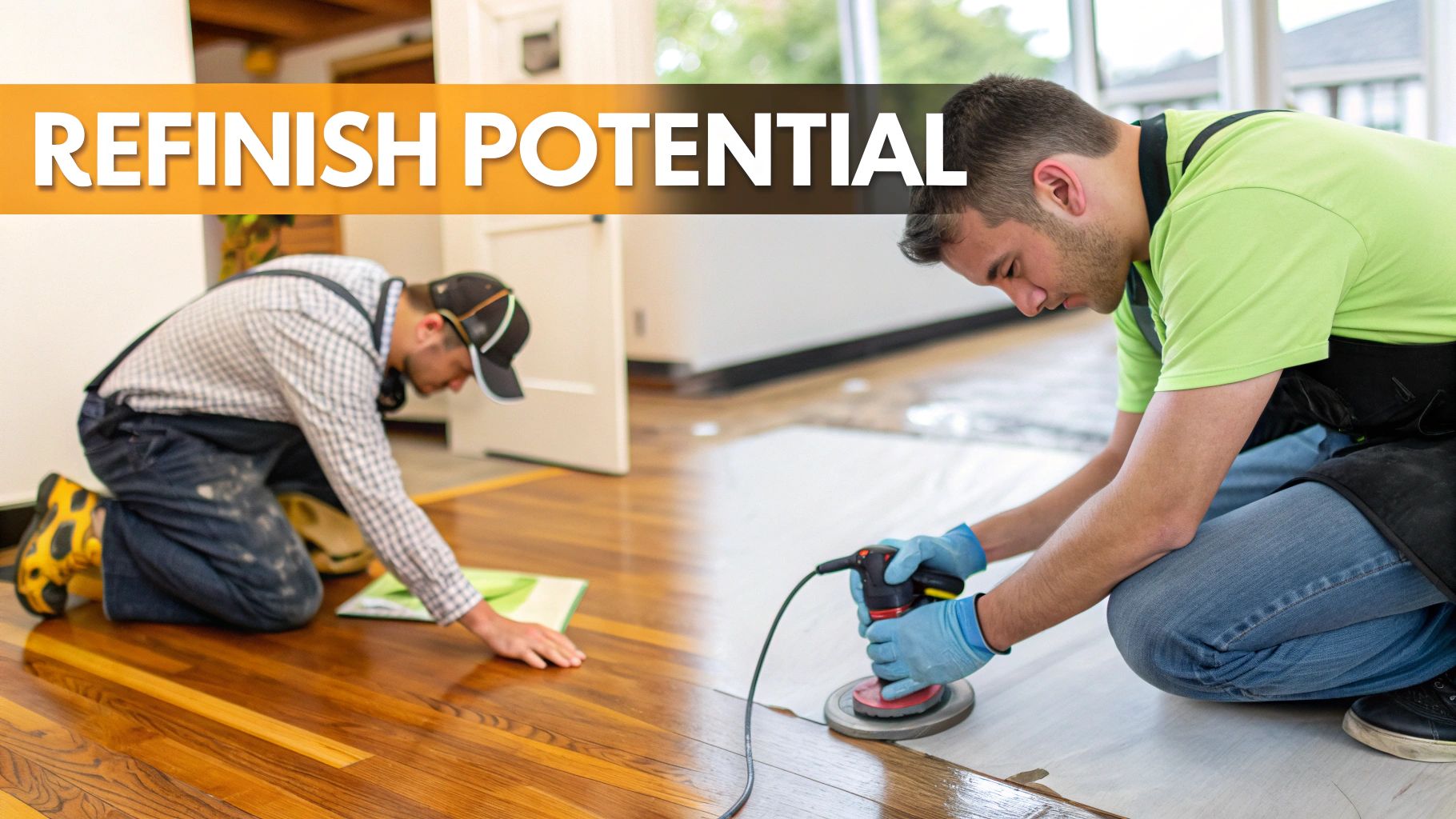
The secret to hardwood's legendary longevity is its ability to be sanded down and completely restored. Because each solid plank is one thick piece of wood, it can handle the sanding process again and again, making it a true generational asset for your home.
The Unmatched Longevity of Solid Hardwood
Hands down, solid hardwood is the undisputed champion of refinishing. A typical solid floor can be sanded and refinished 5 to 7 times, sometimes more, depending on its original thickness and the skill of the crew doing the work. Each time we do a full sanding, we're only taking off a paper-thin layer of wood to erase deep scratches, dings, and years of foot traffic.
This process is like hitting the reset button, revealing a perfect, fresh layer of wood underneath. With the right care, a solid hardwood floor can easily last 80 to 100 years or more. It becomes a permanent part of your home that you can update with new stain colors and finishes for generations. If you're curious about the details, our guide explains how many times you can refinish hardwood floors in more depth.
Solid hardwood flooring, while representing a smaller market segment, maintains distinct advantages that appeal to discerning homeowners seeking premium, long-lasting solutions. Within this market, solid hardwood continues to command respect due to its superior refinishing capabilities and aesthetic qualities. Unlike engineered wood, solid hardwood can be sanded and re-finished multiple times throughout its lifetime, making it ideal for homeowners who value exceptional durability and the ability to restore floors to like-new condition—precisely what we specialize in for Parker and the Denver Metro Area residents. Discover more insights about this trend on fcnews.net.
Understanding the Limits of Engineered Hardwood
With engineered hardwood, its refinishing potential all comes down to one thing: the thickness of its top hardwood layer, also called the veneer or wear layer. That’s the only part of the plank that can be sanded.
- Thick Veneer (3mm or more): Good quality engineered planks with a beefy wear layer can usually be sanded and refinished once or twice. That’s enough for a major refresh during its typical 20 to 40-year lifespan.
- Thin Veneer (less than 2mm): More budget-friendly engineered flooring often has a super-thin top layer. These floors cannot be sanded at all. If you try, you’ll burn right through the veneer and expose the ugly plywood core, ruining the plank for good.
For those thinner-veneer floors, you need a less invasive approach to bring back their beauty. Beyond just the initial install, thinking about general property maintenance and repairs is key to making sure whichever floor you choose stays looking great for years to come.
The Screen & Recoat Solution for Engineered Floors with a UV-Cure System
So what do you do when a full sanding isn't an option? Our screen and recoat service is the perfect answer. This process doesn't actually remove any wood. Instead, we lightly abrade (or "screen") the existing finish to create a surface that a new topcoat can grip onto. It’s like a spa day for your floors—it revitalizes the protective layer, fills in minor surface scuffs, and brings back that original luster.
Just recently, we performed a screen and recoat on an engineered floor in a Castle Rock home where the high-traffic areas were looking pretty tired. The homeowners thought they’d have to replace the whole floor, but our process restored its protective sheen and fresh look in just a single day. This service, especially when paired with our fast UV-Cure System, is a fantastic way to extend the life of engineered floors without sanding, showing how professional Parker hardwood floor refinishing can adapt to any type of wood floor.
Installation and Climate Considerations for Hardwood Floor Refinishing in Parker
Where and how you can install your hardwood floor is a huge piece of the puzzle, especially for us here in Colorado. The kind of subfloor you have and the room's location in your home can often make the choice for you, revealing a major difference between solid and engineered hardwood.
Solid hardwood has some pretty traditional rules. It has to be nailed or stapled down to a wooden subfloor, which means it’s usually limited to the ground floor or upper levels. That makes it a no-go for below-grade areas like basements—a common feature in so many homes around Parker and the greater Denver area.
Engineered Hardwood's Installation Versatility
This is exactly where engineered hardwood steps into the spotlight. Its layered construction opens up a world of installation possibilities that solid wood just can't touch. Honestly, this versatility is one of its biggest wins for modern homes.
Engineered planks can be installed in a few different ways:
- Floating: The planks simply click together and "float" over a padded underlayment without being physically attached to the subfloor. It's a quick and budget-friendly method.
- Glue-Down: The planks are glued directly to the subfloor, which is perfect for the concrete slabs you find in basements or ground-floor home additions.
- Nail or Staple-Down: Just like its solid counterpart, it can also be fastened to a wood subfloor for that classic, secure feel.
This flexibility means you can put engineered hardwood almost anywhere in your home—from a finished basement in Littleton to a main-level living room over concrete in a new Parker development. If you want to get into the nitty-gritty of what goes underneath your floor, check out our guide on the best underlayment for hardwood floors.
Conquering Colorado's Challenging Climate
Colorado’s climate is famously dry and loves to throw dramatic seasonal swings in humidity and temperature at us. These conditions can be brutal on solid hardwood, which naturally expands when it’s humid and shrinks when it’s dry. Without tight climate control, this movement can lead to ugly gaps between boards in the winter or cupping during our brief humid spells.
Engineered wood's stable, cross-layered core was specifically designed to fight this movement. It is far more dimensionally stable, making it much less likely to gap, warp, or buckle when our environment shifts. For homeowners all along the Front Range, this stability provides some serious peace of mind.
Recent market data proves this isn't just a local trend. Engineered hardwood is now the dominant product in North America, making up a massive 66.6% of revenue share in 2022. For homeowners in Denver and our surrounding communities, this number highlights why engineered flooring has become the go-to choice. Its superior stability means it resists warping and shrinking from our wild temperature and humidity swings—a critical advantage in Colorado's climate.
Now, don't get me wrong. Solid wood can absolutely be installed successfully with proper site prep and careful acclimation—a process our expert installers have perfected over the years. But engineered flooring often presents a more reliable and forgiving solution for our demanding environment. A meticulous installation, followed by a tough finish like our UV-Cure system, is the final step in ensuring any Parker hardwood floor refinishing or new installation project gives you a beautiful, durable surface built to last.
Choosing the Right Floor for Your Home and Budget
Alright, let's bring all this technical talk down to earth. Figuring out the difference between solid and engineered hardwood is one thing, but choosing the right one for your home, your lifestyle, and your wallet? That’s where the real decision-making happens. It’s about picking a floor that will serve you well for years to come.
The best choice really comes down to the situation. If you're in a historic Cherry Hills Village property and planning your forever home, the timeless appeal and unmatched longevity of solid hardwood are almost always the right answer. Its ability to be sanded and refinished over and over again makes it a true generational investment in your home's character.
Practical Scenarios for Parker Homeowners
Now, let's flip the script. Imagine you’re a family finishing your basement in Highlands Ranch. You’re dealing with a concrete subfloor and the potential for moisture—a classic Colorado scenario. In this case, a high-quality engineered hardwood isn't just a good choice; it's often the only smart choice. Its layered construction gives it the stability to handle those below-grade conditions beautifully.
Or maybe you're a property manager in Parker looking after a rental unit. You need something that looks fantastic but is also durable, stable, and makes financial sense. Engineered flooring delivers that high-end wood look while being far more resilient to the temperature and humidity swings that can happen when a property sits vacant between tenants. That stability means fewer maintenance headaches and a floor that stays looking great.
Analyzing the Lifetime Cost and Value
While solid wood often has a higher price tag upfront, you have to look at the long-term financial picture. When you can fully sand and refinish a floor multiple times, you're essentially getting several "new" floors for the price of one. This is a huge factor when you're planning for the long haul. As you weigh the value of your flooring, it’s a good idea to consult a comprehensive home renovations checklist to see how it fits into your overall investment strategy.
Engineered wood, on the other hand, usually costs less to install and can be kept fresh with less invasive methods, even with its limited refinishing capacity. Services like our Screen & Recoat, starting at just $2.00/sq. ft., are a perfect, budget-friendly way to maintain its protective layer and keep it looking sharp. To get a better sense of the options out there, check out our detailed guide on the best engineered wood flooring brands.
Your Budget and Your Home's Future: The choice isn't just about today's cost. It's about weighing the upfront investment against the lifetime value. Solid wood is a century-long asset, while engineered wood offers modern stability and immediate affordability.
Here at J.R. Hardwood, our job is to help you navigate these choices with clear pricing and honest advice that fits your exact needs. Whether it's a dust-free Parker hardwood floor refinishing to bring a classic solid oak floor back to life or installing a tough engineered plank in a new build, we're here to align your floor with your lifestyle. When you understand both the immediate costs and the long-term potential—including the game-changing benefits of our instant UV-Cure System—you can pick a floor you’ll absolutely love for decades.
FAQs on Solid vs. Engineered Hardwood in Parker
When you're comparing solid and engineered hardwood, a lot of practical questions come up. We get it. Homeowners in Parker are always asking us how these floors really perform in a busy house. Let's tackle the big ones so you have the straightforward answers you need.
Which Floor Is Better for Homes with Pets and Kids?
This is the million-dollar question for most families, right? The honest truth is, both solid and engineered floors can hold up beautifully in an active home. The real hero isn't the type of wood—it’s the finish. The wood gives you the look you love, but that protective topcoat is what takes the daily beating from dog nails, dropped toys, and constant foot traffic.
Durability really comes down to the quality of that final layer. For the toughest possible surface, we always recommend our Diamond Traffic Plus finish. This isn't your average coating; it's beefed up with a nano wear oxide additive that provides incredible scratch and scuff resistance.
Paired with our UV-Cure System, this finish becomes rock-solid the moment we're done. There's no waiting around for days. You can move your furniture back in and get on with your life the very same day. It’s the ultimate solution for a busy household that can't afford any downtime.
Can Hardwood Be Installed Over Radiant Heat?
Yes, but this is one area where engineered hardwood is the hands-down winner. Radiant heating systems cause constant temperature swings right under your floorboards, and you need a material built to handle that stress without complaining.
Engineered hardwood’s layered core gives it the dimensional stability it needs to resist warping, cupping, or gapping when things heat up. While a few specific cuts of solid wood (like quarter-sawn white oak) can sometimes work, it's a much riskier play that demands perfect conditions. Our installation pros can take a look at your specific heating system and recommend the safest, most reliable flooring option for your Parker home.
How Do I Know if My Current Floors Are Solid or Engineered?
Knowing what kind of floor you're working with is step one for any restoration project. The easiest way to tell the difference between solid and engineered hardwood is to find an exposed edge of a plank. It sounds tricky, but it's usually pretty simple.
Pop off a floor register or look at a transition strip between rooms. If you can see the side of a board, here’s what to look for:
- Solid Hardwood: You’ll see one continuous piece of wood from top to bottom. The grain runs straight through the entire thickness of the board.
- Engineered Hardwood: You’ll see obvious layers stacked together, kind of like a high-tech plywood sandwich with a beautiful wood veneer on top.
This one detail changes our entire game plan for your Parker hardwood floor refinishing project. If it's solid, we know we can do a full dustless sanding. If it's engineered, we’ll measure that top veneer to see if it can handle sanding or if a less invasive screen and recoat is the smarter move.
Is There a Difference in Daily Maintenance?
When it comes to day-to-day cleaning? Absolutely no difference. Whether it's solid or engineered, a modern finish calls for the exact same simple routine. Regular sweeping or vacuuming (just turn that beater bar off!) and an occasional mop with a pH-neutral hardwood floor cleaner is all it takes to keep them looking fantastic.
The real maintenance difference shows up years down the road. Solid hardwood can be completely sanded down and renewed multiple times, giving it a potential lifespan of a century or more. Engineered hardwood has its limits, but you can keep it looking beautiful for a very long time with the right care. Our professional clean and buff service is a great, cost-effective way to maintain the protective finish on either type of floor, pushing back the need for a major refinishing job and keeping your floors looking pristine.
Homeowners in Parker trust J.R. Hardwood Floor Refinishing & Cleaning to restore the natural beauty of their hardwood floors with our dust-free sanding system and advanced UV-curable finishes. Unlike traditional methods, our UV technology cures instantly, so you can move furniture back the same day with no lingering odor or downtime. Choose the perfect refinishing service to match your needs and home traffic. Our dust-free process ensures a clean, beautiful finish every time.
📞 Phone: 720-327-1127
🌐 Website: jrhardwoodfloorrefinishingandcleaning.com
📍 Service Area: Parker, Lone Tree, Castle Rock, Highlands Ranch, and the surrounding Denver metro area.
📺 YouTube: See our work in action!