 Skip to content
It can be unsettling to spot new gaps between your beautiful hardwood floorboards. But here’s the simple truth: hardwood floor gaps between boards are often a completely normal reaction to the environment, especially here in Colorado’s unique climate. For homeowners in Littleton looking for professional hardwood floor refinishing, understanding this is the first step. Our advanced UV-Cure System is part of a complete solution that addresses these issues for good.
Think of your wood floors as a living, breathing part of your home. They naturally expand and contract with the constant shifts in humidity, and those little openings are just a sign that they're doing their thing.
What Those Gaps in Your Hardwood Floors Are Telling You
If you own a home anywhere in the Littleton area—from the historic houses downtown to newer builds in Highlands Ranch—you’ve probably noticed gaps between your hardwood planks at some point. It’s one of the most common things we see, and it’s almost always tied to Colorado’s dry winters and wild humidity swings.
When the air gets dry, your wood loses moisture and shrinks, creating gaps. Then, when the humidity comes back in the spring and summer, the wood swells up and the gaps often disappear. It's a natural cycle.
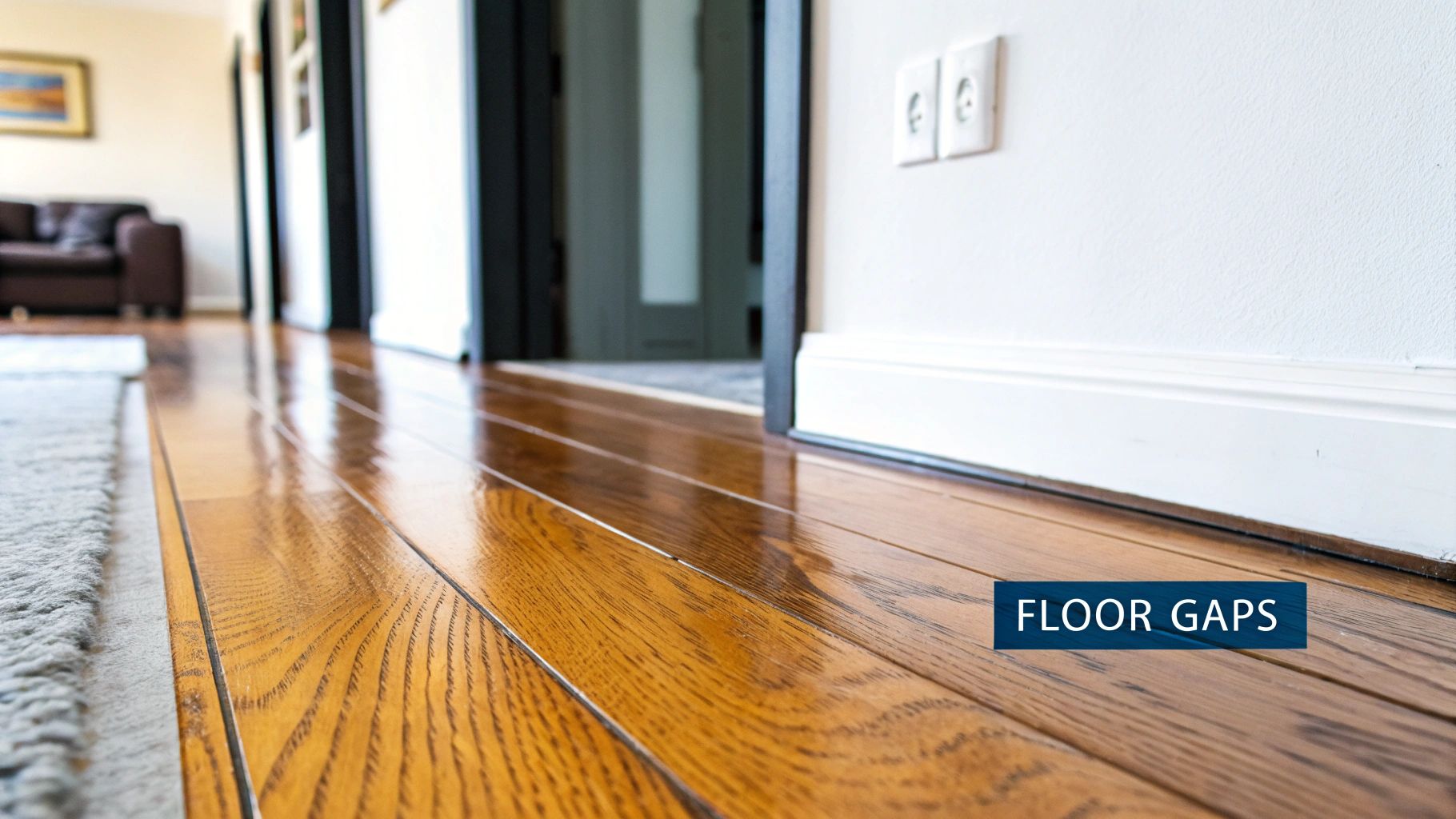
This section will help you figure out what your floors are trying to tell you, so you can tell the difference between a normal seasonal shift and a sign of a deeper issue. Understanding the cause is always the first step toward finding the right solution.
Seasonal Shifts vs. Potential Problems
For most homeowners, these gaps are temporary. Those hairline cracks that show up in January and vanish by July? That’s just your floor breathing with the seasons, and it's typically nothing to worry about.
However, some signs point to a more significant problem that really does need a professional eye. Keep a lookout for these red flags:
- Persistent Gaps: Gaps that stick around all year and don't close up during the more humid months.
- Wide Gaps: Any opening you can easily slide a dime or a credit card into is a pretty clear signal that something more is going on.
- Uneven Edges: If the edges of the boards are splintering or one board is sitting higher than its neighbor (a condition called cupping), it could be a symptom of moisture damage. To see how serious that can be, check out our guide on what causes hardwood floors to buckle.
At J.R. Hardwood Floor Refinishing & Cleaning, we diagnose these kinds of problems for homeowners all over Littleton. Our team can get to the root cause of the gapping and map out a solution that will actually last.
To help you get a quick read on your situation, here's a simple breakdown of what might be happening with your floors.
Quick Guide to Hardwood Floor Gaps
This table summarizes the most common causes of floor gaps, helping you quickly assess what might be going on.
| Cause of Gap | Typical Gap Size | Is It a Major Concern? | Best First Step |
|---|---|---|---|
| Seasonal Humidity Swings | Hairline to credit card | Usually no, if it closes in summer. | Monitor the gaps and run a humidifier during winter. |
| Improper Acclimation | Varies, often persistent | Can be; the wood wasn't ready for installation. | Professional assessment to see if replacement is needed. |
| Direct Heat Source (Vents) | Localized, can be wide | Sometimes; can cause permanent damage to boards. | Use vent deflectors and monitor humidity near the heat source. |
| Excessive Moisture/Water Damage | Wide, with board cupping | Yes, absolutely. This needs immediate attention. | Find and stop the moisture source, then call a professional. |
Remember, this is just a starting point. If you're ever in doubt, getting an expert opinion is the safest bet.
Finding the Right Solution for Your Floors
Ignoring persistent or wide hardwood floor gaps between boards is a bad idea. They collect dirt and debris, create tripping hazards, and can lead to even more damage over time.
The good news is that professional restoration can bring your floors back to that seamless, beautiful state you love. Our expert services, like dust-free sanding and advanced UV-Cure System finishes, don’t just fix the cosmetic issue—they restore your floor's structural integrity. We deliver a flawless surface that can handle the demands of everyday life, making sure your investment is protected for years to come.
Why Do My Hardwood Floors Have Gaps, Anyway?
So, why do those pesky hardwood floor gaps between boards even show up in the first place? It’s all about the wood’s relationship with moisture, and here in Colorado, that relationship is… complicated.
Think of your hardwood floorboards as a bundle of tiny, tightly packed sponges. During our humid Littleton summers, those "sponges" soak up moisture from the air and swell up, pressing snugly against each other. Gaps disappear. It’s a beautiful thing.
But then winter hits. The furnace kicks on, the air inside gets bone-dry, and all that moisture gets pulled right back out of the wood. Just like a sponge shrinking as it dries, your floorboards contract. Suddenly, those gaps are back. This natural rhythm of expansion and contraction is just what wood does.
This whole cycle is put on fast-forward here in Colorado. Our climate loves to swing from semi-arid to surprisingly humid and back again, putting a ton of stress on your floors. These dramatic shifts are the number one reason we see gapping in homes all over the Front Range, from Parker to Lakewood.
How Colorado’s Climate Puts Your Floors to the Test
It’s not just one thing—it's a perfect storm of local factors that can cause gaps to form in your hardwood. Getting a handle on them is the first step to figuring out the right fix for your Littleton home.
- Seasonal Humidity Swings: This is the big one. The relative humidity (RH) inside your home can plummet from 50% in the summer down to 20% or even lower in the winter. That’s a massive swing that forces your floors to expand and contract like crazy.
- Improper Acclimation: Before a single board is nailed down, new hardwood needs to sit in your home for several days. This lets it get used to your home’s unique temperature and humidity levels. If a crew rushes the job and installs it too soon, the wood will acclimate after it's already in place, leading to some serious and often permanent gapping as it shrinks.
- Age and Wood Species: Older floors, like the ones you find in so many historic Littleton homes, have endured these seasonal battles for decades and tend to show more gapping. The type of wood matters, too. Red Oak, for example, is known to move more than a super-stable wood like quarter-sawn White Oak.
Knowing this helps explain why a little bit of seasonal gapping is totally normal. But when those gaps get wide enough to lose a credit card in, stay all year round, or you start seeing splintering, that’s your floor telling you it needs a professional’s touch.
The Numbers Behind the Movement
This isn't just a theory; you can actually measure the movement in your floors. In a place with climate swings like Colorado, hardwood floor gaps between boards are a well-documented reality.
In fact, statistics show that up to 70% of hardwood floors develop noticeable gaps within 5-10 years simply due to this natural expansion and contraction. A typical Oak board can shift by 0.2% for every 1% change in humidity. In a Littleton home, that can easily create gaps that are **1/16 to 1/8 inch wide. This isn't just about looks—those gaps trap dirt, cause premature wear, and can shorten the life of your floor.
When it comes to hardwood, stability is everything. Our expert hardwood floor refinishing process in Littleton always starts with an assessment of the home’s environment to ensure our solutions, from installation to our UV-Cure System, are designed to last in Colorado's climate.
Understanding how Colorado's climate messes with your floors is key. The same principles apply to keeping your indoor air stable—learning how to reduce indoor humidity can make a huge difference. This knowledge is your first line of defense against future gapping and is fundamental to long-term care, which we dive into in our guide on how to restore old hardwood floors.
Figuring Out Your Floor Gaps: When to DIY and When to Call a Pro
Seeing hardwood floor gaps between boards can definitely make your heart skip a beat. But before you start imagining worst-case scenarios, take a breath. Some gaps are just a normal part of a wood floor's life, while others are a clear SOS that it's time to call in a professional. Knowing how to spot the difference is key to making the right call for your home in Littleton.
This little flowchart breaks down the decision-making process perfectly.
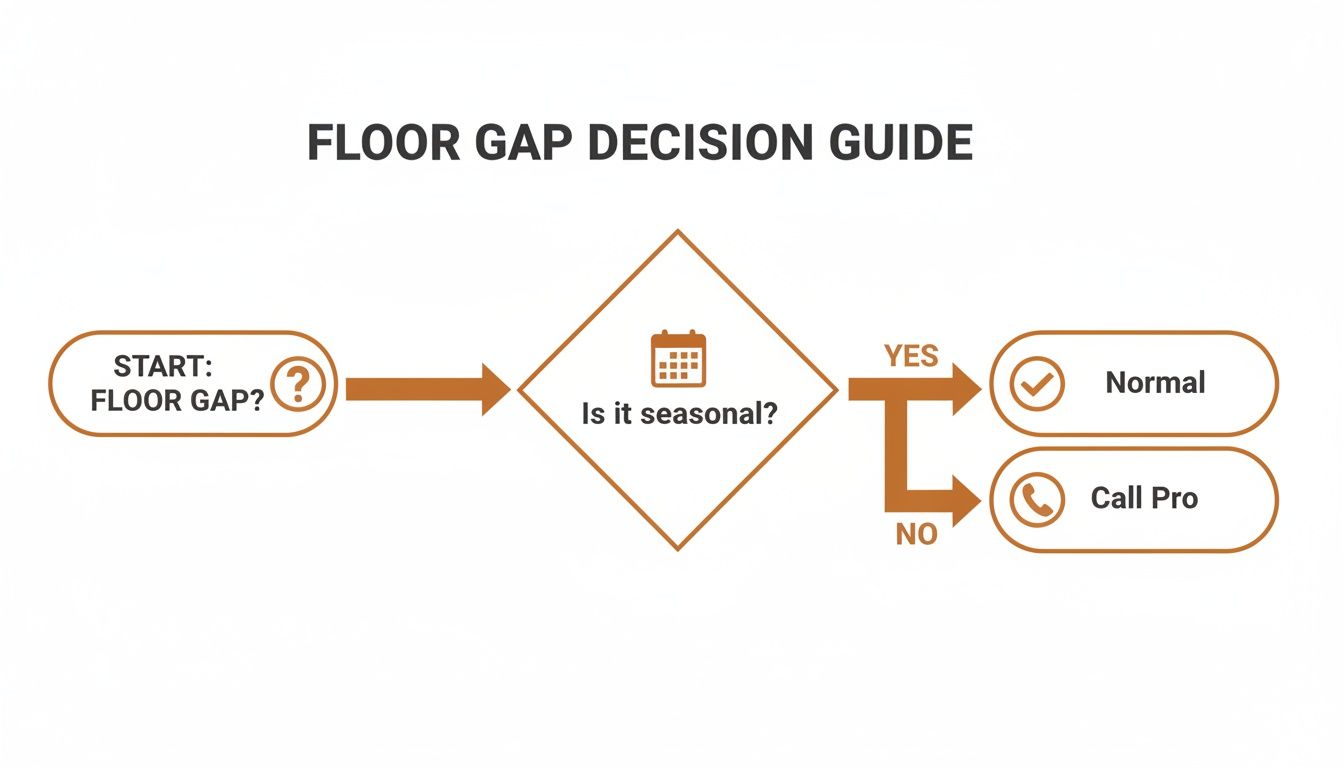
The main takeaway here? Gaps that come and go with the seasons are usually fine. It's the ones that stick around or keep getting worse that need a closer look from an expert to prevent bigger problems down the road.
The Dime Test: A Super Simple Assessment
One of the easiest tricks in the book to check a gap’s severity is what we call the "dime test." Just grab a standard dime and see if you can slide it down into the gap between your floorboards.
If that dime slips right in, you’ve got a pretty good sign that the gap is wider than normal seasonal movement would cause. This is often the first thing we ask Littleton homeowners to do when they call us—it’s a quick and surprisingly effective way to know if you need a professional set of eyes on it.
Tracking Seasonal vs. Stubborn Gaps
To figure out if your gaps are just doing their seasonal dance, you'll need to play detective for a bit. Find a few of the more obvious gaps around your home and place a small piece of masking tape on the floor right next to each one. Snap a picture in the winter when the air is bone-dry, then take another one in the middle of summer when humidity is at its peak.
If the gaps shrink up or disappear entirely in the summer photo, you’re almost certainly seeing a normal reaction to Colorado’s climate. But if those gaps are still wide open year-round, you’re looking at a more stubborn issue that isn't going to fix itself.
Red Flags That Signal a Deeper Problem
Beyond the dime test, there are a few clear warning signs that your floor gaps are more than just cosmetic. Trying to patch these issues yourself can honestly make things a whole lot worse.
Keep an eye out for these red flags:
- Splintered Board Edges: If the wood along the gap's edges looks cracked, splintered, or chewed up, it means the boards are under serious stress.
- Cupping or Crowning: "Cupping" is when a board’s edges curl up higher than its center, like a shallow bowl. "Crowning" is the opposite, where the center is bowed upward. Both are dead giveaways of a major moisture problem.
- Localized Gapping: Are the big gaps all huddled in one area? Maybe near an exterior door, under a window, or next to the dishwasher? That could point to a localized leak or even a structural issue that needs investigating ASAP.
A quick heads-up on DIY wood fillers: they might seem like a fast and easy fix, but they are almost never a permanent solution. As your floor naturally expands and contracts, that filler will just crack and pop right out. More importantly, it can seriously complicate a future professional hardwood floor refinishing job, making it tougher for us to get a seamless, lasting repair with our UV-Cure System.
If you're on the fence about what to do next, our guide on hardwood floor refinishing DIY vs professional service breaks it down even further. But when you spot any of these red flags, your best bet is to call a pro. At J.R. Hardwood, we can figure out the real root cause and recommend a fix that actually restores your floor's health and beauty for good.
Professional Solutions for Flawless Hardwood Floors in Littleton
When those temporary fixes just won't cut it anymore and you're ready to deal with hardwood floor gaps between boards for good, it's time to call in the pros. At J.R. Hardwood Floor Refinishing & Cleaning, we don't just patch the problem—we restore your entire floor to its original, seamless beauty. Our professional hardwood floor refinishing in Littleton is a world away from a DIY kit, guaranteeing a flawless finish that actually lasts.
For homeowners all across Littleton, our go-to solution is a full, dust-free sanding and refinishing service. This isn't just about skimming the surface; it's a deep, restorative process that fundamentally repairs the floor. During this process, we tackle every single gap with a custom-matched filler, ensuring a perfect, invisible blend.
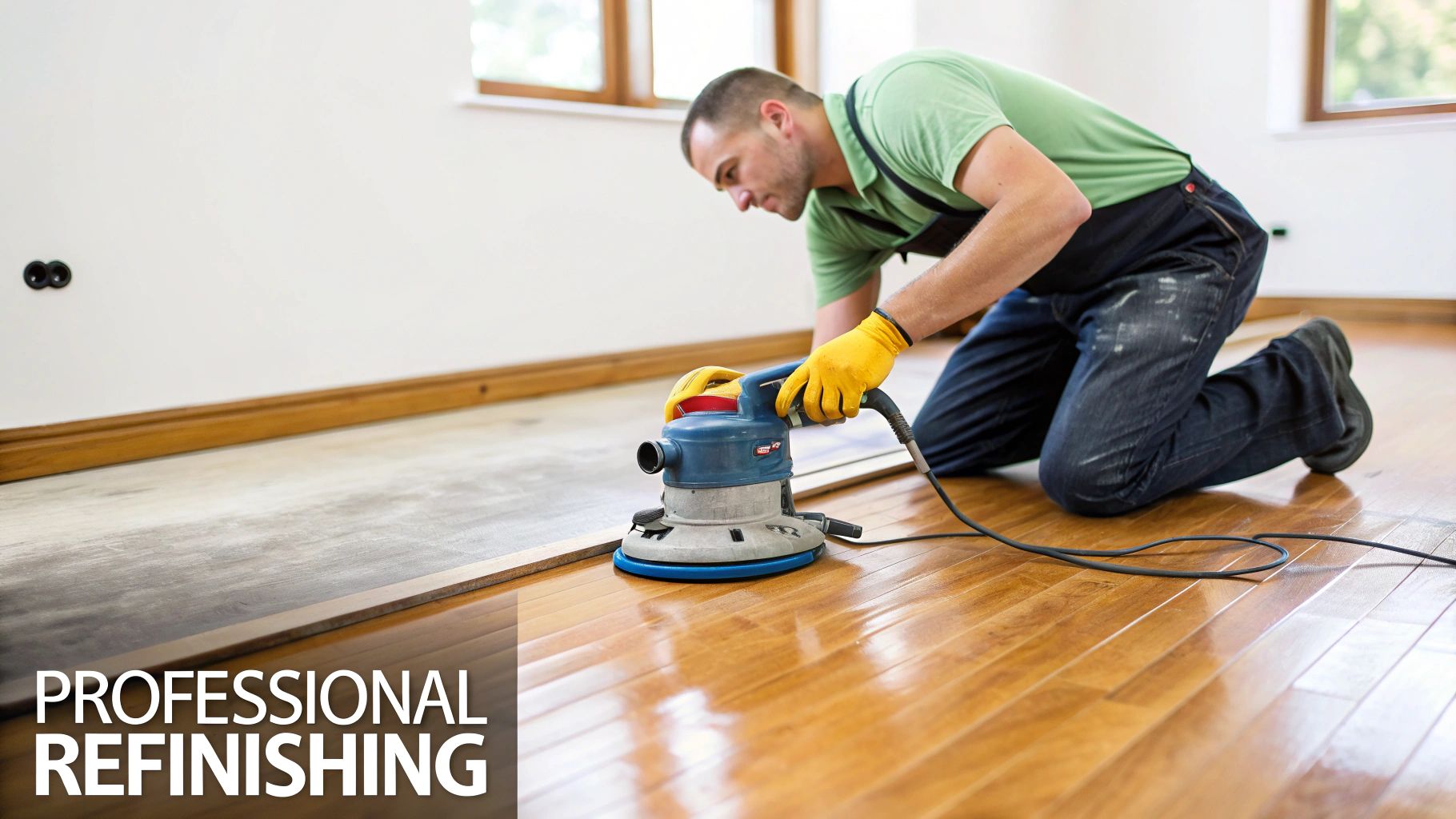
Creating the Perfect Color-Matched Filler
What’s the secret to making a repair completely disappear? Simple: you use a filler made from the floor itself. As we perform our dust-free sanding, we collect the super-fine wood dust from your actual floorboards. We then mix this dust with a high-quality resin to create a strong, pliable wood putty.
Because the filler is literally made from your own wood, it has the exact same tone, grain, and character. When we apply it, it fills the gaps perfectly. Once it's sanded smooth and sealed, it becomes a truly undetectable part of your floor. This method is light-years ahead of any off-the-shelf filler that rarely matches and often cracks under pressure.
The Power of the UV-Cure System
After filling every gap and sanding the surface to a pristine smoothness, we bring in the big guns: our advanced UV-Cure System finish. For busy households in Castle Rock or Littleton, this technology is a complete game-changer. The finish is cured instantly with a specialized UV light, creating an incredibly hard and durable surface the moment we're done.
This system does more than just protect; it stabilizes the entire floor.
- Seals Gaps Permanently: The UV finish creates a monolithic seal over the filled gaps, locking them in place. This prevents the filler from cracking or popping out from foot traffic or minor wood movement.
- Instant Durability: Unlike old-school finishes that need days to cure, our UV finish is 100% cured before we even pack up our truck. You can move your furniture back and walk on your floors immediately, with no lingering odors or downtime.
Achieving this level of quality requires more than just skill; it's about a rigorous process, much like a standard operating procedure in manufacturing, that guarantees consistent, top-tier results every time.
Comparing Gap Repair Methods
When deciding how to tackle gaps in your floors, it helps to see the options side-by-side. Here’s a quick breakdown of DIY fixes versus professional solutions.
| Repair Method | Effectiveness & Durability | Best For | Average Cost |
|---|---|---|---|
| DIY Wood Filler/Putty | Low. Often a poor color match, cracks, and pops out over time. | Very small, single gaps in low-traffic areas. A temporary fix. | $10 – $30 |
| Rope/Caulk Filling | Low to Medium. Can look unnatural and doesn't bond with wood. | A quick cosmetic fix, not a structural repair. | $20 – $50 |
| Professional Fill & Refinish | High. Custom-matched filler bonds permanently with the wood. | Widespread seasonal gaps, ensuring a seamless, uniform finish. | $4.20 – $5.50 per sq. ft. |
| Board Replacement | Very High. A permanent, structural repair. | Warped, cracked, or severely damaged boards that can't be filled. | Varies by project |
While a quick trip to the hardware store might seem tempting, the table makes it clear: for a solution that truly lasts and restores your floor's integrity, professional methods are the only way to go.
Board Replacement for Severe Damage
Sometimes, especially in older Littleton homes that have seen some water damage or structural shifts, filling gaps just isn't enough. When boards are warped, cracked, or splintered beyond saving, our expert craftsmen can perform surgical board replacements. We carefully source matching wood, meticulously cut and fit the new board, and weave it right into the existing floor. Once it's all sanded and refinished together, the repair is completely invisible.
To get a better sense of how we handle these projects from start to finish, you can find a ton of helpful information in Your Guide to Hardwood Floor Refinishing in Denver.
How to Keep Those Gaps from Coming Back in Colorado
Alright, so your floors are looking brand-new and seamless again. The big question now is: how do you keep them that way? Preventing hardwood floor gaps between boards from reappearing is all about managing the environment inside your home. You can't do much about Colorado's rollercoaster weather, but you have total control over your indoor climate—and that's what your floors really care about.
Think of it as playing defense. By staying on top of humidity, cleaning smart, and calling in the pros for routine maintenance, you can dramatically cut down on the stress your hardwood endures. This keeps it looking tight and beautiful for the long haul, especially in newer homes across Littleton and Centennial where establishing stable conditions early on is a game-changer.
Master Your Home's Humidity
This is the big one. If you take away only one tip, make it this: control your home's indoor humidity. Wood is a natural material, and it’s happiest when its surroundings are consistent. Colorado's bone-dry winters are its absolute worst enemy.
The moment you crank up the heat for the season, the relative humidity (RH) inside your house can nosedive to desert-like levels. This forces moisture right out of your floorboards, causing them to shrink. The fix is surprisingly simple—you just have to put that moisture back into the air.
- Aim for the Sweet Spot: 35-50% RH: We can't stress this enough. Get a whole-home humidifier or set up a few good portable units during the winter. Your goal is to keep the indoor humidity consistently between 35% and 50%. This is the "happy zone" for wood, minimizing that natural expansion and contraction cycle.
- Grab a Hygrometer: This is a small, inexpensive gadget that measures indoor humidity. Pop a few around the house to keep an eye on the levels and know when to adjust your humidifier. It takes the guesswork out of the equation.
Smart Cleaning Habits for Healthy Floors
You might be surprised to learn how much your cleaning routine affects your floor's stability. The golden rule is to avoid soaking your floors with water. Too much moisture causes wood to swell up, and as it dries out, it shrinks back unnaturally, creating new gaps.
Your cleaning routine should be about protection, not just polishing. A slightly damp mop is your floor's best friend; a sopping wet one can be its biggest foe, leading to swelling, cupping, and eventually, even wider gaps.
Stick with a microfiber mop that's just barely damp, using a pH-neutral hardwood floor cleaner. Never, ever let water puddle on the surface, and make sure to wipe up any spills the second they happen.
Reinforce Your Floor's Defenses with Professional Maintenance
Think of regular professional care as a protective shield for your hardwood. A periodic screen and recoat service from our team is the perfect way to reinforce the floor's top protective layer without the disruption of a full sanding. We lightly buff the existing finish and apply a fresh coat, which seals up tiny scratches and strengthens the barrier against moisture swings.
A strong, intact finish is your first line of defense. An advanced topcoat, like our UV-Cure System finish, provides an incredible barrier against moisture getting into the wood, preserving its integrity year-round. With home renovation spending on the rise, preventing gaps is more important than ever for maintaining your property's value. In fact, flooring association surveys show that solid wood floors—popular in premium Colorado homes—can contract seasonally, and if those gaps are ignored, they can slash a home's resale value by 3-5%. You can check out more hardwood flooring market trends over on mordorintelligence.com.
At the end of the day, it's a team effort: environmental control, proper cleaning, and expert maintenance work together to create a stable, long-lasting foundation for your floors. For a deeper dive into building that foundation from the ground up, take a look at our guide on the best underlayment for hardwood floors.
Ready to Get Those Gaps Fixed for Good? Let’s Talk.
If you're a homeowner anywhere in the Littleton area, from Columbine Valley to Ken Caryl, you've probably noticed a few gaps between your hardwood floor boards at some point. It’s a super common thing around here. As we've covered, those little gaps are often just your floors breathing with Colorado's wild climate swings. But knowing when it's just nature and when it's a real problem is the key to protecting your beautiful floors.
Here’s the main thing to remember: minor seasonal shrinking is totally normal and expected. But if those gaps are sticking around all year, getting wider, or just driving you crazy, it’s time to call in a professional. Ignoring them can lead to bigger headaches down the road, but with the right game plan, they're completely fixable.
The Best Way to Make Your Floors Look New Again
For a fix that not only looks incredible but also lasts for years, a professional repair is hands-down the best way to go. At J.R. Hardwood Floor Refinishing & Cleaning, we don’t just slap some putty in the cracks and call it a day. Our process for hardwood floor refinishing in Littleton is a whole lot smarter.
- Dust-Free Sanding: First things first, we create a perfectly smooth, clean slate for the repairs without turning your home into a dust bowl.
- Custom Color-Matched Filling: This is our secret sauce. We use the super-fine dust from sanding your own floors to create a filler. The result? A patch that blends in so perfectly you’ll forget the gap was ever there.
- Advanced UV-Cure System: We then seal it all in with our cutting-edge UV-Cure System. A special light instantly hardens the finish, making the repairs rock-solid and giving you unmatched durability the second we walk out the door.
"Our whole philosophy is built on quality, craftsmanship, and making sure our customers are thrilled. We treat every floor like it’s in our own house, which is why so many folks in Littleton trust us to bring their floors back to life. Our 5-star reviews on our testimonials page really speak for themselves."
We get it—your home is your happy place. Whether you've got a historic Victorian in Downtown Littleton or a brand-new build out in Lone Tree, our team has the know-how to make your floors look absolutely perfect. Don’t just take our word for it; watch our videos and see the transformations for yourself.
Don’t let a few gaps steal the show from your beautiful hardwood. Give J.R. Hardwood a call today for a free, no-pressure quote and see what a difference true professional craftsmanship can make. We’re the local team you can trust for hardwood floor refinishing, and we're ready to get your floors glowing again.
FAQs: Gaps in Hardwood Floors in Littleton
When it comes to hardwood floor gaps between boards, we get a lot of questions from homeowners. It's one of those things that can make you worry, but often, it's just your floors doing what they're supposed to do. Here are some of the most common questions our team at J.R. Hardwood hears from Littleton residents, with straightforward answers from our experience with local hardwood floor refinishing and our UV-Cure System.
Are Small Hairline Gaps Between My Hardwood Floors Normal?
Yes, absolutely. Small, seasonal gaps are perfectly normal, especially here in Colorado's famously dry climate. Think of your wood floors as a living, breathing part of your home. Wood naturally expands when the air is humid in the summer and contracts when it gets dry in the winter.
That natural movement is what causes those tiny hairline gaps to show up and then disappear as the seasons change. As long as the gaps are pretty uniform across the floor and they seem to shrink back down in the summer, it's usually nothing to worry about.
However, if you're seeing gaps wide enough to slide a coin into, or if they stick around all year and seem to be getting wider, that’s when it’s a good idea to have a pro like us take a look.
Can You Fill Gaps in Hardwood Floors Without Refinishing?
While you can technically spot-fill a few gaps with a DIY wood filler from the hardware store, we almost always advise against it. Those store-bought fillers are a nightmare to match to the exact color and texture of your wood, and you often end up with a blotchy, distracting look.
Even worse, those fillers are rigid. As your floor continues its natural seasonal movement, the filler will almost certainly crack, shrink, or pop right out. This just creates a bigger mess and can make a professional repair down the road more difficult and expensive.
For a seamless look that actually lasts, the only right way to do it is to fill the gaps as part of a complete hardwood floor refinishing service. This ensures the filler is custom-matched, bonds properly, and gets sealed under a uniform, beautiful finish along with the rest of the floor.
Will a UV-Cure Finish Help with My Floor Gaps?
A UV-Cure System finish is a fantastic final step, but it comes into play after we've professionally filled the gaps and sanded the floor smooth. The finish itself isn't a gap filler, but its incredible durability is key to making the repair last.
Once we apply it, the UV finish creates a super-strong, single-piece seal across your entire floor. This tough protective layer does a few important things:
- It locks in the filler, preventing it from cracking or working its way loose over time.
- It protects the edges of the boards from splintering or chipping, which can easily happen around gapped areas.
- It helps minimize the impact of minor moisture swings, keeping the entire floor more stable.
Plus, with our advanced UV-Cure system, your floors are 100% cured and ready for life—furniture, pets, and foot traffic—the second we walk out the door. No waiting required.
How Much Does It Cost to Fix Gaps in a Hardwood Floor in Littleton?
The cost to fix hardwood floor gaps between boards really depends on how severe the problem is and which repair method will give you the best long-term results.
For the vast majority of homes, filling minor seasonal gaps is simply part of our standard hardwood floor refinishing service. The final price is based on the square footage and the finish you choose, like our popular Platinum Traffic Plus or Diamond Traffic Plus options.
In more serious cases where boards are warped, cracked, or damaged beyond saving, we might need to do a board replacement, which would adjust the cost. The best way to get a clear number is to contact us for a free estimate. We can often give you an accurate quote right over the phone if you can text or email us a few pictures of your floor.
Homeowners in Littleton trust J.R. Hardwood Floor Refinishing & Cleaning to restore the natural beauty of their hardwood floors with our dust-free sanding system and advanced UV-curable finishes. Unlike traditional methods, our UV technology cures instantly, so you can move furniture back the same day with no lingering odor or downtime. Choose the perfect refinishing service to match your needs and home traffic. Our dust-free process ensures a clean, beautiful finish every time.
📞 Phone: 720-327-1127
🌐 Website: jrhardwoodfloorrefinishingandcleaning.com
📍 Service Area: Littleton, Denver, Highlands Ranch, Centennial, Lakewood, and surrounding areas.
📺 YouTube: https://www.youtube.com/channel/UCLaTAi6KxwT-g8QCKqKTQ8Q?sub_confirmation=1