 Skip to content
That sinking feeling when you spot a dark, discolored patch creeping across your beautiful hardwood floors? It’s a homeowner's worst nightmare. We're not just talking about an ugly stain; this is often the first sign of black mold on a hardwood floor, a problem that goes way beyond aesthetics and can threaten your home's structure and your family's health. For homeowners in Parker facing this issue, the solution often involves professional Parker hardwood floor refinishing using advanced tools like a UV-Cure System to ensure the problem is gone for good.
The Hidden Threat in Your Parker Home
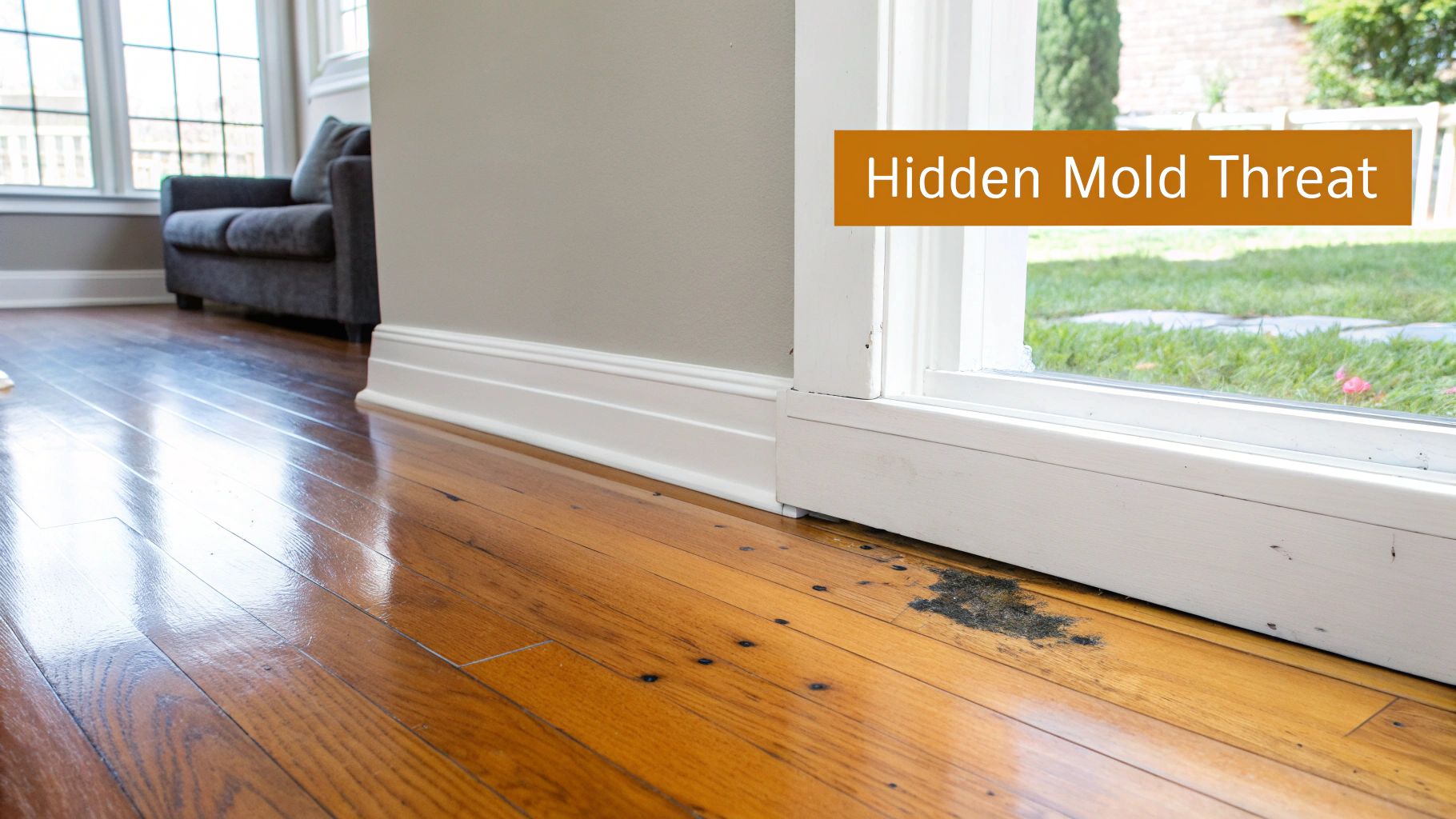
If you live in a beautiful Parker neighborhood like Stonegate or The Pinery, that fear of finding black mold is especially real. These stunning homes are incredible, but they can still fall victim to older plumbing or damp basements that practically roll out the welcome mat for moisture problems—and mold is always ready to move in.
While "black mold" is the term everyone uses, it often points to a nasty species called Stachybotrys chartarum, known for its slimy, greenish-black appearance. But honestly, dozens of other molds can look black and cause just as much trouble. These fungi aren't picky, but they do have a specific recipe for survival.
Why Your Hardwood Is a Target for Mold Growth
Hardwood floors are tough, but at the end of the day, they're made of wood—an organic material that mold sees as a buffet. Add a little moisture, warmth, and darkness, and you’ve created the perfect breeding ground. The real trouble brews beneath the surface, where moisture gets trapped between your floorboards and the subfloor, a common issue we address with our Parker hardwood floor refinishing services and our specialized UV-Cure System.
So where does this sneaky moisture come from? Usually, it's one of these culprits:
- A slow, sneaky plumbing leak from a kitchen sink or bathroom pipe.
- High humidity seeping up from a crawl space or basement.
- Spills that weren't mopped up fast enough and soaked into the seams.
- Condensation building up under an area rug without any air circulation.
Once mold takes hold, it starts eating away at the wood fibers. This isn't just a surface issue; it leads to rot and decay, weakening the very structure of your floors. That's why just wiping the surface clean never works—the problem's roots run much deeper.
Understanding the Risks and Realities of Black Mold
Finding black mold on your hardwood isn't just a flooring problem; it's a whole-house problem. Mold pumps microscopic spores into the air, which can get sucked into your HVAC system and spread everywhere. This can trigger respiratory issues, allergic reactions, and other health headaches, especially for kids, older adults, or anyone with a sensitive immune system.
The structural and financial damage can be massive, too. Research shows that mold starts growing on most wood once its moisture content climbs to between 20% and 28%. Since hardwood floors can trap moisture in the subfloor, they become a prime spot for colonization. The costs add up fast, with professional mold remediation averaging $500 to $6,000. Even worse, an undisclosed mold issue can slash a home's value by a staggering 10-25%.
At J.R. Hardwood Floor Refinishing & Cleaning, we tackle black mold with a crucial one-two punch: first, professional remediation to get rid of the health threat, followed by expert floor restoration explained for Denver homeowners to fix the damage. Our dust-free sanding system is key, allowing us to safely remove the contaminated layers of wood without launching spores into your home. After the mold is gone, our advanced UV-Cure System creates a tough, non-porous seal that helps block future moisture—the perfect final step for any Parker hardwood floor refinishing project.
Spotting Black Mold On Your Hardwood Floor
Before you can even think about fixing a mold problem, you have to play detective. The first, most important step is knowing exactly what you’re looking for. Black mold on a hardwood floor doesn’t always show up as a huge, glaring patch. It often starts small, sending out subtle warnings that are easy to brush off if you’re not paying close attention.
The very first clue you’ll probably notice is the smell. Mold, especially the notorious Stachybotrys chartarum, gives off a very distinct, musty odor. Think damp basement, wet socks, or rotting leaves. If you walk into a room and your nose just tells you something isn't right, trust that instinct. You can often smell it long before you see any visible growth, particularly if the mold is hiding underneath the floorboards.
Visual and Textural Clues of Mold
Once you’ve sniffed out a problem, it’s time to use your eyes. Look for any changes in your hardwood, because mold can appear in a few different ways—and it isn't always jet black.
- Discoloration: Keep an eye out for patches that are dark green, brown, or black. These spots might look fuzzy, feel a bit slimy, or even have a powdery texture. A simple water stain is usually flat and varies in shades of brown, but mold has a texture and depth to it.
- Warping and Cupping: Wood swells and deforms when moisture gets trapped underneath. This can make the edges of your floorboards lift, a problem known as cupping. If your once-flat floors are starting to look wavy, that’s a huge red flag for a moisture issue—which is basically a welcome mat for mold. We dive deeper into this in our guide on how to fix cupped hardwood floors.
- Peeling Finish: Notice the protective finish on your floors bubbling, cracking, or peeling away in a certain spot? That's often a sign that moisture is trapped underneath, creating the perfect hidden breeding ground for mold.
Picture this: you have a beautiful home in Centennial, but the oak floors near your dishwasher are starting to look a little off-color. Or maybe you're in your Littleton basement and you spot a few dark marks on the flooring near a wall that always feels damp. These are classic real-world scenarios that demand a closer look, right away.
Is It Mold Or Just A Stain? A Guide for Parker Homeowners
Telling the difference between mold, mildew, and a plain old water stain can be tough at first glance. They all come from moisture, but they are not the same problem. Here’s a quick guide to help you figure out what you might be dealing with before calling for Parker hardwood floor refinishing.
| Symptom | Potential Black Mold | Simple Water Stain | Mildew |
|---|---|---|---|
| Texture | Can be fuzzy, slimy, or powdery. | Flat, with no raised texture. | Powdery and flat. |
| Color | Dark green, black, or dark brown. | Varies from light tan to dark brown. | Typically gray, white, or yellow. |
| Smell | Strong, musty, and earthy odor. | Usually has no smell once dry. | A milder, musty smell. |
| Growth | Will continue to spread if moisture is present. | The stain does not grow in size. | Spreads on the surface only. |
While this table is a great starting point, don't underestimate the health risks. Around 4.6 million of the 21.8 million asthma cases reported in the U.S. are linked to dampness and mold exposure at home. And with experts finding that 93% of chronic sinus infections have been attributed to mold, the stakes are higher than most people think.
Given what's at risk, if you even suspect you have black mold on your hardwood floor, the smartest and safest move is to get a professional opinion. An expert can confirm if it’s truly mold, assess how far it has spread, and guide you down the right path for safe removal and restoration.
Repair, Refinish, Or Replace Your Flooring? A Parker Homeowner's Dilemma
Okay, so you've found black mold on a hardwood floor. Take a deep breath. The next move is figuring out how to deal with the damage, and the right call depends entirely on one thing: how deep that mold has gone. A little surface discoloration is one thing; boards that have been compromised all the way through are a completely different beast.
Getting this decision wrong can mean a world of headaches—recurring mold, wasted money, and even lingering health risks. Your choice will fall into one of three buckets: a targeted repair, a full-blown refinish, or yanking out the boards completely.
This little flowchart is a great starting point for figuring out what you're looking at.
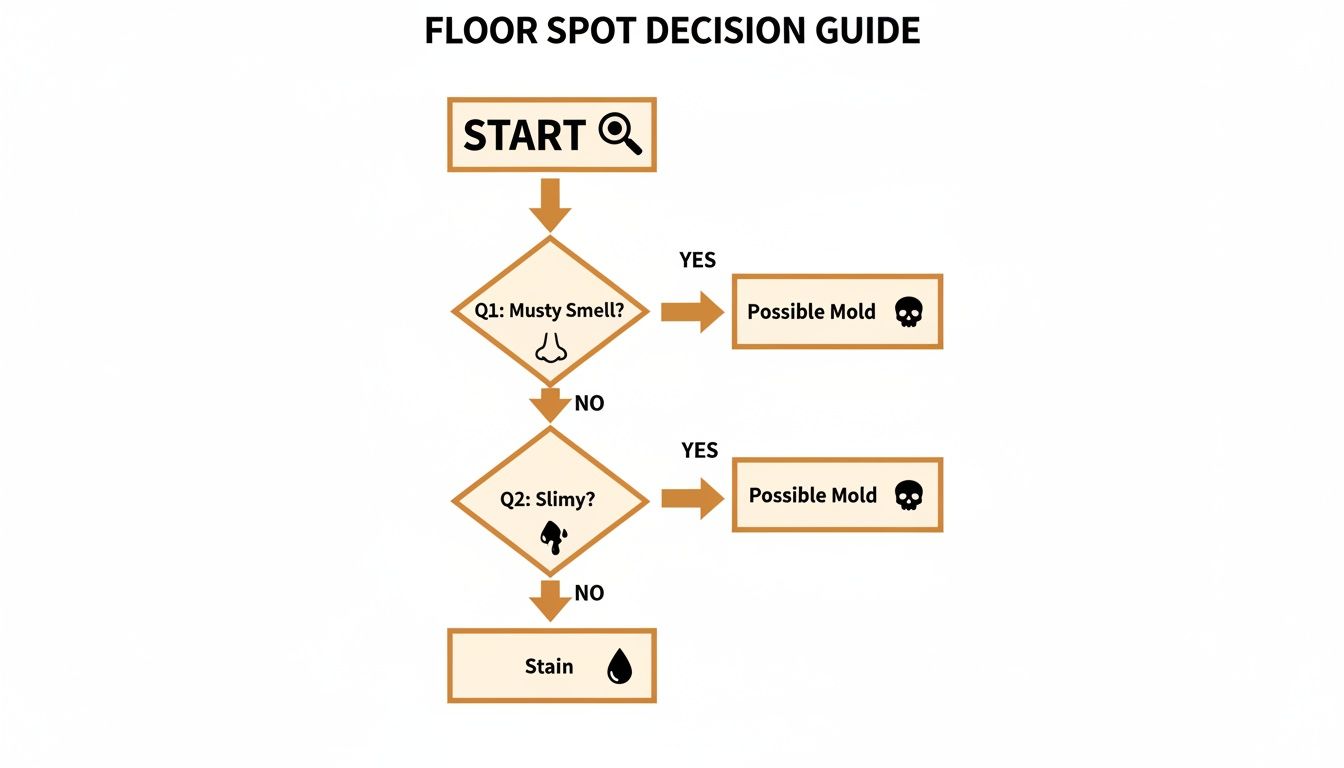
The big takeaway here? Trust your senses. If you smell that tell-tale musty odor or the spot feels slimy, you're almost certainly dealing with more than a simple stain.
When a Screen & Recoat Won't Cut It
A screen and recoat is a fantastic way to freshen up a dull finish or buff out minor scuffs. It’s quick and cost-effective, but it's absolutely useless against mold. All this process does is lightly abrade the top layer of finish before a new one is applied. It never touches the actual wood.
Mold, even a tiny speck, lives down in the wood fibers. Slapping a new coat of finish over it is like putting a band-aid on a bullet wound. You're just trapping the mold underneath, giving it a dark, protected place to grow and spread unseen. It creates a false sense of security while the problem quietly gets much, much worse.
The Power of Dust-Free Sanding and Parker Hardwood Floor Refinishing
When mold has stained the wood but hasn't caused it to rot, a full hardwood sanding and refinishing is the gold standard. This was the perfect solution for a client in Parker whose ice maker had a slow leak, leaving a nasty black stain on their beautiful red oak kitchen floor.
Here’s why this approach works so well:
- Total Elimination: Our dust-free sanding equipment literally grinds away the top layers of the wood, physically removing the moldy fibers. The powerful, HEPA-filtered vacuums attached to our sanders suck up the contaminated dust right at the source, so spores don't get blasted all over your house.
- A Clean Slate: Sanding reveals a fresh, untouched layer of wood, completely erasing the stains and damage. It’s the ultimate reset button for your floor.
- Next-Level Protection: Once the floor is sanded, we seal it with our advanced UV-Cure System. The finish is hardened instantly with ultraviolet light, creating an incredibly tough, non-porous shield. Unlike traditional finishes that can take days to fully cure, our UV-Cure System offers immediate, rock-solid protection against future moisture—a must-have after a mold scare.
After dealing with mold, professional refinishing isn't just about making the floor look good again. It's about building a stronger defense. The goal is to make that surface as unwelcoming as possible to future moisture and mold.
Knowing When It's Time To Replace Boards
Sometimes, the damage is just too far gone for sanding to be an option. If mold has been festering for a long time, it eats away at the wood, causing it to rot, go soft, and lose all structural integrity. In those situations, replacing the affected boards is the only safe and responsible path forward.
You'll know it's time for replacement if you see these signs:
- Soft or Spongy Wood: If you press on a board and it feels soft or gives way, the wood fibers are decayed beyond saving.
- Serious Warping or Cupping: When a board is severely twisted or cupped, it means moisture has saturated it completely. Sanding can't fix that kind of distortion.
- Subfloor Contamination: If we pull up a board and find mold has spread to the subfloor, the hardwood above it has to go so we can properly treat the structure underneath.
For our clients here in the Parker area, we carefully assess the damage to map out the right plan. We can expertly remove the bad boards, make sure the subfloor is clean and solid, and then lace in new planks that are a perfect match for your existing floor. Afterward, we sand and refinish the entire area with our instant UV-Cure System to create a seamless, protected surface. It’s a comprehensive fix that ensures the black mold on your hardwood floor is gone for good.
Your Guide To Safe Mold Removal And Remediation
When you first spot black mold on a hardwood floor, your gut reaction might be to grab the nearest scrub brush and go to town. I get it. But hold on—disturbing mold without the right precautions can be a huge mistake.
One wrong move can blast millions of tiny spores into the air, turning a small, contained problem into a contamination nightmare that affects your entire home. Let's walk through the two ways to handle this: the very limited DIY path and when it's absolutely time to call in the pros.
The Limits Of DIY Mold Removal
Let's be crystal clear: DIY is only an option for a tiny, surface-level mold spot. We're talking about an area smaller than the palm of your hand, no more than a few square feet in total. If you're considering tackling it yourself, "careful" isn't just a suggestion; it's a non-negotiable rule.
Before you even think about touching the mold, you need the right gear.
- An N95 Respirator: This is mandatory. A simple dust mask is useless against microscopic mold spores. Don't skip this.
- Gloves and Goggles: You need a barrier to protect your skin and eyes from both the mold itself and any cleaning solution you're using.
- Good Ventilation: Open up those windows. You want any disturbed air to flow outside, not deeper into your house.
As for cleaning, stay away from harsh chemicals like bleach. It can damage your beautiful wood and often doesn't kill the mold at its roots anyway. A simple solution of equal parts white vinegar and water is a much better bet. Lightly spray the area, let it sit for about an hour, and then gently scrub it before drying the spot completely. You can also look into some of our favorite best hardwood floor cleaning products that are tough on grime but safe for your finish.
When To Immediately Call A Professional
The DIY approach has a hard stop. If you see any of the following, pick up the phone and call for professional help immediately.
- The mold patch is bigger than 10 square feet.
- There's a strong, musty smell that just won't go away, even if you can't see the source.
- Your hardwood floors are starting to warp, cup, or feel soft and spongy to the touch.
- Someone in your home has allergies, asthma, or a compromised immune system.
Trying to tackle a serious infestation on your own is a major gamble with your health and your home's integrity. Experts have the training and equipment to handle the job safely. If you're in this situation, it's worth learning more about what professional mold remediation services can do for you.
The Professional Remediation and Restoration Process
When you hire a pro, you’re not just getting a cleaning crew. You’re getting a systematic, multi-stage solution designed to completely eradicate the problem, not just cover it up.
First, they’ll set up containment. This involves using heavy plastic sheeting and creating negative air pressure to completely seal off the contaminated area. It’s a critical step that stops spores from sneaking through your HVAC system and spreading to other rooms.
Next comes air scrubbing. High-powered machines with HEPA filters run continuously to capture any airborne spores kicked up during the process. Any contaminated materials, like rotted floorboards or a compromised subfloor, are carefully removed and disposed of following strict protocols.
Once the mold is officially gone, our Parker hardwood floor refinishing team can come in to handle the restoration. This is where our dust-free sanding process really shines, as it removes any final surface traces without reintroducing dust into your clean air. We finish the job with our advanced UV-Cure System, which hardens instantly to form a tough, non-porous barrier, sealing the wood against any future moisture.
Preventing Future Mold Growth On Hardwood Floors
After going through the headache and cost of getting rid of black mold on a hardwood floor, the last thing you want is a repeat performance. The good news? Preventing mold is way easier—and cheaper—than removing it. It all boils down to one simple rule: control the moisture, and you control the mold.
Master Your Home's Moisture Levels
Mold doesn't need much to get started. Give it a damp wood surface, and it can begin growing in as little as 24-48 hours. Your main job is to cut off its life source: water. This means being proactive about your home's environment.
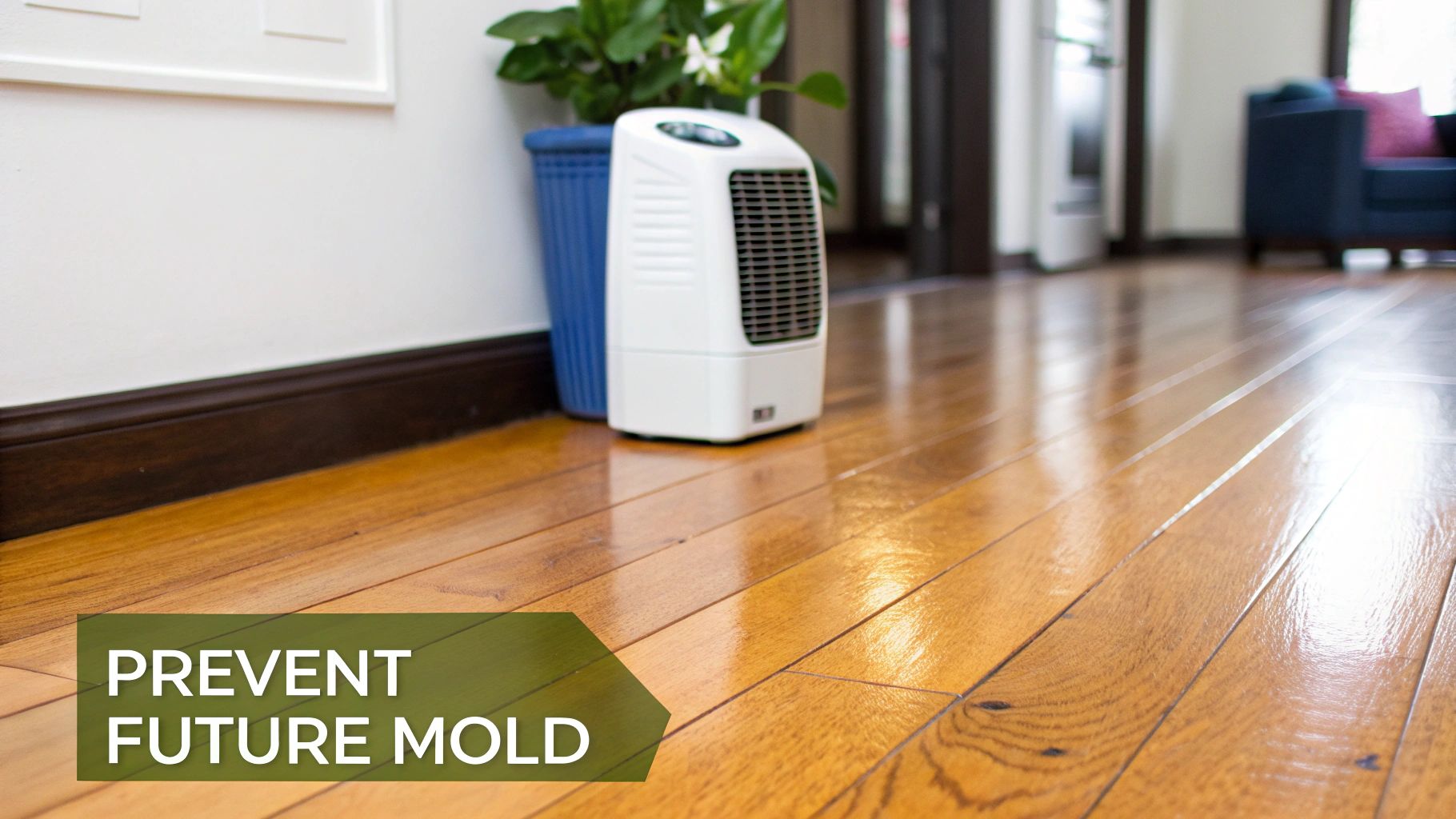
First up, keep an eye on your indoor humidity. Your hardwood floors are happiest when humidity stays between 30% and 50%. If it’s consistently creeping above 60%, you're rolling out the welcome mat for mold. A good dehumidifier is a fantastic investment, especially for basements or during Colorado's muggy summer spells.
You also need to become a leak detective. That tiny, slow drip under the kitchen sink or a sweating appliance hose can create a massive mold problem before you even know it's there. Get in the habit of regularly checking plumbing, appliance connections, and seals around windows to catch small issues before they become big, expensive ones.
The Right Maintenance and Cleaning Routines
How you clean your floors can either protect them or put them at risk. A word of warning: never use a soaking wet mop or a steam cleaner on hardwood. Both methods force way too much moisture deep into the wood grain and between the planks, creating the perfect hidden breeding ground for mold.
Instead, stick with a microfiber mop that’s just lightly dampened with a pH-neutral cleaner made specifically for hardwood. This cleans the surface perfectly without leaving behind puddles or lingering dampness. For a full rundown, check out our guide on hardwood maintenance best practices.
Good airflow is another key player in this game. Always use exhaust fans in kitchens and bathrooms to vent steam and moisture outside. If you have area rugs, make a point to lift them up every so often to let the wood underneath breathe.
While you’re focused on protecting your floors, it helps to think bigger. Learning some effective strategies for preventing mold throughout your entire home and in damp buildings can make your whole space healthier.
To make things easier, here's a quick checklist to keep your floors safe and dry.
Hardwood Floor Mold Prevention Checklist
This simple routine is your best defense against moisture damage and the perfect way to protect your investment.
| Frequency | Prevention Task | Why It Matters |
|---|---|---|
| Daily/Weekly | Wipe up spills immediately. | Prevents moisture from seeping into the wood grain. |
| Weekly | Sweep or vacuum with a soft brush attachment. | Removes dirt that can trap moisture and scratch the finish. |
| Monthly | Inspect under sinks, appliances, and near windows for leaks. | Catches small drips before they cause widespread water damage. |
| Seasonally | Check indoor humidity levels; aim for 30-50%. | Keeps the environment stable and inhospitable to mold spores. |
| Annually | Lift area rugs to check for trapped moisture. | Ensures the wood underneath is breathing and staying dry. |
Staying on top of these small tasks makes a huge difference and helps ensure you never have to deal with a mold problem again.
Upgrade Your Floor's Defenses With a UV-Cure System
Your hardwood floor's single best line of defense is its finish. A tough, seamless finish acts like a shield, stopping moisture before it ever touches the wood fibers. After a mold remediation project, upgrading this protective layer is one of the smartest moves you can make.
This is where our UV-Cure System is a total game-changer for Parker hardwood floor refinishing. Traditional finishes can take days or even weeks to fully harden, leaving them vulnerable. Our UV finish, however, is cured instantly with ultraviolet light. This process creates an incredibly durable, non-porous surface that's far more resistant to water and scratches.
For a homeowner in Parker who just dealt with a mold scare, choosing our Diamond Traffic Plus finish with the UV-Cure System delivers serious peace of mind. This advanced refinishing service doesn't just restore the floor's beauty—it builds a superior defense against the very moisture that caused the problem, making sure that black mold on the hardwood floor stays gone for good.
FAQs on Mold and Hardwood Floors in Parker
Finding what looks like a black mold hardwood floor issue can send any homeowner into a panic. We get it. As the go-to experts for hardwood floor restoration in the Parker area, we've pretty much heard every question in the book. Let's clear the air and give you the straightforward answers you need.
Can I just sand the black mold off my hardwood floor myself?
This is the first question almost everyone asks, and it makes sense on the surface. But please, don't do it. Trying to sand black mold yourself is one of the most dangerous things you can do for your home's health. When you hit mold with a sander, you're not just removing it—you're turning millions of toxic spores into an invisible, airborne cloud. That cloud gets sucked right into your HVAC system and spread to every room in your house. What started as a contained problem can quickly become a full-blown, home-wide contamination. For anything more than a tiny spot, this is a job for pros. Our dust-free sanding and Parker hardwood floor refinishing service uses powerful, HEPA-filtered vacuums to capture every contaminated particle at the source, keeping your home's air safe.
Will my homeowners insurance cover mold damage to my hardwood floors?
This one's tricky, as coverage for mold can be all over the map. Most standard policies might cover mold damage if it’s the direct result of a "covered peril"—think a sudden pipe burst that you couldn't have prevented. But if the mold grew because of a slow, persistent leak or high humidity, you're often out of luck. The key is to grab your policy, read the fine print, and call your agent immediately. Document everything with photos and notes. We can provide a detailed, professional assessment and a clear quote for repairs or replacement that you can submit with your claim.
Is it possible to save hardwood floors that have had black mold?
Absolutely—in many cases, the floor can be saved! It all comes down to how deep the damage goes. If the mold is just on the surface and hasn't caused the wood to rot or get spongy, we can usually fix it with a full dust-free sanding and refinishing. Once the wood is sanded back to its clean, raw state, we seal it up with a durable, high-performance finish. Our UV-Cure System is a fantastic choice here, as it creates an instant, non-porous shield against future moisture. However, if the wood has lost its structural integrity, the only safe path forward is to replace the affected boards.
Homeowners in Parker trust J.R. Hardwood Floor Refinishing & Cleaning to restore the natural beauty of their hardwood floors with our dust-free sanding system and advanced UV-curable finishes. Unlike traditional methods, our UV technology cures instantly, so you can move furniture back the same day with no lingering odor or downtime. Choose the perfect refinishing service to match your needs and home traffic. Our dust-free process ensures a clean, beautiful finish every time.
📞 Phone: 720-327-1127
🌐 Website: jrhardwoodfloorrefinishingandcleaning.com
📍 Service Area: Parker, Denver, Aurora, Castle Rock, Littleton, Highlands Ranch, and surrounding towns.
📺 See Our Work: Watch our YouTube videos!