 Skip to content
Luxury vinyl plank holds up well in retail and other high-traffic commercial spaces when you choose the right wear-layer thickness and insist on correct installation. Three things make it work: a wear layer rated for commercial foot traffic, moisture-tested subfloors, and a maintenance routine that avoids harsh chemicals. Before you sign off on any product, check the wear-layer spec sheet and confirm your installer plans to test subfloor moisture.
TL;DR:
- Specify at least 20 mil of wear layer, and choose 30 mil or more for entrances, checkout lanes, main aisles, and zones with rolling carts.
- Require documented ASTM F2170 and F1869 moisture tests before installation, then verify that the adhesive matches the manufacturer’s approved specifications and moisture limits.
- Ask for traction test results for the exact finish you plan to install, because no single coefficient of friction label reliably predicts slip risk.
- Use glue down LVP with full waterproof backing around refrigerated cases, where persistent condensation can seep beneath the seams of floating floors.
- Clean daily with a pH neutral cleaner, use entrance mats to trap grit, and avoid unapproved waxes that can damage the finish or void warranties.
Table of Contents
- How does LVP hold up in high-traffic retail spaces?
- What makes LVP worth considering for a retail buildout
- Choosing the right wear layer and construction for your space
- Installation and subfloor prep that protect your warranty
- Keeping LVP looking good through daily retail use
- Weighing upfront cost against lifecycle expense
- A quick checklist before you commit to a product and installer
- Does LVP work around refrigeration units, displays, and fixtures?
- How sunlight and temperature swings affect LVP over time
- What certifications and standards actually matter for commercial LVP
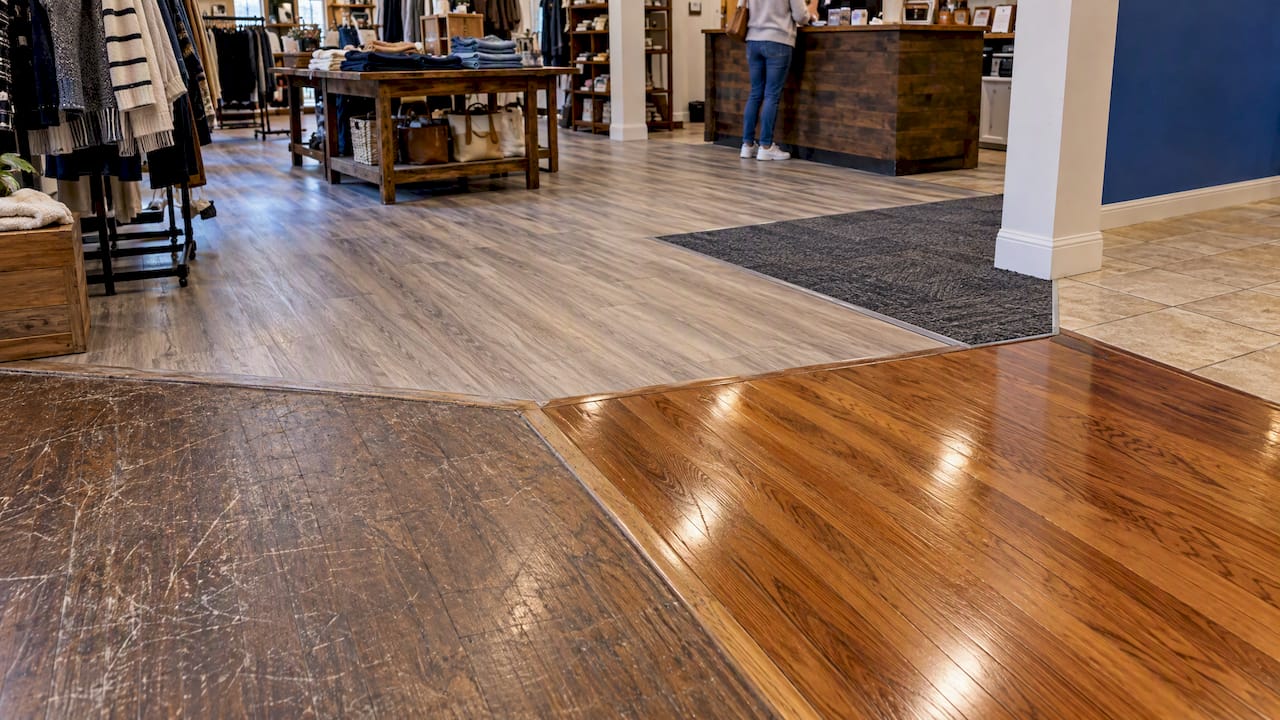
- How LVP stacks up against carpet and tile for a sales floor
- What to look for when hiring a commercial LVP installer
- A field perspective on specifying LVP for retail
- Get LVP installed right the first time
- FAQ
- Sources
How does LVP hold up in high-traffic retail spaces?
The wear layer is the clear coating on top of a luxury vinyl plank, and it is the single part of the product standing between your floor and daily abuse. Everything else, the printed design layer, the rigid core, the backing, matters for stability and sound, but the wear layer is what actually fails first under heavy use: scuffing, scratching, and dulling show up there before anywhere else.
In a retail setting, that means constant foot traffic, rolling carts, hand trucks for restocking, and the occasional dropped box all land directly on that top layer. Spills get tracked in from parking lots and sidewalks, so water and stain resistance across the whole plank matter almost as much as surface hardness.
Well-specified commercial LVP routinely outperforms options like sheet vinyl composition tile in day-to-day wear, though actual service life depends heavily on traffic volume and maintenance rather than a fixed number of years. One tradeoff worth flagging early: a highly textured or embossed finish can look great on a showroom floor but may reduce traction when wet, so slip resistance deserves its own look before you commit to a finish.
What makes LVP worth considering for a retail buildout
Retail owners juggle a lot of competing priorities when picking a floor, and LVP checks several boxes at once without forcing a tradeoff on any single one.
- Design flexibility: LVP comes in a wide range of wood, stone, and concrete looks, so it is easy to match a brand aesthetic without the cost or weight of real stone or hardwood.
- Comfort underfoot: Compared to tile or polished concrete, LVP has a bit more give, which staff on their feet for eight-hour shifts tend to notice and appreciate.
- Fast return to service: Properly installed LVP is water and stain resistant from day one, and many commercial installs allow foot traffic again within a day or two of completion, which matters when every closed hour costs revenue.
Those three advantages explain why LVP shows up so often in boutique retail, grocery, and big-box settings alike.
Choosing the right wear layer and construction for your space
Not all LVP is built for retail. The wear-layer thickness, measured in mils, is the number that tells you whether a product is meant for a quiet back office or a busy sales floor.
Specification guidance from a university facilities department recommends a 20-mil minimum for offices and light-traffic areas, with 30 mil or higher preferred for high-use corridors and retail. That gap matters: a product rated for a quiet hallway will wear through far faster under shopping carts and daily foot traffic than one built for commercial retail.
- Wear layer: Look for 20 mil as an absolute floor, and lean toward 30 mil or higher for entryways, checkout lanes, and main aisles.
- Surface coating: Urethane or enhanced urethane finishes add scratch and stain resistance beyond the wear layer itself.
- Construction type: Rigid-core click-lock products handle subfloor imperfections better; glue-down products generally offer the most stable long-term bond in heavy-cart areas.
Pro Tip: Ask every manufacturer for a coefficient-of-friction (COF) test report alongside the wear-layer spec. A beautiful finish that is also slippery when wet is a liability you do not want to discover after opening day.
Installation and subfloor prep that protect your warranty
Most LVP failures in commercial spaces trace back to installation, not the product itself. Getting the prep right is what separates a floor that lasts a decade from one that bubbles or delaminates within a year.
- Test the subfloor moisture. Commercial installation guides call for ASTM F2170 in-situ relative humidity testing and ASTM F1869 calcium chloride testing before installation begins, and the results should be documented in writing, not just verbally confirmed.
- Match the adhesive to the manufacturer’s spec. The wrong adhesive, or one used outside its listed moisture range, is one of the most common causes of early failure and can void a warranty outright.
- Control site conditions. Acclimate the material, keep HVAC running within the manufacturer’s temperature and humidity range, and protect the finished floor from other trades still working on-site.
- Get a signed workmanship warranty. A written installer warranty, separate from the manufacturer’s product warranty, is your recourse if something goes wrong down the line.
Pro Tip: Have your installer photograph each moisture-test probe location and attach the readings to your project file. Manufacturers and warranty administrators often ask for exactly this evidence when a claim comes up, and having it ready can save weeks of back-and-forth.
Keeping LVP looking good through daily retail use
A maintenance routine that fits the floor extends its life far beyond what the product spec alone promises.
- Clean daily with a pH-neutral cleaner. Harsh or soap-based detergents leave a dull film and can degrade the wear layer’s finish over time.
- Use grit-control mats at every exterior entrance. Most of the damage that dulls a retail floor comes in on shoe soles, so trapping grit before it reaches the plank matters more than any cleaning product.
- Avoid wax or acrylic coatings not approved by the manufacturer. These can interfere with the factory finish and sometimes void the warranty outright.
- Address scuffs and gouges promptly. Spot repairs on individual planks are far cheaper than letting damage spread or waiting for a full refinish.
Weighing upfront cost against lifecycle expense
LVP typically costs less upfront than ceramic tile or natural stone, but the real comparison is lifecycle cost, not sticker price. A lifecycle analysis of commercial finish floor systems found that lower-cost options like VCT can end up more expensive than higher-upfront alternatives once decades of maintenance and replacement are factored in, because the cheaper material needs more frequent stripping, waxing, or replacement.
LVP’s own lifecycle math depends heavily on traffic and upkeep rather than a fixed number of years. A well-specified, properly maintained commercial LVP floor in a moderate-traffic retail space can perform for a long stretch, while a thin residential-grade product in a busy entryway may need replacing far sooner.
Budget for more than just the material and labor. Set aside contingency funds for moisture remediation if subfloor testing turns up a problem, for the correct adhesive (sometimes pricier than a generic alternative), and for periodic spot repairs over the floor’s life. For a broader look at how LVP stacks up against other finishes over time, our commercial flooring options overview walks through the tradeoffs in more detail.
A quick checklist before you commit to a product and installer
Use this short list when you are comparing quotes or product samples, so nothing critical slips through:
- Confirm wear-layer thickness in writing, 20 mil minimum, 30 mil or higher for high-traffic zones.
- Request COF or slip-resistance test data for the specific finish you are considering.
- Require ASTM F2170 and F1869 moisture testing before installation, with written results.
- Verify the adhesive matches the manufacturer’s approved list for your subfloor type.
- Ask for installer references on comparable retail or commercial projects.
- Get the workmanship warranty in writing, separate from the product warranty.
If an installer hesitates on any of these points, especially moisture testing or references, treat it as a reason to ask more questions or look elsewhere before signing a contract.
Does LVP work around refrigeration units, displays, and fixtures?
Retail floors rarely sit empty. They carry refrigerated cases, rolling display racks, point-of-sale counters, and seasonal fixtures that get moved several times a year, and LVP generally handles that load well when the product and installation match the job.
Refrigeration units are the trickiest case because of condensation. Water that collects under or around a refrigerated case can sit on the floor longer than a typical spill, so a glue-down LVP with full waterproof backing, rather than a click-lock floating floor, tends to perform better in those zones. A floating floor’s locking seams can be more vulnerable to moisture working its way underneath over time.
Heavy, stationary fixtures like permanent shelving or checkout counters are generally fine on LVP as long as the subfloor underneath was flat and properly prepped. The concern is less about weight and more about point-load indentation from narrow feet or casters sitting in one spot for months. Wider feet, load-distributing pads, or simply rotating display furniture periodically help avoid permanent dents in the wear layer.
Rolling fixtures, including merchandising carts and portable racks, are where wear-layer thickness earns its keep. A 20 mil floor in a zone with constant cart traffic will show wear far faster than a 30 mil or higher product in the same spot, which is exactly why mil rating deserves more attention than finish color when you are speccing a sales floor.
How sunlight and temperature swings affect LVP over time
LVP is vinyl, and vinyl responds to heat and UV exposure, which matters more in retail than in a typical home because storefronts often have large glass windows facing the street.
Direct, sustained sunlight can fade the printed design layer over months or years, and uneven exposure, say, a sunny strip near the front windows versus the shaded back of the store, can create a visible color difference between zones. Where storefront glazing lets in strong afternoon sun, window film or UV-blocking coatings on the glass itself help protect the floor’s finish as much as they protect merchandise.
Temperature swings are the other factor. Vinyl expands and contracts with heat, so a sales floor that gets very warm near sun-exposed windows and much cooler overnight when HVAC cycles down can stress plank seams over time. This is part of why manufacturer-approved acclimation periods and stable HVAC operation during and after installation matter so much, not just for the day of installation but for ongoing performance. A floor installed without proper acclimation in a space with wide daily temperature swings is more likely to show gapping or buckling at the seams within the first year or two.
What certifications and standards actually matter for commercial LVP
Commercial LVP does not have one single federal safety certification the way some building products do, but a handful of standards and testing protocols function as the real benchmarks procurement teams should ask about.
ASTM F2170 and ASTM F1869 are the moisture-testing standards referenced throughout commercial installation guides, and installation instructions for commercial-grade LVT specifically call out both tests as prerequisites for warranty-compliant installation. These are not optional best practices. Skipping them is one of the most common reasons a warranty claim gets denied later.
Slip resistance is murkier. There is no single, universally adopted coefficient-of-friction label that guarantees real-world slip reduction. A federal regulatory review of a petition to require uniform slip-resistance labeling on flooring packaging found limited evidence that a single COF number on a label reliably predicts fewer slip incidents. That does not mean traction does not matter. It means the industry has not settled on one labeling standard, so ask manufacturers directly for their own testing methodology (ANSI or ASTM-based test reports are the most common) rather than trusting a single printed number at face value.
How LVP stacks up against carpet and tile for a sales floor
Each major commercial flooring option solves a different problem, and the right choice depends on what your retail space needs most.
Commercial carpet softens sound and feels warmer underfoot, which matters in some retail categories, but it absorbs spills and odors, traps grit from outside, and needs far more frequent professional cleaning to look presentable in a high-traffic corridor. It also tends to show wear paths in heavy zones faster than a resilient floor does.
Ceramic tile is extremely durable and resists almost everything LVP is vulnerable to, including sustained heat and scratching from heavy equipment. The tradeoffs are a harder, less forgiving surface for staff standing all day, a colder feel, grout lines that need regular sealing and cleaning, and a meaningfully higher upfront installation cost. Tile is also unforgiving if a subfloor settles even slightly, where cracks can appear and are difficult to spot-repair.
LVP sits in between: it is far easier on the feet than tile, resists water and stains better than carpet, costs less upfront than most tile installations, and allows faster individual plank repairs than either alternative. Its main vulnerabilities, heat sensitivity and dependence on a correctly prepped subfloor, are both manageable with the right spec and installation practices covered earlier in this guide. For a closer look at how LVP compares specifically to hardwood on durability and look, our LVP versus hardwood comparison breaks that down further.
What to look for when hiring a commercial LVP installer
The product spec only gets you half the way to a floor that lasts. The installer’s experience with commercial retail projects, specifically, is the other half.
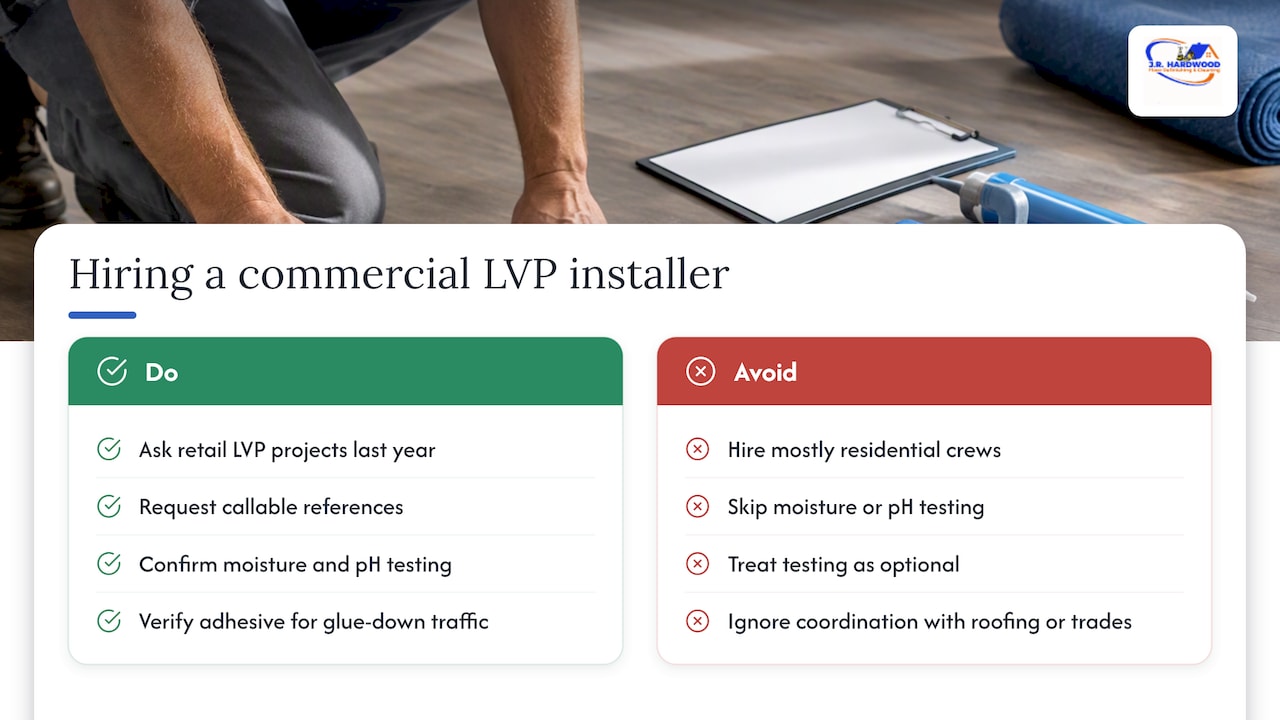
Ask directly how many retail or commercial LVP projects an installer has completed in the past year, and request references you can actually call. A crew experienced primarily in residential installs may not be familiar with the moisture-testing documentation, adhesive selection for high-traffic glue-down applications, or scheduling realities (like working around other trades or a tight reopening deadline) that commercial retail jobs demand.
A practitioner-level breakdown of ASTM standards for installers makes the point plainly: moisture and pH testing along with proper substrate prep are the most critical pre-installation steps, and skipping them is a leading cause of warranty denial and premature floor failure. An installer who cannot explain their moisture-testing process in detail, or who treats it as optional, is a red flag worth taking seriously.
Also ask what happens if other contractors are still working on-site, flooring, roofing, electrical, or otherwise, during your installation window. Dust, debris, or water intrusion from ongoing construction can damage a freshly installed floor before it even opens to customers, so sequencing matters. If your buildout involves roofing work alongside flooring, coordinating timelines with a contractor experienced in commercial roofing and warranty-aware repair work can help avoid water intrusion issues that end up on your new floor instead of staying on the roof.
A field perspective on specifying LVP for retail
When we quote LVP installations over the phone, the photos and verbal details owners send us tell us almost everything we need to know before we ever set foot on-site: subfloor type, visible moisture staining, existing flooring being removed, and traffic patterns through the space.
On-site, the real work starts with acclimation time and HVAC conditions, not the install itself. We have seen costly mistakes come from skipping moisture testing or rushing a glue-down job before a space reached stable temperature and humidity, problems that show up as bubbling or seam gaps months later, long after the crew has moved on.
— J.R.
Get LVP installed right the first time
Specifying the right wear layer and demanding proper moisture testing only pays off if the installation itself is done correctly, and that is where we come in. We handle LVP and laminate installation for commercial and residential clients with attention to subfloor prep and manufacturer adhesive specs covered throughout this guide.

- We offer free over-the-phone quotes based on photos and a description of your space, so you get a number before committing to a site visit.
- Our team handles subfloor moisture checks and adhesive selection as part of every commercial LVP job.
- We serve retail, office, and residential clients in Colorado.
If you have a retail buildout or renovation on the calendar, reach out through our LVP and laminate installation page to get a quote started.
FAQ
What is the best vinyl plank flooring for commercial use?
The best choice is a rigid-core or glue-down LVP with a wear layer of at least 20 mil, and ideally 30 mil or higher for high-traffic corridors, backed by a manufacturer’s commercial-grade construction specs. Confirm the specific product carries a commercial rating and request its coefficient-of-friction test data before ordering.
What is the best flooring for commercial retail spaces?
There is no single best option. LVP offers a strong balance of cost, comfort, and water resistance for most sales floors, while ceramic tile suits extremely heavy-duty zones and carpet fits spaces that prioritize sound and warmth over durability. The right choice depends on your traffic volume, budget, and maintenance capacity.
What is the going rate for LVP?
Installation pricing varies by region, product grade, and subfloor condition, so the most reliable number comes from a quote based on your specific space. We provide free over-the-phone quotes based on photos and project details for LVP and laminate installation.
Which flooring is best for commercial use?
For most retail and office environments, commercial-grade LVP with a thick wear layer and proper moisture-tested installation performs well across durability, comfort, and cost. Spaces with extreme heat, heavy equipment, or constant wet conditions may be better served by ceramic tile or another hard surface instead.
How long does LVP last in a high-traffic retail store?
Service life depends heavily on wear-layer thickness, traffic volume, and maintenance rather than a fixed timeline, with lifecycle studies showing wide variation across resilient flooring products. A well-specified commercial product with a proper maintenance routine will consistently outlast a thin, residential-grade plank in the same space.
Sources
- Division 9 – Resilient Flooring specification (University of Arizona)
- Interface LVT installation instructions
- Finish Floor System Analysis (Penn State thesis)
- CPSC briefing package on slip-resistance labeling petition