 Skip to content

Finish type sets the count: plan on about two to three coats for oil-based polyurethane, three to four for water-based, and one to two for a screen and recoat over a sound existing finish, always checked against the product data sheet. Why, then, can floors with the same number of coats perform so differently?
For Parker hardwood floor refinishing, the answer comes down to chemistry, film thickness, floor condition, and room use. Whether you're updating an oak floor near downtown Parker or comparing a UV-Cure System with traditional finishes for a Denver rental, counting applications is only the starting point.
Coat Counts by Finish Type for Parker Hardwood Floor Refinishing
The finish type sets the coat count, not a universal rule. Before comparing estimates, identify whether each contractor is quoting bare-wood refinishing or maintenance over an existing protective film.
A historical industry statement attributed to the National Wood Flooring Association in i+s's American hardwoods overview gives baselines of two coats for moisture-cured urethane, three for oil-based urethane, and four for water-based urethane. Those are useful reference points, not permission to override a current technical sheet.
Coat count by finish type and project
| Finish or project | Typical coat count | Why this count |
|---|---|---|
| Moisture-cured urethane, fully sanded | 2 | Historical industry baseline |
| Oil-based polyurethane, fully sanded | 2–3 | Older bare-wood practice used three; the documented two-coat commercial example is over screened finish |
| Water-based polyurethane, fully sanded | 3–4 | Historical baseline of four; an approved sealer plus two topcoats totals three applications |
| Screen and recoat over sound existing finish | 1–2 | Routine renewal versus heavier use, where the product permits |
| Water-based UV-cure finish, fully sanded | Manufacturer-specified system | Installer follows the approved build and UV-lamp curing procedure |
For modern waterborne work, Bona's Mega application guidance describes one primer coat plus two finish coats. That distinction matters: a quote for three applications may include a sealer rather than three polyurethane topcoats.
Read the table by project condition first, chemistry second. Don't use a screened-floor specification to justify reduced protection on freshly sanded wood.
Check the container label or installation record, then compare the approved system with our guide to the best polyurethane for hardwood floors. For Parker hardwood floor refinishing with a UV-Cure System, request the actual product specification rather than assuming lamp curing changes the required build.
Why Film Thickness Matters More Than Coat Count
Polyurethane works much like paint on a wall: each application adds material, but uneven coverage leaves uneven protection. The cured film matters more than the number of passes.
An even application starts with controlled spreading, not pouring more finish onto the floor.
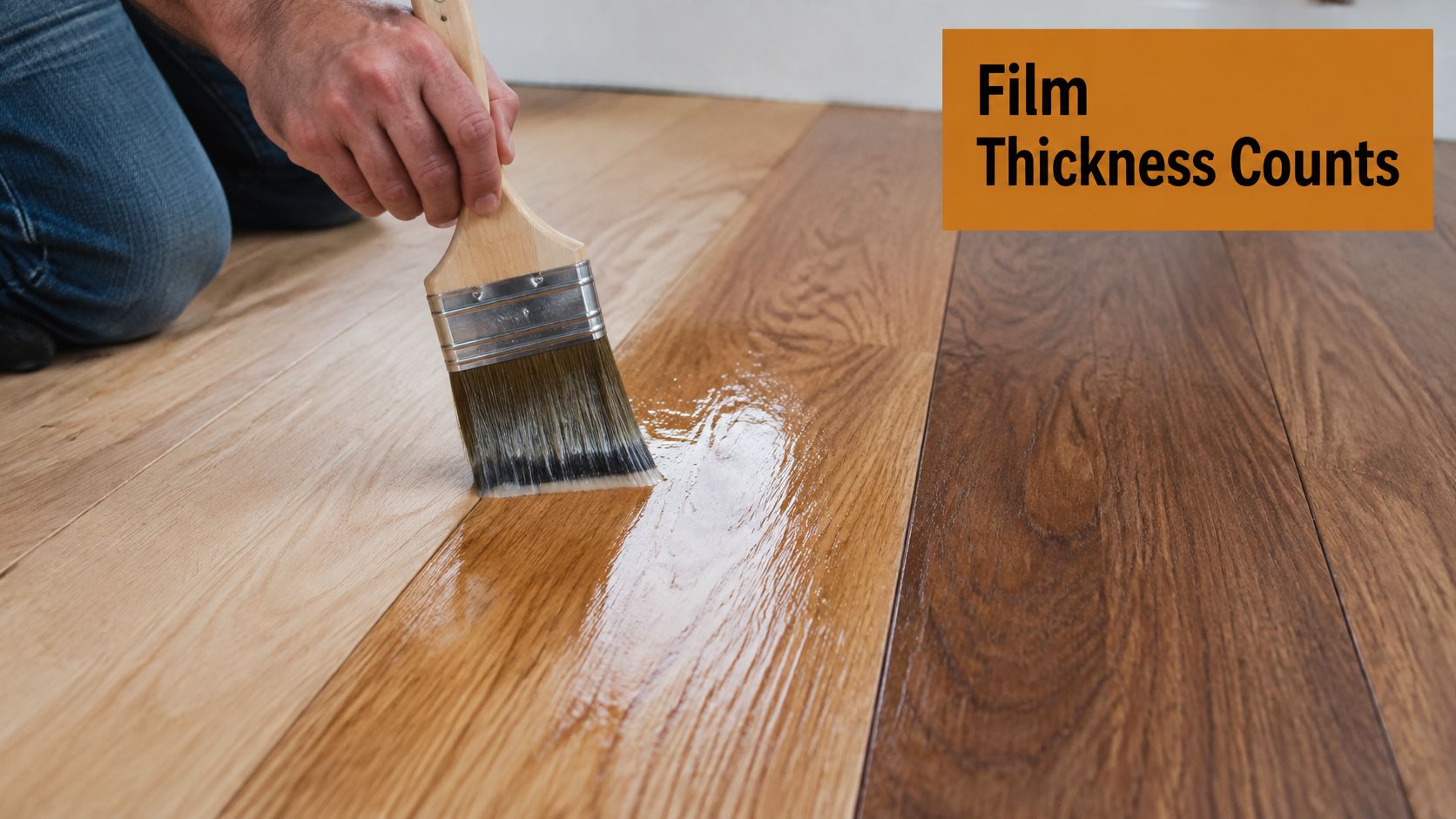
The Benjamin Moore 350 VOC Polyurethane Wood Finish technical sheet specifies 1.5–2.0 dry mils per application, from a 3–4 mil wet film. At that specified thickness, three coats nominally produce 4.5–6.0 dry mils, assuming uniform coverage and no sanding loss.
That arithmetic explains why a thin application isn't automatically equivalent to a properly spread coat. Stretching the finish across too much flooring reduces the material left behind.
Build an even film, not a thick puddle
Freshly sanded wood absorbs finish differently from an already sealed surface. A compatible sealer helps control absorption so subsequent applications can build evenly.
Too little material can leave inadequate protection. Too much can produce ridges, slow drying, or trap solvent when the next layer goes on prematurely.
Practical rule: Ask what product, spread rate, and cured film the estimate includes, not just how many coats you're buying.
Watch the application process with attention to how the installer maintains even coverage.
Check the technical sheet for application thickness and the recoat window before setting the final count. A correctly built system is the goal, not the greatest possible accumulation of finish.
Durability Versus Sheen and Coat Count by Room
Sheen and durability are separate decisions. Choose matte, satin, semi-gloss, or high-gloss for appearance, then specify a finish system suitable for the wear.
Matte and satin generally make dust and fine scratches less conspicuous. Gloss reflects more light across the surface, making sanding marks, debris, and application flaws easier to notice.
Match protection to actual use
- Kitchens and entryways: Choose the manufacturer-approved heavier-use specification. Grit, spills, and repeated cleaning matter more than whether the room looks busy.
- Bedrooms and living rooms: A sound existing film may need only routine renewal. Don't treat a lightly worn bedroom as bare wood because its shine has faded.
- Commercial spaces: Follow the written maintenance specification and reopening schedule rather than borrowing a residential rule.
A Massachusetts College of Liberal Arts gymnasium specification calls for 150-grit screening followed by two coats of commercial-grade oil-based polyurethane. That's a documented maintenance system, not evidence that the same treatment suits every fully sanded floor.
For a rental turnover or home sale, identify what the next occupants need. A glossy finish won't compensate for weak adhesion, and adding material won't make a floor scratch-proof.
Choose sheen for the look you want. Choose the protective system for the traffic you expect.
How to Prep an Existing Finish Before Recoating
A new coat must bond to the existing film. If that surface is contaminated or failing, extra polyurethane adds another layer that can detach.
Bona's recoat guidance describes an adhesion-promoting preparation system and abrasion with approximately 240-grit diamond discs. Follow the sequence for the exact products being used, because adhesion treatments aren't interchangeable.
This preparation overview shows the essential checkpoints.
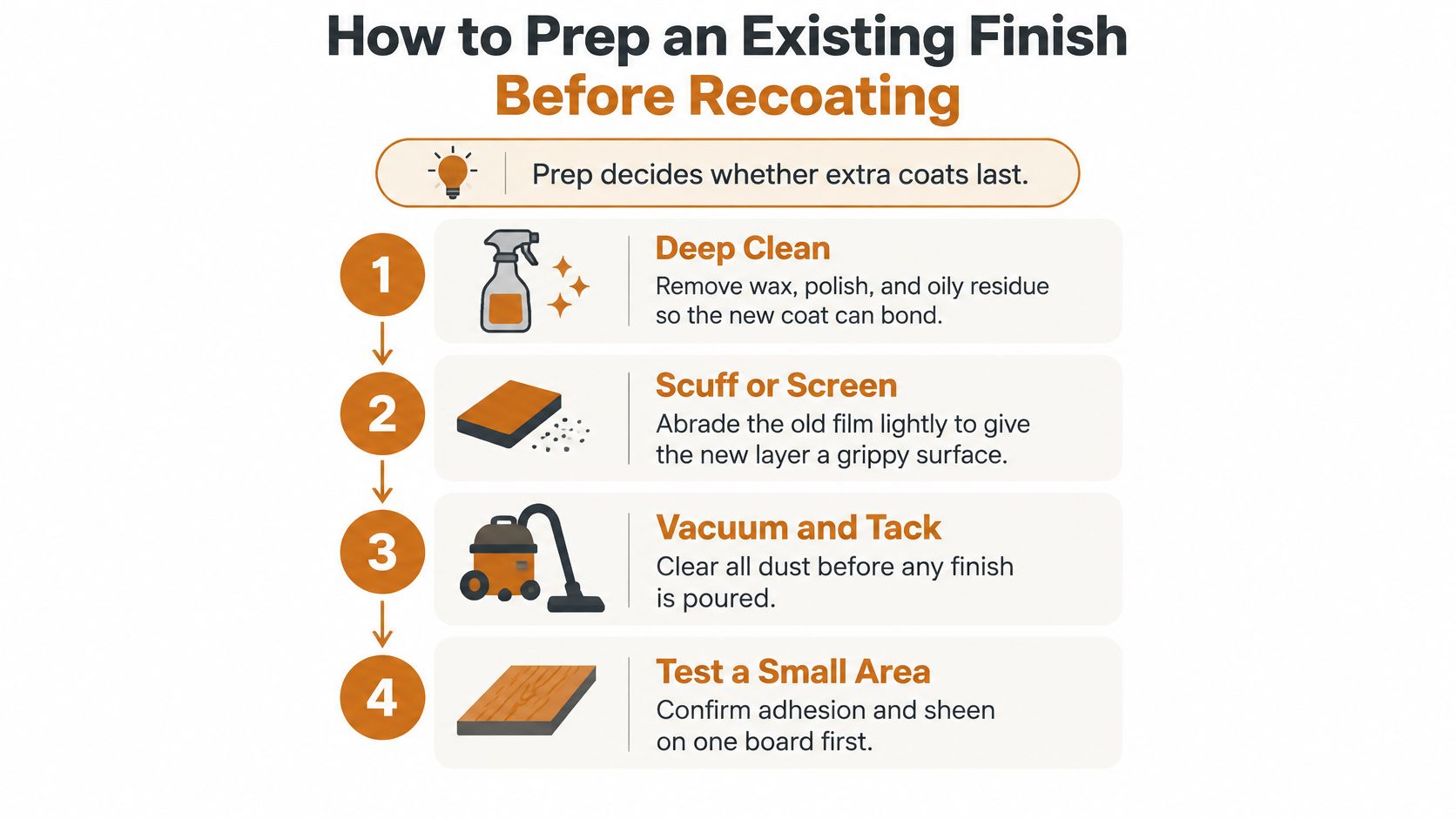
A reliable preparation sequence
Deep clean and remove contaminants. Clear dirt, wax, polish, and oily residue with a compatible cleaning system. The common mistake is assuming a floor is ready because it looks clean.
Inspect the existing finish. Look for exposed wood, peeling, deep scratches, and board movement. Coating over those problems won't repair the substrate or stabilize loose flooring.
Use the specified adhesion treatment and abrasion sequence. Some systems require treatment before abrasion, not afterward. Screen uniformly without cutting through the protective film, and check edges where glossy patches are easily missed.
Vacuum and wipe carefully. Use a clean vacuum attachment, then a finish-compatible tack method or microfiber cloth. A waxy tack cloth can reintroduce the contamination you just removed.
Test compatibility on an inconspicuous board. Check appearance and adhesion using the coating manufacturer's procedure. Don't judge success solely by how attractive the wet patch looks.
Apply an even coat with the grain. Maintain a wet edge and avoid pooling beside baseboards. Heavy perimeter buildup often dries differently from the main field.
Respect the recoat window. Abrade between applications when the system requires it, then remove the resulting dust. Don't use surface dryness alone as permission to continue.
Know when a recoat is the wrong repair
Avoid soaking the floor or using harsh chemicals. We recommend controlled moisture during cleaning because excessive water and aggressive cleaners can damage wood.
For a separate garage or utility-floor project, Painters North Shore's explanation of how long epoxy coatings last offers useful context on coating maintenance, but epoxy preparation isn't a hardwood recoat specification.
A suitable floor should look uniformly dull under low-angle light, without contamination or loose finish. Our screen-and-recoat explanation helps distinguish surface renewal from deeper restoration.
Drying Times Between Coats and Before Walking on Floors
Dry to the touch isn't fully cured. A floor that feels hard under a fingertip can still be soft enough underneath for a second coat to wrinkle, or for a sock-clad step to print into the film. Treat recoating, walking, and returning rugs or heavy furniture as three separate milestones, each with its own clock.
The recoat window tells the installer when the next layer can go on. Light-traffic approval allows limited, shoe-free access. Full cure is the later point where the coating has developed its intended hardness and chemical resistance, which is why rugs and heavy furniture wait longest.
Recoat window and foot traffic timing by finish
| Finish | Recoat window | Light foot traffic | Full cure |
|---|---|---|---|
| Benjamin Moore 350 VOC polyurethane | Overnight | 24–48 hours | 30 days |
| Bona waterborne system | 2–3 hours | About 8 hours | About 7 days |
| Oil-based polyurethane | At least 12 hours, potentially 24–48 hours | 24–48 hours | About 30 days |
| UV-cure water-based finish | Cured instantly under specialized UV lamps between passes | Same day | Immediate once lamp curing is complete |
For any finish not listed above, the product's own label sets the recoat, occupancy, and full-cure times. The timing distinctions in Varathane floor-finish technical guidance show why a short recoat interval from one formulation never transfers to another.
Oil-finish drying runs at least 12 hours and can stretch to 24–48 hours depending on conditions, according to Southern West Virginia polyurethane-curing guidance, which also identifies 40%–60% relative humidity as an optimal curing range.
Colorado's dry air can make touch testing misleading. Maintain stable indoor conditions and record the application time, rather than deciding the floor is ready because its surface no longer feels wet.
Use our polyurethane cure-time guide when planning access. Put separate dates on the calendar for walking, moving furniture, and returning rugs.
UV-Cure System Versus Traditional Polyurethane Coats
Both systems can deliver a durable floor. The decision sits in downtime, product suitability, and how the household uses the room, because the right method follows finish chemistry, floor condition, and room use rather than a universal answer.
Traditional finishes harden through a specified drying and chemical-curing process between coats. A UV-cure system pairs a compatible water-based coating, formulated specifically for hardwood floors, with specialized lamps that harden the film instantly. For qualifying floors, J.R. Hardwood Floor Refinishing & Cleaning offers refinishing through a one-day sandless refinishing and UV-cure system.
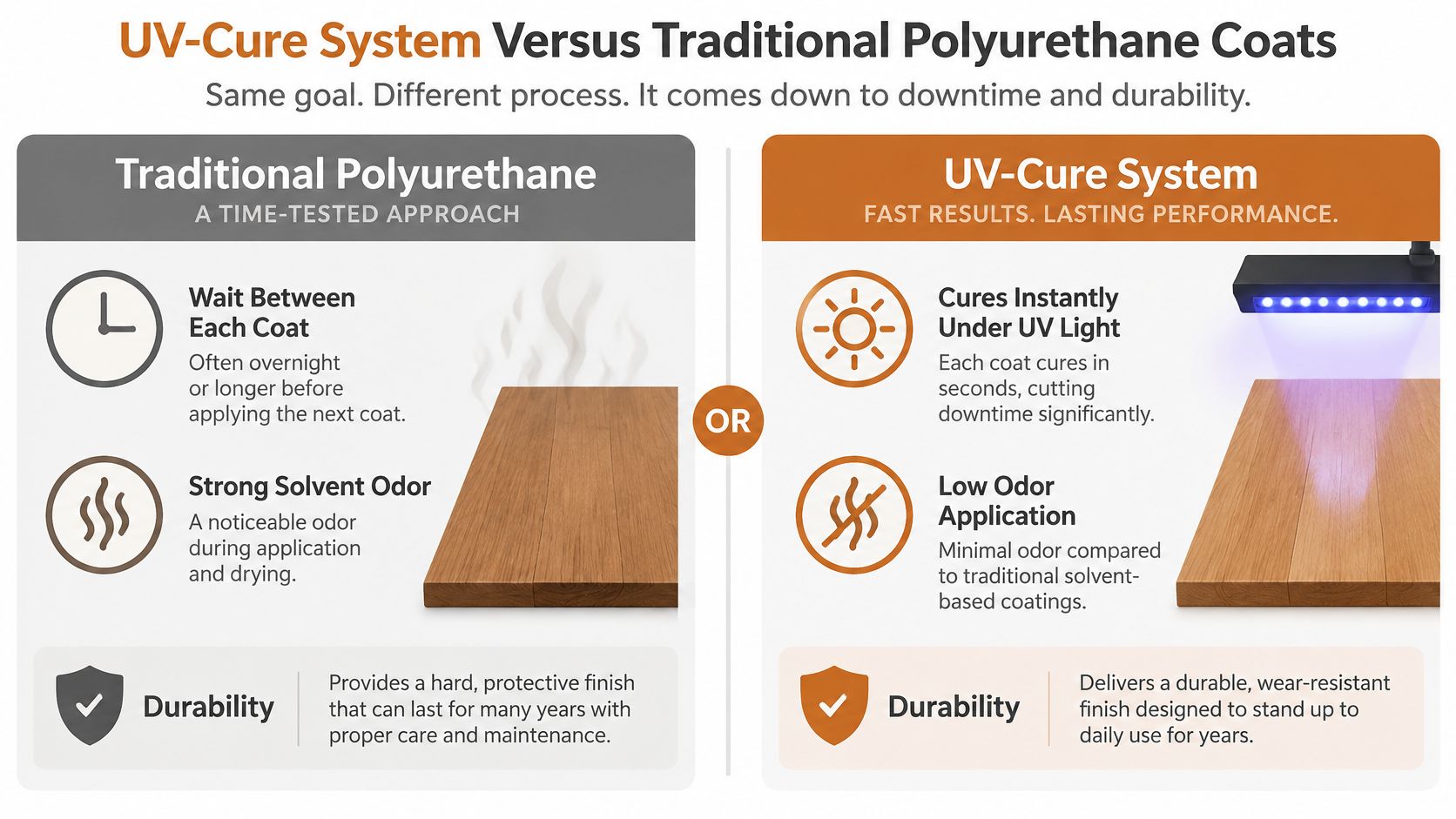
Traditional polyurethane vs UV-cure system
| Factor | Traditional polyurethane | UV-cure system |
|---|---|---|
| Curing between passes | Evaporation and chemical hardening; some systems require overnight drying | Specialized UV-lamp exposure cures the coating instantly |
| Coat count | Set by finish chemistry and approved build | Set by the approved UV system |
| Odor | Solvent-based products can have strong odor; waterborne options differ | Water-based finish designed specifically for hardwood floors |
| Time out of use | Conventional cure schedules can restrict use for days | Instant hardening under lamps shortens the wait before the installer releases the floor |
| Sheen choice | Broad selection of sheens | Select from the compatible product's available sheens |
| Best fit | Specified products or matching an existing system | Busy homes and tight turnaround schedules |
A wood-coating study involving oak reported approximately 22 minutes for a UV-curing polyurethane-acrylate, versus more than 35 minutes for its comparison water-based coatings. Lab speed shows relative curing performance; your actual return to the room still follows the installer's schedule and the product's instructions.
What the household decision looks like
A household restoring a red oak floor in Denver with flexible accommodation can comfortably follow a conventional curing schedule. An oak floor in Parker that serves as the family's main route through the house puts more weight on faster return to use. When a floor qualifies for either route, I weigh traffic and downtime heavier than the coating itself.
Completed projects can be reviewed through our project videos.
Neither method removes the need for preparation or makes wood immune to scratches. UV curing suits a compressed timeline; traditional coatings remain the right call where a specified product or an existing system controls the choice.
Problems from Too Few or Too Many Coats
More coats aren't automatically more protection. If the floor looks worse after another application, stop and diagnose the problem.
An underbuilt film may wear prematurely. An overapplied or poorly bonded film can stay soft, develop unevenness, or detach.
Coating problems, causes and fixes
| Symptom | Likely cause | Fix |
|---|---|---|
| Tacky or soft finish after a week | Recoating before adequate drying, excessive build, or unsuitable humidity | Stop coating, stabilize conditions, and obtain product-specific recovery instructions |
| New coat peeling or lifting | Wax, polish, incompatibility, or inadequate abrasion | Remove unsound material, clean, test adhesion, and prepare correctly |
| Cloudy or milky haze | Moisture or cold during curing | Correct conditions and follow the product's haze-removal procedure |
| Visible ridges or uneven sheen | Heavy applications, uneven spreading, or skipped intercoat preparation | Let the film harden, then level and recoat as permitted |
| Scratches or dark spots still visible | Damage extends into wood or the existing finish is failing | Assess full sanding, stain treatment, or board repair |
Don't try to bury a defect under another wet layer. A peeling surface needs adhesion work; a deep dent needs a wood repair decision.
Stop-work checkpoint: Identify whether the defect is in the new coating, the old coating, or the wood before choosing the repair.
Refinishing preserves usable flooring when sufficient wood remains. Replacement or new floor installation makes more sense where boards are structurally damaged, severely compromised, or unsuitable for further sanding.
For ongoing maintenance, remove abrasive grit, use furniture pads, and clean with a finish-compatible product. Those habits protect the coating without adding unnecessary material.
Confirm Your Coat Count Before Parker Hardwood Floor Refinishing with a UV-Cure System
Coat count follows finish chemistry, film build, floor condition, and room use, so the right schedule for your floor may differ from a generic number quoted online. Before approving Parker hardwood floor refinishing with a UV-Cure System, settle these decisions:
- Identify the finish. Get the product name, approved coat schedule, and written return-to-use instructions.
- Check the damage depth. Finish-only wear may suit Screen and Recoat; exposed wood or deeper damage may require full sanding and refinishing.
- Plan household access. Compare conventional curing with Instant UV-Curable Finish before arranging furniture storage.
The ONE-DAY SANDLESS REFINISHING & UV-CURE SYSTEM is an option for suitable floors. Screen and recoat typically takes about 6-8 hours, with floors ready to walk on the same day, and the recoat protective layer can last 3-5 years depending on lifestyle and traffic. That matters most in rooms where a conventional cure window would keep furniture out for days. For floors showing wear that has not reached the wood, I would quote screen and recoat first and reserve full sanding for damage a recoat cannot cover.
The service list also covers dust-free sanding, deep cleaning, wax removal, and floor installation, so the treatment can match the floor's actual condition.
Contact our Parker team with photos and your target completion date, and review the YouTube project videos to see finished work on floors like yours.
📞 Phone: 720-327-1127
🌐 Website: jrhardwoodfloorrefinishingandcleaning.com
📍 Service Area: Parker, Denver, Castle Rock, Littleton, Aurora, Lakewood, Boulder, and Colorado Springs. Coverage is confirmed for each address.
J.R. Hardwood Floor Refinishing & Cleaning offers surface recoating, full sanding, and UV-curable finishing matched to your floor's condition. Visit J.R. Hardwood Floor Refinishing & Cleaning or call 720-327-1127 to discuss the right coat schedule and return-to-use plan for your Parker home.