 Skip to content
That annoying creak you hear isn't just your house settling in for a chat; it’s your floor's way of telling you something is out of place. So, what causes hardwood floors to creak? The short answer is almost always friction. Your beautiful wood planks are constantly expanding, contracting, and shifting with the seasons, rubbing against each other or the subfloor below. For homeowners in Parker, understanding this is the first step toward a quieter home. At J.R. Hardwood Floor Refinishing & Cleaning, we specialize in Parker hardwood floor refinishing using our advanced UV-Cure System to diagnose and solve these noisy problems for good.
Understanding the Source of Creaky Floors
Whether you're in a historic bungalow near Mainstreet or a modern build in the Pinery, a creaky floor can really disrupt the peace and quiet of your home. That noise is a clear signal that different parts of your flooring system are moving when they really shouldn't be. Here in the Parker area, this movement usually boils down to a few key issues. Our professional Parker hardwood floor refinishing services, including our instant UV-Cure System, are designed to address these very problems.
The Main Culprits Behind Noisy Floors
More often than not, a creaky floor can be traced back to one of three main sources. Figuring out which one is yours is the first step to silencing that squeak for good.
- Environmental Changes: Colorado's wild seasons are a big one. The dramatic swings in humidity make wood expand in our humid summers and shrink back down in the dry winters. This natural movement is probably the most common reason for boards to start rubbing together and making noise.
- Subfloor and Structural Issues: Sometimes the problem is hiding underneath. If the subfloor has separated from the floor joists or was installed poorly to begin with, it can create a gap. Every time you step on that spot, the floor moves and groans in protest.
- Installation and Age: Shortcuts taken during the initial hardwood floor installation—like not using enough nails or forgetting to leave proper expansion gaps around the edges—almost always lead to problems later on. As floors age, fasteners can loosen and old adhesives can fail, introducing brand new squeaks.
A creaky floor is more than just a nuisance; it's a symptom of movement. Pinpointing whether that movement is from the surface boards, the subfloor, or the home's structure is the first step toward a quiet, stable floor.
At J.R. Hardwood Floor Refinishing & Cleaning, we're experts at diagnosing the true source of floor noise. Our professional Parker hardwood floor refinishing and advanced UV-Cure System don't just restore your floor's beauty; they can also tighten up the surface and solve some of those friction-related creaks. Similar issues can also pop up when moisture is involved, which can lead to other headaches. You might find it helpful to learn about what causes hardwood floors to buckle.
How Colorado's Climate Affects Your Parker Floors
Here in the Parker area, if your floors have started talking, there's one culprit that's almost always to blame: our dramatic seasonal climate shifts. Think of a wood plank like a sponge. It's a natural, porous material that literally breathes, absorbing and releasing moisture from the air around it. That simple fact is why our local weather plays such a huge role in creaky floors. Our expertise in Parker hardwood floor refinishing and our specialized UV-Cure System help combat these effects.
During our notoriously dry Colorado winters, our heating systems are working overtime, sucking moisture out of everything—including your floors. As the wood loses that moisture, each plank shrinks just a tiny bit. This contraction can create microscopic gaps between boards or loosen their grip on the subfloor, leading to that tell-tale squeak every time you walk across them.
Then, summer rolls in. The opposite happens. Humidity spikes, especially during our afternoon storms, and your "sponge-like" floors soak up all that extra moisture from the air. This causes the wood to swell, pushing the planks tightly against each other. All that pressure creates friction, which is the source of those loud, persistent creaks you hear all season long.
The Science of Swelling and Shrinking
This constant cycle of expansion and contraction isn't just a small annoyance; it's a measurable scientific process. Seasonal humidity swings are the primary driver behind creaking floors, forcing wood to expand and contract. In a place like the Parker Metro Area, where indoor winter humidity can plummet to 20-30% from heating, and summers can bring it up to 50-60%, your hardwood can actually swell or shrink by 0.2-0.5% in width each year.
That movement forces boards to rub against each other, generating noise. In fact, experts note that over 60% of hardwood floor creaks in variable climates like ours stem directly from this humidity cycle, not from bad installation. You can learn more about how humidity affects hardwood floors on HardwoodInfo.com.
A Professional Solution for a Stable Floor
While you can't change the weather, you can definitely protect your floors from it. Our professional Parker hardwood floor refinishing is specifically designed to create a more stable, resilient surface that can better handle these seasonal changes.
A high-quality finish does more than just add shine. It acts as a protective barrier, slowing down the rate at which your floors absorb and release moisture. This helps minimize the extreme swelling and shrinking that cause all that noise.
Our advanced UV-Cure System, for instance, creates an incredibly durable, non-porous seal right over your hardwood. Unlike traditional finishes that can take days to fully harden, our UV finish cures instantly. It forms a tough, unified layer that helps lock the edges of the boards together and dramatically reduces their movement. It's one of the most effective modern solutions for silencing your floors for good. To see how this process can completely change your space, you should learn more about how to restore old hardwood floors.
Diagnosing Subfloor And Structural Issues
When your floors start to sing—or, more accurately, creak and groan—it’s natural to blame the beautiful wood planks you walk on every day. But sometimes, the real culprit isn't the floorboards at all. The problem often lies deeper, in the hidden structure beneath. Our Parker hardwood floor refinishing team, using our UV-Cure System, can help identify these issues.
Think of your floor as a complete system, from the joists in the basement all the way up to the finish you see. For a quiet, solid floor, every single part has to work together perfectly. Learning to tell the difference between a simple board-on-board squeak and a deeper subfloor issue is the key to finding a fix that actually lasts.
This flowchart is a great starting point, especially for us here in Colorado, because it shows how our dramatic seasons can be the first clue.
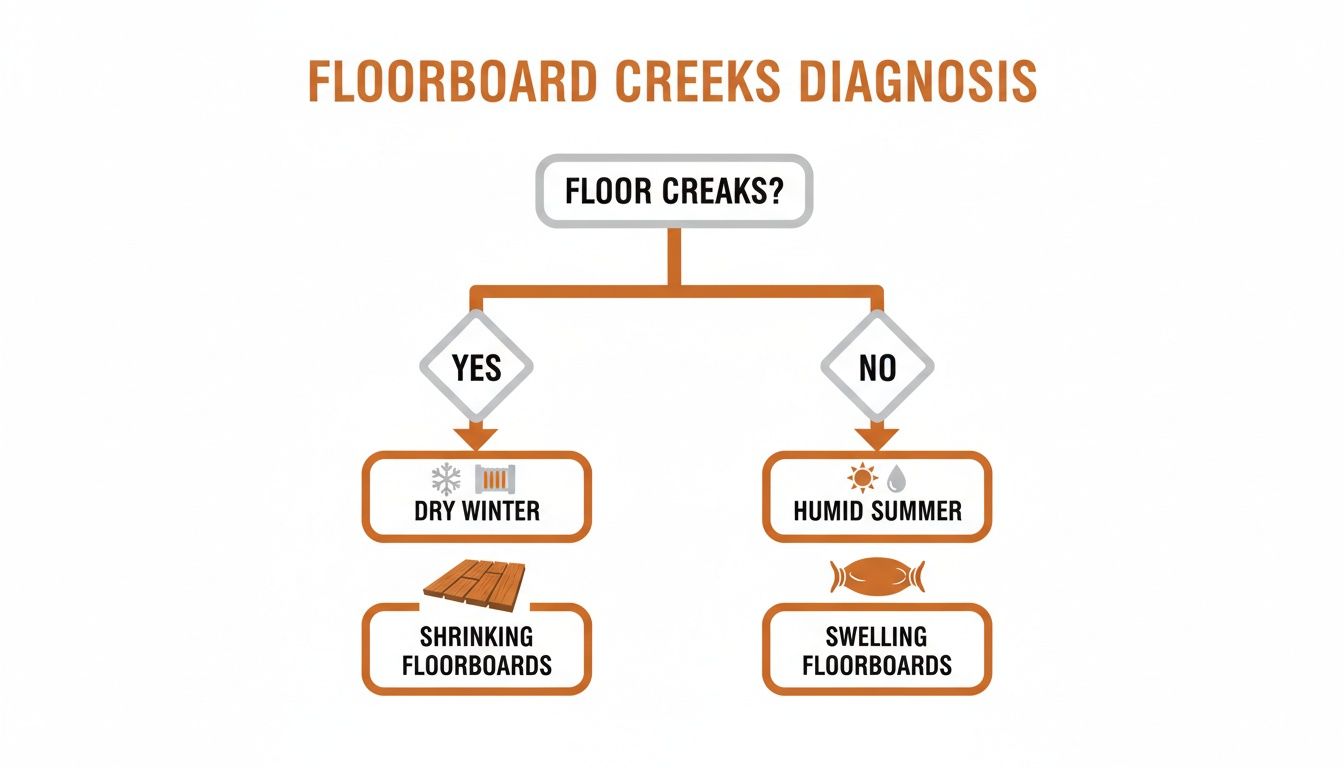
As you can see, our bone-dry winters and more humid summers make wood expand and contract. This movement is a primary cause of noisy floors. If controlling the humidity in your home doesn't quiet things down, it’s time to look at the structure itself.
Common Culprits Hiding Under Your Floorboards
Right below your hardwood is the subfloor, usually a layer of plywood or oriented strand board (OSB) that acts as the foundation. When this layer has problems, you’ll hear about it with every step.
Here are the usual suspects:
- Loose Subfloor Panels: Over the years, the glue holding the subfloor to the joists can dry out and fail. The nails or screws can also work their way loose. This creates a tiny gap, and when you step on that spot, the subfloor moves and rubs against the joist or fastener, making that classic squeak.
- "Shiners": This is a surprisingly common installation mistake. It happens when a nail or staple is driven through the subfloor but completely misses the joist below. Instead of securing anything, it just hangs there in the empty space, allowing the subfloor to rock back and forth and make a racket.
- Uneven Joists: In a perfect world, all the floor joists that support your subfloor would be perfectly level. But if they're not, the subfloor won't lie flat, creating high spots and gaps. As the house settles and you walk around, this unevenness causes movement and, you guessed it, more creaks.
Believe it or not, improper subfloor prep is behind a staggering 40% of all hardwood floor creaks. Things like "shiners" are found in about 15% of new homes, and when subfloors are installed too tightly without room to expand, they can buckle and loosen fasteners in 25-35% of cases.
To help you get a better handle on what might be going on, here’s a quick guide to playing detective with your floor noises.
Diagnosing Your Floor Creaks A Homeowners Guide
This table can help you pinpoint the likely source of the noise based on what you're hearing and seeing, and what your next step should be.
| Symptom | Potential Cause | Recommended Action |
|---|---|---|
| A single, sharp "tick" or "pop" in one specific spot | A nail has worked loose from the subfloor ("nail pop"). | DIY Fix: Try using a screw-based floor repair kit to re-secure the board or subfloor from above. |
| A long, groaning creak over a wider area | The subfloor panel is loose and rubbing against a floor joist. | Professional Help: This usually requires access from below to re-glue and screw the subfloor to the joist. |
| Squeaking is widespread and changes with the seasons | Humidity fluctuations causing wood to expand and contract. | DIY Fix: Use a whole-home humidifier in winter and a dehumidifier in summer to maintain 35-55% relative humidity. |
| A loud, hollow "thump" followed by a squeak | A gap between the subfloor and the floor joist is closing. | Professional Help: Shims may need to be inserted from below, or the subfloor may need to be re-secured. |
| The noise is near a wall or corner | The flooring is too tight against the wall (no expansion gap). | Professional Help: A pro may need to trim the flooring and reinstall the baseboard to create the necessary expansion gap. |
This isn't an exhaustive list, of course, but it covers the most common issues we see. If your noise doesn't fit neatly into one of these categories, it's a good sign that a professional diagnosis is in order.
When To Call The Pros
If you've tried the simple fixes and suspect the problem runs deeper than your floorboards, it's time to bring in a professional. For homeowners here in Parker and across the Denver metro, getting an accurate diagnosis from the start will save you a ton of time, money, and frustration down the road.
While our Parker hardwood floor refinishing and advanced UV-Cure System can often solve surface-level creaks caused by a worn-out finish, a compromised subfloor needs a different kind of attention. It’s something we can spot right away during an assessment. Getting the installation right from the beginning is the best prevention, and you can learn more about what that entails in our guide to professional hardwood floor installation.
The Impact of Installation and Aging
Believe it or not, the story of your creaky floors often begins the day your home was built. Shortcuts during the initial installation, combined with the simple, unavoidable effects of time, can turn a once-silent floor into a symphony of squeaks. To get to the bottom of the noise, you have to understand both how your floor was put together and how it has aged. Our Parker hardwood floor refinishing process considers these factors, and our UV-Cure System provides a modern solution.
A huge—and often hidden—problem comes down to the materials used during construction. In the rush to build, especially in fast-growing Parker suburbs, it's not uncommon for contractors to use lumber that hasn't been properly dried. In fact, one of the leading causes of creaky floors is using "green" lumber with a moisture content over 19%. Once that wood is sealed up inside a finished home, it dries out, shrinks, and pulls away. That shrinkage creates tiny gaps between the floorboards, the subfloor, and the joists, which is a perfect recipe for movement and noise.
How Time Takes Its Toll on Older Floors
The aging process itself is a major contributor to noisy floors. Think about the beautiful older homes in neighborhoods like Parker. Their floors have put up with decades of foot traffic, heavy furniture, and Colorado's wild seasonal swings. All that stress gradually weakens the entire system.
Over the years, a few things start to happen:
- Failing Fasteners: The nails or staples that once held everything together rock-solid can work themselves loose after countless cycles of expansion and contraction.
- Degraded Subfloors: Older subfloors, especially those built with individual plank boards instead of modern plywood or OSB, can warp, crack, and lose their ability to hold fasteners tightly.
- Worn-Out Adhesives: The original construction glue that bonded the subfloor to the joists can dry out, become brittle, and eventually break apart, leaving a gap where there used to be a solid connection.
A floor's quiet strength comes from every piece working in harmony. As a home gets older, the connections between the floorboards, subfloor, and joists naturally loosen, making a little friction and noise almost inevitable.
A Comprehensive Approach to Silencing Your Floors
For many homeowners, the fix isn't as simple as hammering in a loose nail. Sometimes, the problem is right on the surface. Our Parker hardwood floor refinishing, which includes a meticulous dust-free sanding process, can solve a lot of creaks by leveling out the planks and creating a solid, unified surface. When we apply our advanced UV-Cure System, it bonds the edges of the boards together, physically restricting the kind of tiny movements that cause all that friction.
But we don't just look at the surface. During our initial consultation, our experts dig deeper to figure out if your creaks are just a minor annoyance or a sign of a more serious structural issue. While refinishing can work wonders, we make sure you have a complete picture of your floor's health. After all, the best defense against future problems is a properly installed floor to begin with. You can learn more about this by reading about what homeowners need to know before installing hardwood floors.
DIY Fixes vs. Professional Floor Solutions
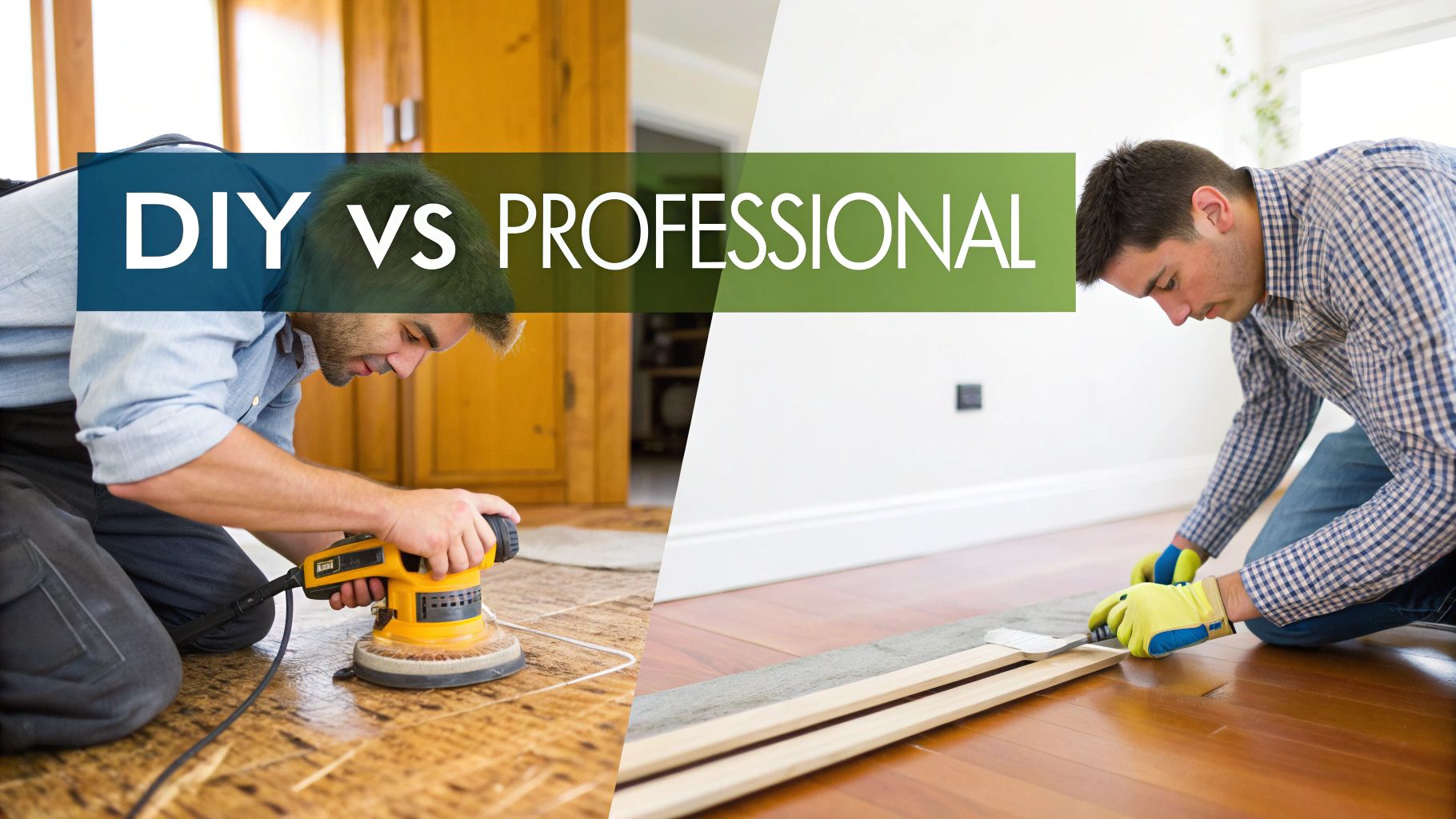
When you’ve got a floor that sings a little tune every time you walk across it, the temptation to find a quick, quiet fix is strong. I get it. For a single, stubborn creak, you might find some temporary relief with a DIY remedy. Some homeowners swear by sprinkling powdered graphite or even talcum powder between the boards to act as a lubricant, while others might try specialized screws to pull a loose board tight against the subfloor. A professional Parker hardwood floor refinishing service with a UV-Cure System offers a more permanent solution.
And sometimes, those little tricks can quiet down a small, isolated noise for a bit. But let's be honest—they're usually just a band-aid. They don’t get to the heart of the matter, which is often a bigger issue like humidity swings, a shifting subfloor, or an original installation that wasn't quite right. Those are the real culprits behind what causes hardwood floors to creak.
The Limits of a Quick Fix
While a bottle of talcum powder is cheap, it almost never provides a permanent solution. Here’s why those quick fixes often fall short:
- They’re cosmetic: Squirting some lubricant in a joint doesn’t stop the wood from moving. It just muffles the sound for a little while, like turning down the volume on a problem instead of fixing it.
- They can be totally ineffective: If the real issue is happening in the subfloor, no amount of powder sprinkled on top is going to make a lick of difference.
- They don’t address the root cause: These methods are all about symptoms, not the actual disease. They do nothing to solve the core problems of moisture imbalance or structural looseness.
For a floor that’s truly solid, stable, and silent, you need a more comprehensive approach. To get a better sense of what’s involved, you can check out our detailed comparison of DIY vs. professional hardwood floor refinishing.
The Professional Difference
When you're dealing with widespread or persistent creaks, it's time to weigh the temporary satisfaction of a quick fix against the lasting peace of a professional solution. Let's break it down.
DIY Creak Fixes vs Professional Refinishing
| Solution | Effectiveness | Cost | Best For |
|---|---|---|---|
| DIY Powder/Lubricant | Low to Moderate. Often a short-term fix that only masks the noise. | Very Low ($10-$20) | A single, minor creak in a low-traffic area. |
| DIY Counter-Snap Screws | Moderate. Can work for an isolated loose board but won't solve systemic issues. | Low ($20-$50) | A specific, identifiable board that has pulled away from the subfloor. |
| Professional Refinishing | High. Addresses root causes by leveling the surface and bonding planks. | Moderate to High | Widespread, persistent creaking and floors that need a full refresh. |
| Professional UV-Cure | Very High. Creates a monolithic surface that virtually eliminates board movement. | High | Homeowners wanting the most durable, long-lasting, and quietest possible floor. |
While a quick DIY fix might seem appealing for its low upfront cost, it's often just kicking the can down the road. For floors with more than just a stray squeak, a professional approach is the only way to get a truly silent, stable surface that lasts.
At J.R. Hardwood Floor Refinishing & Cleaning, we don’t just see our service as a cost—it’s a smart investment in your home’s value and, frankly, your daily sanity. Our Parker hardwood floor refinishing goes way beyond a simple patch job. We're here to deliver a definitive, lasting solution that silences your floors for good.
It all starts with a thorough diagnosis to pinpoint the true source of the noise. From there, our dust-free sanding system creates a perfectly level, unified surface, which gets rid of the unevenness that lets boards rub and squeak against each other.
But the real game-changer is our state-of-the-art UV-Cure System. This advanced finish doesn’t just sit on top of the wood; it chemically bonds the edges of the planks together. This creates a solid, monolithic surface that severely restricts those tiny micro-movements responsible for creaking. It’s hands-down the most effective way to restore peace and quiet to your home.
Your Guide to Preventing Future Creaks
While it’s good to know there are fixes for squeaky floors, the absolute best strategy is to stop them from ever starting. A little proactive care goes a long, long way in keeping your floors quiet and healthy. Think of it as preventative medicine for your home. Our team can advise you on the best practices during your Parker hardwood floor refinishing service, especially when using our UV-Cure System.
For anyone living here in Colorado, the number one enemy of quiet hardwood floors is our wild climate. The constant tug-of-war between bone-dry winters and surprisingly humid summers makes wood expand and contract like crazy. Your best defense? Control your indoor environment.
Getting a whole-home humidifier and dehumidifier to keep your indoor humidity between 35% and 55% all year round is the single most effective thing you can do. Seriously. It stabilizes the wood and stops the movement that causes most creaks before they even begin.
Smart Habits for Silent Floors
Beyond wrestling with humidity levels, a few simple daily habits can make a huge difference. These aren't complicated chores; they're just small adjustments that protect your investment and keep your floors from developing that annoying friction that leads to noise.
Here are a few easy wins:
- Use Furniture Pads: Stick felt pads under the legs of every heavy piece of furniture—your couch, your bed, your bookcases. This simple trick spreads the weight out, preventing the intense, focused pressure that can slowly work floorboards loose.
- Clean Carefully: Ditch the all-purpose cleaners and grab one that’s pH-neutral and made specifically for hardwood. And please, never wet-mop your floors. Even a little standing water can seep between the planks, damaging the wood and the subfloor beneath.
- Listen for Early Warnings: Pay attention to your home. A tiny new squeak that pops up in January might just be the dry winter air at work. But if that squeak sticks around into spring or gets worse, it's a signal to investigate before a small annoyance turns into a bigger headache.
Proactive maintenance is always less disruptive and far cheaper than waiting for a problem to force your hand. A simple professional hardwood clean and buff service, for example, reinforces your floor's protective finish, which is its first line of defense against moisture swings.
Following a proper care routine is essential to keep your floors in prime condition. For a deeper dive, A Homeowner’s Guide on How to Maintain Hardwood Floors is packed with great tips. When you combine these smart habits with occasional professional care, you ensure your beautiful hardwood floors remain a source of pride, not a source of noise.
Frequently Asked Questions About Creaky Floors in Parker
Living here in the Parker area, we hear a lot of the same questions from homeowners who are just plain tired of their noisy floors. We get it! So, we’ve put together some straightforward answers to the questions we hear most often to help you figure out what’s really going on under your feet.
Will Parker hardwood floor refinishing stop the squeaking?
This is a big one, and the answer is: it often helps, sometimes a lot. When the creaks are coming from friction between loose floorboards rubbing against each other, our process can make a world of difference. Our dust-free sanding flattens the entire surface, and our advanced UV-Cure System actually helps bond the edges of the boards together. This drastically limits their ability to move and rub, silencing many of those annoying surface-level squeaks. But—and this is important—if the real problem is deeper down in the subfloor or with the joists, refinishing alone is just a band-aid. That’s exactly why our free consultation for Parker hardwood floor refinishing is so critical. We get to the root of the noise to make sure we’re recommending a fix that will actually last.
Is it normal for brand-new hardwood floors to creak?
You might hear a few quiet sounds as a new floor settles in during the first few weeks, but loud, persistent creaking is a huge red flag. Honestly, it almost always points back to a problem with the installation. The most common culprits are an uneven subfloor, wood that wasn't properly acclimated to our unique Colorado climate, or the wrong fastening methods being used. Acclimation is absolutely non-negotiable here. If your new floors are already making a racket, it’s best to get a professional inspection right away.
Does heavy furniture or my dog make the creaks worse?
Absolutely. Think of a loose floorboard like a seesaw. High foot traffic, the focused weight of a heavy sofa, or an energetic dog running back and forth repeatedly push down on that weak spot. This constant stress amplifies the movement, which in turn makes the creaking louder and more frequent. It's a vicious cycle. This is precisely why we often recommend our premium Diamond Traffic Plus finish paired with the instant UV-Cure System for busy households in places like Parker. That combo offers incredible durability to handle daily life while also helping to lock the floor's surface together and keep things quiet.
Ready for a real solution that quiets your floors and brings back their beauty? Homeowners in Parker trust J.R. Hardwood Floor Refinishing & Cleaning to restore the natural beauty of their hardwood floors with our dust-free sanding system and advanced UV-curable finishes. Unlike traditional methods, our UV technology cures instantly, so you can move furniture back the same day with no lingering odor or downtime. Choose the perfect refinishing service to match your needs and home traffic. Our dust-free process ensures a clean, beautiful finish every time. Get your free quote today!
📞 Phone: 720-327-1127
🌐 Website: jrhardwoodfloorrefinishingandcleaning.com
📍 Service Area: Parker, Lone Tree, Castle Rock, Centennial, Highlands Ranch, and surrounding areas.
📺 YouTube: https://www.youtube.com/channel/UCLaTAi6KxwT-g8QCKqKTQ8Q?sub_confirmation=1