 Skip to content
You can usually walk on refinished floors in stocking feet within 3 to 4 hours, move furniture back without dragging it around 48 hours, and expect full cure within about 7 days for many waterborne finishes. Those windows shift with the product and the room, so the real answer always comes from your contractor and the can.
TL;DR:
- Waterborne, oil based, moisture cure, and ultraviolet cured finishes follow different schedules; confirm the product label and room conditions with your contractor.
- Bona Traffic GO reaches 80% cure at 24 hours and full cure at 3 days, compared with Bona Mega’s full cure at 7 days.
- Moisture cure urethane vapors can reach neighboring apartments; NYC Health advises leaving until the coating hardens, and fading odor alone does not prove safety.
- For the first week, dry mop with microfiber and keep rugs off; lift furniture into place with felt pads, and never drag it.
Table of Contents
- Staged timeline: what “dry,” “walkable,” and “cured” actually mean
- Finish chemistry and job factors that determine drying and curing
- Health, odors, and ventilation: special caution for solvent-heavy finishes
- Practical protection and cleaning while the finish continues to cure
- When to put down rugs, place furniture, and resume heavy use
- Spot repairs vs full refinishing: impact on timing and appearance
- Practical recommendations and services from J.R. Hardwood Floor Refinishing & Cleaning
- J.R.’s perspective: conservative advice from an experienced refinisher
- How we can help: J.R.’s relevant services and next steps
- FAQ
- Sources
Staged timeline: what “dry,” “walkable,” and “cured” actually mean
A freshly coated floor goes through stages, and mixing them up is how beautiful new finishes end up scuffed. “Dry to touch” means the surface no longer feels tacky, but it says nothing about how hard that film has actually become underneath.
“Walkable” is the next stage, and it comes in degrees. Stocking-foot walkable usually arrives first, followed by shoe-walkable, and finally fully cured, which is when the finish has reached its maximum hardness and chemical resistance.
Here is roughly how that unfolds for many residential finishes:
- Stocking feet: often safe after 3 to 4 hours, according to Bona’s homeowner guidance.
- Light foot traffic and furniture placement (no dragging): commonly fine after 48 hours.
- Heavier daily use: many systems recommend waiting 48 to 72 hours before normal household activity resumes in full.
- Full hardness: Bona Mega’s technical data lists 70% cure at 24 hours and 100% cure at 7 days for that product line.
That is the gap that trips people up: the surface stops feeling wet long before the film underneath finishes hardening.
Temperature, humidity, how many coats went down, and which product your refinisher used all push these numbers around. A cold, damp basement room will cure slower than a sunny, well-ventilated living room, which is exactly why the same job can carry different timelines from one house to the next.
Finish chemistry and job factors that determine drying and curing
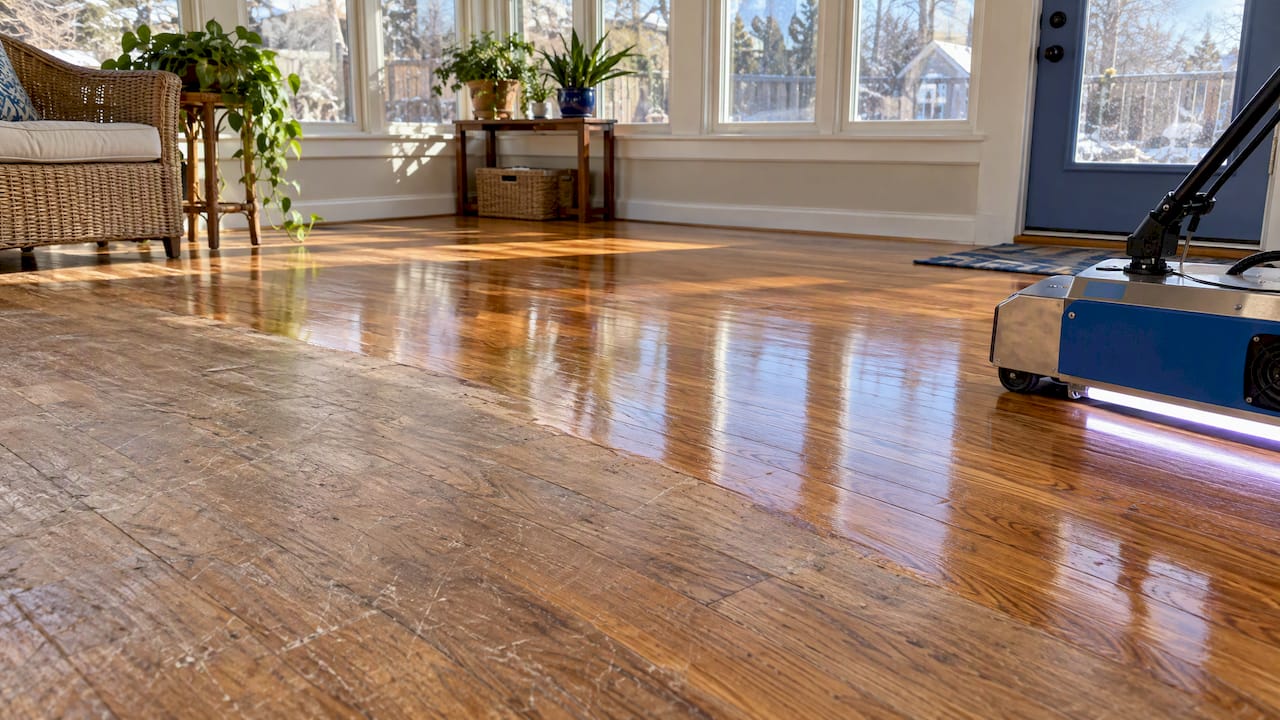
Not all finishes cure the same way, and knowing which one is on your floor changes what you should expect. Waterborne polyurethanes, like many Bona systems, dry through evaporation and are generally low odor, which is part of why they allow relatively fast stocking-foot access. Oil-based polyurethanes cure more slowly and carry more smell. Moisture-cure urethanes (MCUs) react with humidity in the air rather than simply evaporating, which gives them a tough, durable finish but also a stronger odor profile during the process. UV-cured finishes harden almost instantly under ultraviolet light, which is why some jobs allow same-day walking.
Bona Mega’s technical sheet recommends 2 to 3 hours of drying time between coats, with that window stretching in cooler or more humid rooms. A faster-curing option like Bona Traffic GO lists 80% cure at 24 hours and 100% at 3 days, which shows how much variation exists even within one manufacturer’s lineup.
A few practical factors worth asking your contractor about:
- Number of coats and film thickness: more coats mean more total drying time, even if each layer feels dry quickly.
- Room temperature and humidity: a warm, dry room speeds evaporation, while cold or damp air slows it down.
- Ventilation: airflow helps waterborne finishes dry evenly and reduces lingering odor from solvent-based products.
- Product class: waterborne, oil-based, MCU, and UV-cured finishes each follow their own cure math, so the label on the can matters more than general rules of thumb.
Comparing your contractor’s stated timeline to the actual product’s technical data sheet is the single best way to know if you are on track.
Health, odors, and ventilation: special caution for solvent-heavy finishes
Some finishes need more than a cure chart, they need a plan for keeping people safe while the floor hardens. NYC Health guidance on moisture-cure urethanes notes that MCUs release vapors as they cure and recommends leaving the home until the coating fully hardens or the odor subsides, since MCU can take more than 48 hours to finish curing.
An ATSDR/CDC health consultation investigating MCU use in a New York apartment building found that vapors, including compounds like TDI, ethyl benzene, and xylenes, migrated into neighboring units during the curing process. The investigation recommended ventilation and caution around MCU use in multi-family buildings, and it is a useful reminder that smell alone is not a reliable way to judge whether a floor is safe to approach. A finish can still be releasing compounds after the odor has faded, which is why both agencies point back to ventilation and waiting periods rather than your nose.
A few steps help regardless of which finish is on your floor:
- Open windows and run exhaust fans during application and for the first day or two afterward, weather permitting.
- Leave the home during MCU application and plan to stay out until the finish hardens or the smell clears, per NYC Health’s advice.
- Keep children, pregnant occupants, people with respiratory conditions, and pets away from the work area until your contractor confirms it is safe to return.
Pro Tip: Ask your refinisher which finish class they are using before the job starts, so you know in advance whether you need to plan time away from home.
Choosing a certified low or no-VOC product where it fits the job can also reduce indoor exposure, according to PNNL’s guide to low-emission interior finishes, which recommends pairing those products with good ventilation during and after installation.
Practical protection and cleaning while the finish continues to cure
Once your contractor gives the green light to walk, the floor still needs a gentle week before it is ready for normal life. Think of this stretch like the tender period after a good exfoliation: the surface looks great, but it is still a little sensitive underneath.
- Stick to clean socks or stockings, not bare feet or shoes, for the first few days to avoid grit and oils transferring onto the fresh finish.
- Set up walk-off mats at exterior entrances so dirt and small stones never reach the new surface in the first place.
- Keep pets off the floor until claws cannot catch on a still-softening film, and trim nails if that is not realistic right away.
- Avoid high heels and cleats, which concentrate weight into small points and can dent a finish that has not fully hardened.
- Dry mop only, using a microfiber head, for the first week, since wet mopping or aggressive cleaners can interfere with a finish that is still curing, per NWFA’s homeowner handbook.
- Use felt pads under furniture legs and lift, never drag, when you do bring pieces back into the room.
Pro Tip: Slide a sheet of cardboard under heavy furniture legs when repositioning anything in the first two weeks, it spreads the weight and protects the finish while you maneuver.
When to put down rugs, place furniture, and resume heavy use
Furniture and rugs test a freshly finished floor in different ways, so they deserve different timelines. Many manufacturer and installer guidelines allow furniture back in the room within 48 hours, as long as it is lifted into place rather than dragged. Area rugs are a longer wait, commonly around one week per Bona’s homeowner guidance, since rugs can trap residual moisture or solvents against a finish that has not finished hardening.
- Furniture: lift into place after about 48 hours, using felt pads, and avoid dragging even light pieces.
- Area rugs and runners: wait roughly a week so the finish beneath has time to off-gas and harden fully.
- Heavy appliances: give these the longest runway and place protective pads underneath, since concentrated weight is the fastest way to dent a soft finish.
- High-use rooms (kitchens, entryways): test a small area after 48 to 72 hours, then increase use gradually rather than resuming full traffic on day one.
That last point matters more than it sounds. A floor that handles light foot traffic fine on day two might still show marks under a dining chair dragged across it, so easing back in room by room beats declaring the whole house open for business at once.
Spot repairs vs full refinishing: impact on timing and appearance
Not every scuff or worn patch needs a full sand and refinish. Spot refinishing can blend a localized repair into the surrounding floor, and it often comes with its own, shorter timeline since a smaller area means less product and less total dry time.
That said, spot work has real limits. Matching color and sheen to floors that have aged or faded around the repair takes a trained eye, and even a good match can show faint edges under certain light. NWFA’s homeowner handbook recommends consulting a professional to determine whether a spot refinish or a full recoat is the better fit for a given floor’s wear pattern.
- Spot refinishing works best on isolated scratches or wear patterns that have not spread across the whole room.
- Localized recoats may cure on a different schedule than a whole-floor job, so confirm the exact product and timeline with your contractor rather than assuming it matches past experience.
- When in doubt, ask a professional to look at the floor in person. Smaller patches can sometimes be walked on sooner, but they still need their full cure window before heavy use resumes.
If you are weighing whether a touch-up or a complete refinish makes more sense, our comparison of DIY and professional refinishing walks through how to think about that decision.
Practical recommendations and services from J.R. Hardwood Floor Refinishing & Cleaning
We approach re-entry timing the same way every time: we match the finish to the household, not the other way around. For families who cannot plan around a multi-day absence, some finishes are designed for same-day walk-on, which can be the right call for busy households, rental turnovers, or commercial spaces that cannot sit empty. For floors that just need a refresh rather than a full sand, some screen and recoat services can shorten downtime considerably compared to a complete refinish. Eco-friendly, low-VOC waterborne finishes help keep odor and off-gassing concerns to a minimum on jobs suited to those products.
Many refinishing professionals start quotes with a free conversation over the phone, based on a description of your floor and a few photos, so you know your options and realistic timelines before any work begins. Recommendations—including which finish class makes sense—are tailored to your schedule, household, and the condition of the wood itself.
J.R.’s perspective: conservative advice from an experienced refinisher
When a homeowner asks me whether they can push the timeline, my answer is almost always to wait it out. Finishes that look dry on day two are still hardening underneath, and a dent or scuff from early heavy use is far easier to avoid than to fix later. Minor scuffs from stocking feet are rarely a problem. A couch dragged across the room on day one is a different story.
My rule of thumb: when you are unsure, treat the floor as softer than it looks, and call your contractor to confirm before you push past what the label says.
— J.R.
How we can help: J.R.’s relevant services and next steps

If your floors are due for attention and you want a timeline that fits your household rather than a generic guess, we are glad to talk through it. Our full sanding and refinishing service handles floors that need a complete reset, while our Instant UV-curable finish option is built for same-day walk-on when your schedule cannot absorb a long wait. For floors that just need a lighter touch, our screen and recoat and hardwood clean and buff services both offer a faster path back to normal use than a full refinish.
Every project starts with a free over-the-phone quote based on your description and a few photos, so you get a clear timeline and price before committing. Reach out through our hardwood refinishing and cleaning page to schedule a visit or ask about the finish options that fit your home.
FAQ
Is it possible to spot refinish hardwood floors?
Yes, spot refinishing can blend a worn or scratched area into the surrounding floor, and it is a common alternative to a full sand and refinish for isolated wear. Matching color and sheen takes skill, and a professional can confirm whether your floor’s wear pattern is a good candidate, according to NWFA’s homeowner handbook.
How long before you can put furniture on refinished floors?
Many finishes allow furniture back in the room around 48 hours after refinishing, as long as pieces are lifted into place rather than dragged. Always confirm the exact window with your contractor, since it depends on the specific product used.
How should I care for my newly refinished hardwood floor?
Stick to clean socks instead of shoes, use walk-off mats at entrances, and dry mop with a microfiber head rather than wet mopping for the first week, per NWFA guidance. Hold off on area rugs for about a week and use felt pads under furniture once you bring it back in.
What is the difference between a dry floor and a fully cured floor?
A floor that feels dry to the touch has lost its tackiness, but the finish underneath can keep hardening for days afterward. Bona Mega’s technical data lists 70% cure at 24 hours and full cure at 7 days, which shows how much hardening still happens after the surface feels ready.
Do I need to leave my home after floor refinishing?
For moisture-cure urethane finishes, NYC Health recommends leaving the home until the coating fully hardens or the odor subsides, since MCU can take more than 48 hours to cure. Waterborne finishes generally carry much lower odor and rarely require vacating the home, but confirming with your contractor is always the safer move.
Sources
- Bona technical data: Bona Mega (spec/sell sheet)
- Bona — What to expect when sanding and finishing hardwood floors
- NYC Health — Wood floor refinishing and moisture cure urethanes
- ATSDR/CDC — Health Consultation: Airborne exposures to MCU (NY investigation)
- NWFA homeowner handbook