 Skip to content
You walk in after a Colorado weekend, kick off muddy shoes, the dog slides across the hallway, and the afternoon sun hits every scratch in your hardwood. What used to feel warm and classic now looks tired. That’s a common moment in Denver-area homes, whether you live in a Wash Park bungalow, a newer Parker build, or a foothills home that sees plenty of traffic in and out.
That’s where Denver hardwood floor refinishing with a UV- Cure System starts to make sense. A good floor sanding co doesn’t just make floors shiny again. It removes the worn finish, smooths out years of damage, and builds back protection that fits real Colorado life: dry air, pets, ski gear, kids, parties, and constant movement.
Home improvement demand around floors isn’t going away. The global floor sanding tool market was valued at USD 1.2 billion in 2024 and is projected to reach USD 1.8 billion by 2033, with North America holding about 35% share, according to floor sanding tool market data. That lines up with what many Front Range homeowners already know. Restoring existing hardwood is often one of the most practical upgrades you can make.
If you're trying to sort out what your floors need, it also helps to review basic hardwood flooring care tips so you can tell the difference between surface wear and deeper finish failure.
Bringing Your Colorado Hardwood Floors Back to Life
A worn hardwood floor usually tells a story. In Denver, that story might include snow melt by the front door, dog nails in the kitchen, chairs scraping in a busy dining room, and sunlight fading the old finish near south-facing windows. In Boulder and Highlands Ranch, I often hear the same thing from homeowners: “The floor still feels solid. It just looks beat up.”
That distinction matters. If the wood itself is still in good shape, refinishing can bring back the character you already paid for. Old red oak, white oak, maple, and mixed-species floors often have a lot of life left in them. They just need the finish removed, the surface flattened, and a new protective system applied correctly.
What homeowners usually notice first
Some problems are cosmetic. Others are signs the finish has failed and the wood needs more than a quick cleaning.
- Dull traffic lanes: Hallways, kitchens, and entry paths lose sheen first.
- Pet wear: Claw marks tend to show most near doors, food bowls, and favorite nap spots.
- Darkened edges or rough texture: That can mean dirt has worked into a worn finish.
- Old coating buildup: Wax, polish residue, or mismatched touch-ups can make the floor look cloudy.
Floors don’t have to be destroyed to need refinishing. Most just look tired long before they’re structurally worn out.
In neighborhoods with older homes, preserving the original wood often matters as much as improving appearance. A Capitol Hill or Park Hill home can lose part of its feel if original flooring gets covered or replaced unnecessarily. In newer suburban homes, the priority is usually durability. People want a finish that can handle an active household without putting life on pause for days.
Why the right floor sanding co matters
A lot of homeowners still picture sanding as a loud, messy process that fills the house with dust. Modern equipment changed that. Today’s professional refinishing is much more controlled, and the best crews match the sanding method and finish system to the floor’s actual condition.
That’s especially important when you want Denver hardwood floor refinishing with a UV- Cure System. Fast cure times only help if the prep work is right. If the floor isn’t sanded flat and clean, even a premium finish won’t perform the way it should.
The Art of Dust-Free Hardwood Floor Refinishing
It's often thought that sanding means grinding everything down until it looks new. That’s not really the craft. Good refinishing is controlled material removal. You remove the old finish, fix the wear pattern, and create a clean, even wood surface that will accept the next finish properly.
A modern floor sanding co uses dust containment as part of the process, not as an afterthought. The point isn’t just cleanliness. Dust control helps protect indoor air, keeps particles from settling back into the finish, and makes the project easier to live with while work is happening. If you want to see how that service is typically described, this overview of dustless hardwood floor sanding is a useful reference.
What full sanding actually involves
Floor sanding shares similarities with restoring a good wood table, but it's executed on a much larger scale and demands far less room for error. Floors must end up flat across the room, not just smooth to the touch in one spot.
Professional sanding follows a sequence. According to this explanation of the professional sanding process and grit progression, the work typically starts with 36-grit abrasives to cut through deep scratches and wear, moves to 80-grit with planetary sanding to flatten the surface, and ends with 100-120 grit screening for finish adhesion. That NWFA-aligned process can extend floor life by 20-50% in high-traffic areas.
Here’s why each stage matters:
- Coarse cut: Removes old finish, scratches, and minor cupping.
- Intermediate sanding: Refines the scratch pattern and improves flatness.
- Final screening: Prepares the floor so stain or finish bonds evenly.
Skip one step, and the next step can’t fix it. That’s where DIY jobs often go sideways.
Full refinish versus screen and recoat
This confuses a lot of homeowners, and it’s worth clearing up.
A full sanding refinish removes the old finish and addresses deeper wear in the wood itself. A screen and recoat lightly abrades the top finish layer and adds a new coat without sanding down to bare wood. Both are useful, but they solve different problems.
A screen and recoat can work when the finish is just lightly scratched and there’s no exposed bare wood. Full sanding is the right move when you see:
- Gray or dark wear spots
- Deep pet scratches
- Old stain inconsistencies
- Coating buildup from wax or polish
- Uneven board-to-board appearance
Later in the process, seeing the equipment and motion helps many homeowners understand why professional sanding is more precise than it looks.
Practical rule: If the floor color has worn away or the boards feel rough in traffic lanes, you’re usually beyond a simple recoat.
For Denver hardwood floor refinishing with a UV- Cure System, sanding quality is the foundation. The finish can only look as good as the surface underneath it.
Should You Refinish or Replace Your Hardwood Floors
A lot of homeowners ask for replacement when what they really need is a proper refinish. That’s understandable. When a floor looks rough, replacement feels like the cleanest answer. But it often isn’t the smartest one.
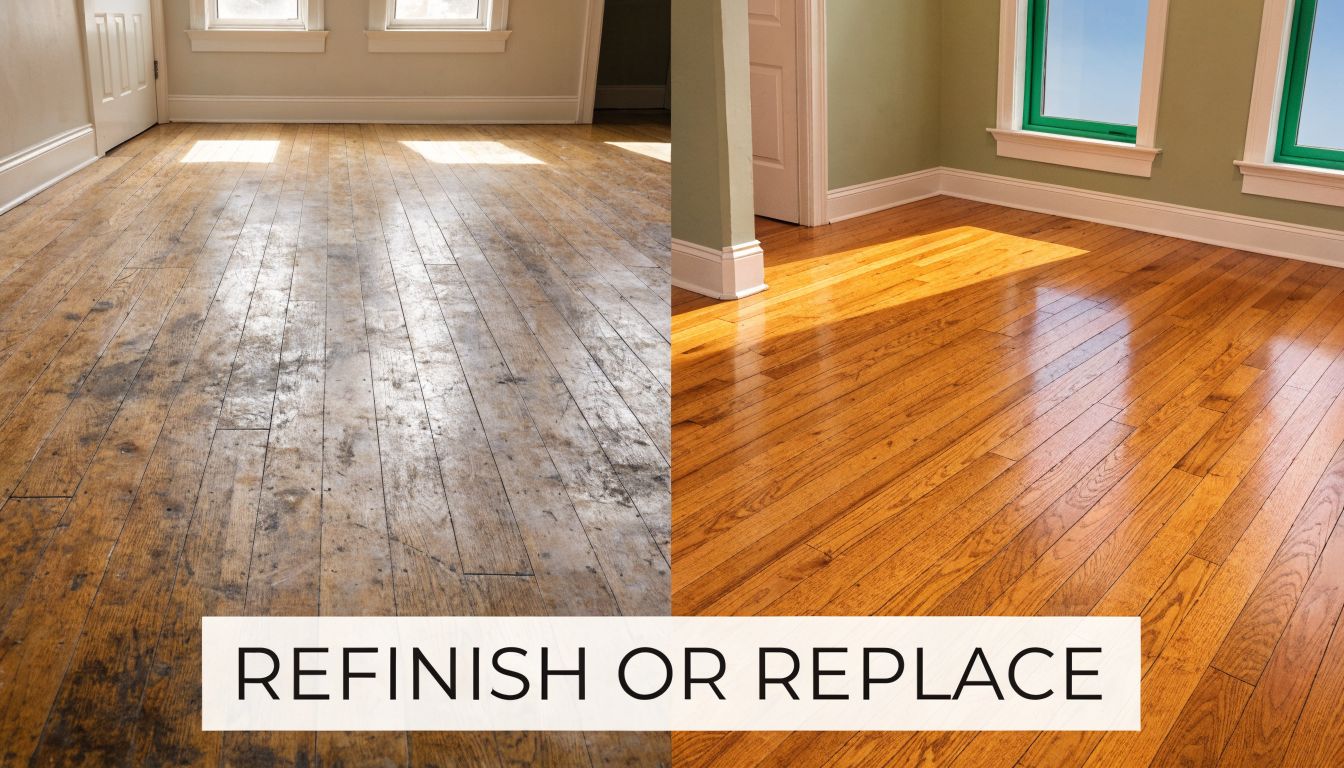
Refinishing keeps the wood you already have. That matters in older Denver homes where original oak floors help define the room. It also matters in newer homes where the boards are still structurally sound and the damage is mostly in the finish layer.
When refinishing usually makes more sense
Refinishing is often the better path if the boards are stable and the main complaints are visual or surface-level. Common examples include scratched living rooms, faded hallways, and finish wear near kitchen entries.
It also preserves details that are hard to duplicate, such as:
- Older board widths and layouts
- Wood tones that match the rest of the house
- Transitions into stairs, trim, and built-ins
- The original feel of a bungalow or mid-century floor plan
For Denver neighborhoods like Wash Park, Congress Park, and Park Hill, that continuity matters. Once old wood is gone, it’s gone.
When replacement is the better call
Sometimes refinishing isn’t enough. If boards are badly warped, broken, or repeatedly patched with mismatched materials, replacement may be the cleaner long-term choice. The same goes for floors with severe moisture damage.
Some homeowners also compare hardwood restoration to switching materials altogether. If you’re weighing wood against resilient products, this plain-language guide to LVP flooring can help frame the pros and tradeoffs.
A simple way to consider this:
| Floor condition | Better fit |
|---|---|
| Surface scratches and dull finish | Refinish |
| Light pet wear and traffic lines | Refinish |
| Deep structural board damage | Replace affected areas or replace floor |
| Major moisture distortion | Often replacement |
| You want to preserve original character | Refinish |
Original hardwood has something new flooring can’t copy perfectly. Age, grain variation, and the way it fits the house all show up once the finish is restored.
For many Colorado homeowners, Denver hardwood floor refinishing with a UV- Cure System lands in a sweet spot. You preserve the floor, avoid a full tear-out, and get a modern finish system that better fits current household use.
Choosing Your Finish The Ultimate Guide to Durability and Style
Once the sanding is done, the finish becomes the working surface your family lives on. At this stage, people get overwhelmed. They hear oil-based, water-based, matte, satin, commercial grade, UV-cured, and they’re not sure what matters most.
The easiest way to choose is to start with your household, not the product label. Do you have dogs? Kids running in from the yard? A rental property between tenants? A home office that can’t stay shut down? Those answers tell you more than sheen charts do.
Traditional finish options
Traditional finishes still have a place. Many homeowners choose them because they’re familiar and can look excellent when matched to the right home.
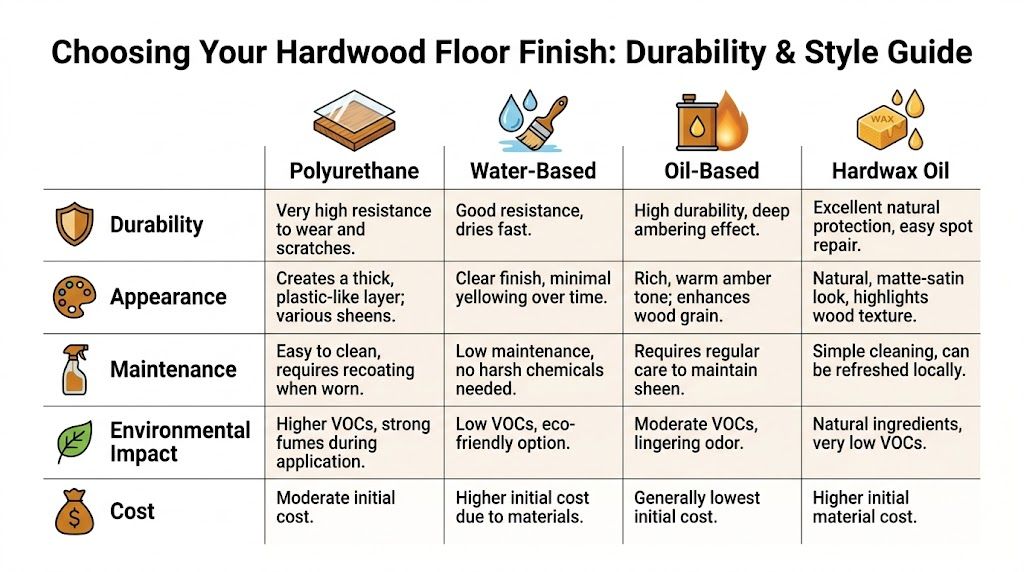
- Oil-based polyurethane: Tends to give wood a warmer, amber tone. Some people love that richer look on older red oak floors.
- Water-based finish: Usually stays clearer over time and works well when homeowners want a more natural color.
- Single-component and two-component systems: The choice often comes down to how much wear resistance you want and how quickly you need the floor back in service.
These systems can perform well, but cure time and household disruption are often the sticking points. If you have to keep pets, kids, and furniture off the floor for an extended stretch, that delay becomes part of the decision.
Why UV-cured finish changes the conversation
For busy homes, Denver hardwood floor refinishing with a UV- Cure System solves the problem many traditional finishes create. You don’t just want a floor that looks good. You want one that’s usable fast.
Surface prep becomes critical. According to the Finitec EX-3 technical data sheet, proper pre-sanding to 100-120 grit supports adhesion and durability, with Taber test results of over 10,000 cycles compared with 5,000 for average solvent finishes. The same technical guidance supports UV curing in seconds under a UV lamp, reducing downtime by over 90% and allowing immediate foot traffic from kids and pets.
That’s the part homeowners feel right away. The floor isn’t sitting there vulnerable for days while everyone tiptoes around it.
If you want a broader overview of how sheen, chemistry, and performance differ, this guide to hardwood floor finishes helps clarify the choices.
Matching the finish to Colorado life
In practice, I’d group finish choices by how the home is used.
For active families and pet owners
Fast return to service matters. Scratch resistance matters. A UV-cured system usually makes the most sense when the floor is going right back into daily use.
For owners who want a classic warm tone
A traditional finish may still be the better aesthetic fit, especially in older homes where a little ambering complements the wood and trim.
For rental turns and real estate prep
Speed and predictability matter. A finish that lets owners move furniture back quickly can simplify scheduling and reduce vacancy stress.
Service package examples in plain language
Some homeowners prefer to compare options as service levels. In Parker, for example, common pricing and finish tiers can be framed like this:
- Diamond Traffic Plus at $5.50 per sqft: UV-curing plus Nano Wear, built around heavy wear and scratch resistance.
- Platinum Traffic Plus at $4.80 per sqft: 2K water-based finish with Nano Wear Oxide Additive.
- Gold Traffic Plus at $4.50 per sqft: Scratch-resistant 2K water-based finish.
- Silver Traffic Plus at $4.20 per sqft: 1K water-based finish with solid wear resistance.
- Screen & Recoat starts at $2.50/sq. ft.
- Wood Floor Cleaning starts at $1.50/sq. ft.
- Wax Removal starts at $2.50/sq. ft.
- Instant UV-Curable Finish $1.5/sq. ft.
Those options aren’t just price differences. They reflect different priorities: immediate use, long wear, easier maintenance, and how much abuse the floor is expected to take.
The best finish isn’t the one with the fanciest label. It’s the one that fits how the room is used on an ordinary Tuesday.
What people usually regret
Most finish regret comes from choosing based on appearance alone. A matte look is popular, but if the prep is poor, matte can highlight chatter and flatness problems. A glossy look can be beautiful, but it also shows every scratch and crumb in a bright room.
The smarter approach is to balance three things:
- Traffic level
- Tolerance for downtime
- Desired look in your lighting
That’s the decision behind Denver hardwood floor refinishing with a UV- Cure System. You’re not just choosing a coating. You’re choosing how the floor will live with you afterward.
The J.R. Hardwood Process From Quote to Flawless Finish
Most homeowners don’t need a lecture on machinery. They want to know what it’s like from the first call to the day they’re walking on their floor again.
A typical project starts with photos, room details, and a conversation about the floor’s condition. Some floors need full sanding. Some only need a screen and recoat. Some have wax contamination and need that addressed first. The point of the early quote process is to narrow down the right service before anyone drags equipment into the house.
Step one is getting the diagnosis right
A family in a Denver bungalow might think their floor needs replacement because the finish is patchy and dark near the kitchen. A closer look often shows an old oak floor with wear, residue, and traffic patterns, but still enough material for a proper refinish.
A Parker homeowner may have the opposite issue. The floor looks fairly new, but two large dogs have scratched the finish across the main level. In that case, the conversation usually turns to durability and how fast the home can return to normal.
One local provider that offers this range of services is J.R. Hardwood Floor Refinishing & Cleaning, including full sanding and refinishing, screen and recoat, clean and buff, wax removal, Instant UV-curable finish, and hardwood floor installation.
What the workdays usually look like
Once the plan is set, the house gets prepped, the sanding sequence starts, and edges, corners, and field areas are blended so the floor reads as one surface instead of several machine paths. This is also where clean communication matters. Homeowners need to know what’s happening each day, when they can enter the area, and how furniture and pets should be handled.
A few common project examples make this easier to picture:
- Denver red oak restoration: Older boards, surface scratches, and dulled finish. Full sanding, detailed edge work, and a finish choice that keeps the original character.
- Parker family home with pets: Main concern is claw wear and downtime. The finish recommendation leans toward a harder-wearing system with faster return to service.
- Rental prep in Aurora or Centennial: The owner wants the home market-ready without stretching the turnover timeline.
Why pet owners ask different questions
Pet owners usually care about two things first: scratch resistance and how soon the floor can be used. That concern is more common than many flooring articles admit. According to this summary hosted through Angi’s floor sanding listing context, a 2025 NWFA report noted 68% of U.S. pet-owning households prioritize scratch-resistant coatings, and Instant UV-curable finishes reduce cure time from 72+ hours to nearly zero, while extending floor life by up to 40% in homes with pets.
That kind of finish logic fits Colorado households well. People here don’t want to board the dog, close off half the house, and wait around if they don’t have to.
A finish that works in a quiet guest room may be the wrong finish for a main level with two dogs, a mudroom entry, and constant traffic.
The final walkthrough matters
The last step isn’t just packing up. It’s checking sheen consistency, transitions, edge detail, and whether the finished floor matches what was promised at the quote stage. Homeowners should also leave with care instructions that fit the finish they chose.
If you want to preview workmanship before scheduling, it helps to review customer testimonials and video examples of completed floor projects.
For Denver hardwood floor refinishing with a UV- Cure System, that final result should feel simple to live with. Clean surface. Clear expectations. Minimal disruption.
DIY vs Hiring a Professional Floor Sanding Co
DIY floor sanding looks manageable until the machine touches the floor. Then the margin for error shows up fast.
The biggest misconception is that sanding is just labor. It isn’t. It’s a skilled trade. The operator has to control cut depth, machine pace, overlap, edge blending, scratch pattern, and finish prep. One pause with a drum sander can leave a visible low spot. One rushed pass with an edger can leave swirl marks you won’t notice until finish goes down.
The hidden costs of doing it yourself
Homeowners often compare a rental rate to a professional quote and stop there. But the true cost stack is broader.
- Tool learning curve: Rental equipment doesn’t teach technique.
- Consumables: You’ll go through multiple grit stages, pads, screens, and finishing supplies.
- Correction risk: If you leave chatter, dish the softer grain, or miss flatness problems, fixing the mistake can take more sanding than the floor should have needed.
- Time: A project that spreads over several days can disrupt the house more than expected.
According to the U.S. Bureau of Labor Statistics profile for Floor Sanders and Finishers, these are skilled trade roles. The same source notes that advanced 2025-era dustless systems capture over 99% of dust and support finishes curing in hours, which is hard to replicate with rental gear.
Where DIY jobs usually fail
The most common problems aren’t dramatic. They’re subtle, and that’s what makes them frustrating.
A homeowner may think the floor looks fine after sanding, then notice after finish application that:
- The room isn’t flat
- Edge areas are lower or rougher than the center
- Old scratch patterns telegraph through
- Dust nibs got trapped in the finish
- The wrong finish was chosen for pets or traffic
This is why the DIY decision should include finish planning, not just sanding confidence. If you’re weighing that choice, this article on DIY vs professional hardwood floor refinishing is a good side-by-side reference.
Rental equipment can remove finish. That doesn’t mean it can produce a flat, consistent, furniture-grade floor across an entire house.
When hiring a floor sanding co is the safer investment
If the floor matters to the value or feel of the home, professional work usually saves stress. That’s especially true for older Denver floors, stained floors, mixed-species floors, and homes where downtime has to be tightly managed.
A professional floor sanding co brings the process, the dust control, the finish knowledge, and the ability to solve problems as they appear. That’s what homeowners are really paying for. Not just labor, but judgment.
Restore Your Floors Today with Denver's Trusted Experts
Most hardwood floors don’t need a miracle. They need the right diagnosis, the right sanding sequence, and a finish that matches how the home is used. That’s the practical value of working with a floor sanding co that understands Colorado homes, from older Denver bungalows to newer houses in Parker, Castle Rock, and Highlands Ranch.
If your floors are dull, scratched, cloudy, or worn through in traffic lanes, refinishing is often the move that brings the room back together. If you also need minimal disruption, Denver hardwood floor refinishing with a UV- Cure System stands out because it solves a real household problem. You get restored wood and a faster return to normal life.
The right service depends on what the floor is telling you. Some homes need full sanding. Some need a screen and recoat. Some need wax removal before anything else. The common thread is that prep quality drives the outcome.
Homeowners across the Denver Metro Area trust J.R. Hardwood Floor Refinishing & Cleaning to restore the natural beauty of their hardwood floors with our dust-free sanding system and advanced UV-curable finishes. Unlike traditional methods, our UV technology cures instantly, so you can move furniture back the same day with no lingering odor or downtime. Choose the perfect refinishing service to match your needs and home traffic. Our dust-free process ensures a clean, beautiful finish every time.
📞 Phone: 720-327-1127
🌐 Website: jrhardwoodfloorrefinishingandcleaning.com
▶️ See Our Work on YouTube: YouTube channel
📍 Service Area: We proudly serve the entire Denver Metro area and surrounding communities, including Denver, Parker, Aurora, Castle Rock, Highlands Ranch, Littleton, Centennial, Boulder, Colorado Springs, and more.
If your hardwood floors are scratched, dull, or hard to live with, contact J.R. Hardwood Floor Refinishing & Cleaning for a free quote and a practical recommendation based on your floor’s condition, your household traffic, and whether a traditional finish or UV- Cure System makes the most sense.