 Skip to content
When you find a pet accident on your hardwood floors, your first instinct might be to grab whatever cleaner is under the sink. But hold on—that could be a costly mistake. For pet urine, the best and only real solution is an enzymatic cleaner. It's the only thing that actually breaks down the uric acid crystals causing those stubborn stains and lingering smells without wrecking your floor’s finish. For Parker homeowners, choosing the right cleaner is the first step in protecting their investment, but for deeper damage, professional Parker hardwood floor refinishing using our advanced UV-Cure System is the ultimate solution.
Why the Right Cleaner Is So Crucial for Your Hardwood Floors
For any homeowner, from the newer builds in Stonegate to the classic properties near Mainstreet in Parker, discovering a pet accident on beautiful hardwood is a heart-sinking moment. The real challenge isn’t just wiping up the visible mess; it’s preventing long-term damage to your investment. This is about more than just cleaning—it's about preserving the value and beauty of your home. If stains have set in, a professional Parker hardwood floor refinishing service equipped with a UV-Cure System is essential.
Here's a little professional secret: many common DIY "fixes" are a recipe for disaster on modern hardwood finishes. What seems like a quick solution often creates a much bigger problem, one that ends up needing professional hardwood floor refinishing to fix. We've seen it firsthand while restoring floors in Parker homes, where an incorrect cleaner led to a full dust-free sanding and refinishing job.
The Dangers Hiding in Your Cleaning Cabinet
It’s tempting to reach for vinegar or an all-purpose cleaner, but these products can become your floor's worst enemy when dealing with pet urine.
- Vinegar and Other Acids: The acidity in vinegar can slowly dull or even etch the polyurethane finish on your floors. Over time, it weakens that protective barrier, making your floors more vulnerable to future damage.
- Ammonia-Based Cleaners: These are especially harsh. They can strip the finish right off, leaving your hardwood exposed to moisture and deep, permanent staining.
- Bleach or Hydrogen Peroxide: While they might lighten a stain, these chemicals often discolor the wood itself. You'll just trade a urine stain for a bleached-out spot that’s just as obvious.
Using the wrong product doesn't just fail to solve the problem—it often makes it worse. It can lock the stain in and trap the odor-causing bacteria deep inside the wood fibers, leading to a persistent smell that comes back on humid days and a stain that never truly goes away.
The Smart Solution: Enzymatic Cleaners
The only way to truly tackle pet urine is with a cleaner made specifically for the job. Enzymatic cleaners are packed with beneficial bacteria that produce enzymes, and these little powerhouses break down organic waste on a molecular level.
Instead of just covering up odors, these specialized enzymes literally consume the uric acid crystals in pet urine. They eliminate the source of both the smell and the stain, which is the key to protecting your floors from lasting damage.
To help you see the difference, here’s a quick comparison showing why enzymatic cleaners are the clear winner for pet urine on your hardwood floors.
Comparing Common Cleaning Solutions for Pet Urine
| Cleaner Type | Effectiveness on Urine Odor | Safety for Hardwood Finish | Recommendation |
|---|---|---|---|
| Enzymatic Cleaner | Excellent: Eliminates uric acid at the source. | Excellent: pH-neutral and formulated to be safe. | Highly Recommended |
| Vinegar & Water | Poor: Temporarily masks odor, doesn't remove it. | Poor: Can dull or etch the finish over time. | Not Recommended |
| Ammonia-Based Cleaner | Poor: Can actually attract pets back to the spot. | Very Poor: Strips finish and damages wood. | Avoid at All Costs |
| Hydrogen Peroxide | Fair: Can lighten stains but not remove odors. | Very Poor: Discolors and bleaches wood. | Avoid at All Costs |
As you can see, reaching for anything other than an enzymatic cleaner is a gamble you don't want to take with your beautiful floors.
The modern hardwood floors in Parker homes are most often finished with polyurethane or a factory-applied aluminum-oxide coating. Both flooring manufacturers and professional refinishers like us will tell you that using the wrong cleaner is a costly mistake. For this reason, always look for labeled, pet-safe hardwood cleaners that explicitly state they are free of harsh solvents.
Ultimately, choosing the right cleaner is your first and most important line of defense. For more tips on keeping your floors gorgeous for years to come (even with furry family members), check out our comprehensive guide on how to protect hardwood floors.
The Science of How Pet Urine Damages Hardwood
To really get why you need to clean up a pet accident fast, it helps to understand what’s happening to your floor on a microscopic level. It’s not just a puddle; it’s a chemical assault on one of your home's most beautiful features. The damage from pet urine happens in stages, and each one is worse than the last. That's why prompt action is critical, and why a Parker hardwood floor refinishing service using a state-of-the-art UV-Cure System may be necessary for severe damage.
Pet urine is a nasty cocktail of uric acid, ammonia, bacteria, and moisture. When it first hits your floor, it lands on the protective finish—usually polyurethane. This top layer is your first and most important line of defense. But it's not invincible. The longer that puddle sits, the more its acidic nature starts eating away at that protective seal.
From Puddle to Permanent Stain
Once the urine chews through the finish, it starts its destructive journey deep into the wood fibers. This is where the real, lasting damage begins.
The moisture in the urine makes the wood fibers swell up, which can lead to warping, cupping, or buckling over time. You might notice the edges of the boards starting to lift or the floor feeling uneven. If you've ever dealt with any kind of water damage, you know exactly what this looks like. You can learn more in our guide on how to fix cupped hardwood floors.
At the same time, the ammonia in the urine kicks off a chemical reaction with the natural tannins in the wood. Tannins are the compounds that give wood its rich, beautiful color. When ammonia hits them, it creates a dark, almost black stain. This isn't just a surface-level mess; it’s a deep chemical burn that has permanently changed the wood itself.
That chemical reaction is exactly why old pet stains turn black. It's not just dirt or residue—it's the wood's own chemistry being weaponized against it. Wiping the surface won't touch a stain like this because the damage is now part of the wood fiber.
Why Time Is Your Biggest Enemy
The difference between a minor cleanup and a major restoration project often comes down to a few hours. A puddle caught within minutes can usually be blotted up with no harm done—the polyurethane finish did its job. But a stain that has had hours to seep into the wood is a completely different ballgame.
This is where the line between "cleaning" and "repair" becomes crystal clear. Our own experience working in countless Parker homes has shown us that time is everything. A fresh accident wiped up within the first hour? Usually manageable with proper blotting and a finish-safe cleaner. But urine that soaks through the finish over 24 to 72 hours can chemically scorch the wood, leaving permanent discoloration that only a professional can fix.
This reality means pet owners need a two-part strategy:
- Rapid Response: Always have a good, hardwood-safe enzymatic cleaner on hand for immediate accidents.
- Professional Help: For deep, set-in black stains, the only real solution is professional hardwood floor refinishing.
Once a stain has turned black, no amount of scrubbing will lift it. The only way to fix it is to physically remove the damaged layer of wood. Our dust-free sanding services are designed for exactly this scenario, safely sanding away the stained wood to reveal the clean, undamaged layers underneath. From there, we can apply a new, durable finish to restore your floor’s beauty and protection for good.
A Realistic Guide to Cleaning Fresh Pet Urine
That moment of panic when you spot a fresh pet accident on your beautiful hardwood floors—we’ve all been there. But what you do in those first few seconds is critical. It can mean the difference between a quick cleanup and a permanent, ugly stain. This is our battle-tested, no-nonsense guide to handling it right. If the stain has already set, you'll need a Parker hardwood floor refinishing professional with a UV-Cure System to truly erase the damage.
First thing's first: blot, don’t rub. Get a thick stack of paper towels and press down firmly on the puddle. Your only goal here is to lift the urine straight up out of the wood. If you rub, you’re just spreading it around and pushing it deeper into the seams between the boards, which is exactly where the real damage starts.
Once you've soaked up everything you can, it’s time to deal with what’s left behind. This is where a high-quality enzymatic cleaner—the absolute best hardwood floor cleaner for pet urine—becomes your best friend.
This diagram shows just how quickly a simple puddle can become a deep, damaging stain that alters the wood itself.

As you can see, the window to act is tiny. Once that urine soaks past the floor's finish, it starts a chemical reaction with the wood fibers, leading to those dark stains that simply can't be wiped away.
Applying Your Cleaner Correctly
How you apply the cleaner is just as important as the product itself. Don’t be shy with it! You need to use enough of the enzymatic solution to saturate the area just as deeply as the urine did. If you suspect it seeped into the cracks, make sure the cleaner gets in there, too.
Now for the hardest part: be patient. You have to give the enzymes time to actually work their magic. This isn't a five-minute spray-and-wipe job. Enzymatic cleaners are designed to chemically break down the uric acid crystals that ordinary detergents leave behind—that’s what causes the lingering smell and stains. For best results, let the treated area air dry completely. This can take several hours or even overnight. Don't be surprised if older, more stubborn spots need two or three rounds of treatment.
Pro Tip: Before you go all-in with a new cleaning product, always test it somewhere hidden first. A spot inside a closet, under the sofa, or behind a door is perfect. This quick check ensures it won’t discolor or damage your specific type of hardwood finish.
The Final Steps: Blot and Dry
After the cleaner has had plenty of time to work, grab a clean, soft cloth and gently blot up any leftover residue. You want to avoid rinsing with water, since adding more moisture to hardwood is never a good idea. Just focus on blotting the area until it's dry.
To finish the job, you can point a small fan at the spot. Good air circulation is key to making sure the wood dries out completely. Trapped moisture is the enemy of hardwood, so this final step is crucial.
This immediate action plan is your best defense against new accidents. But what if you're dealing with stains that have already set in? You'll likely need a more intensive approach. We cover that in our detailed guide on how to remove set pet stains from hardwood floors. For those deep, dark stains where the damage is already done, professional refinishing might be the only way to truly restore your floor’s original beauty.
How to Choose the Best Hardwood Floor Cleaner
Walking down the cleaning aisle can feel like a pop quiz you didn't study for. Dozens of bottles shout promises of a perfect shine, but when you're tackling pet urine on hardwood, grabbing the wrong one can lead to disaster. It's not just about cleaning; it's about protecting your investment. The right product saves your floors, while the wrong one can cause permanent damage requiring a professional Parker hardwood floor refinishing service.
Let's cut through the noise and figure out exactly what your floors need.
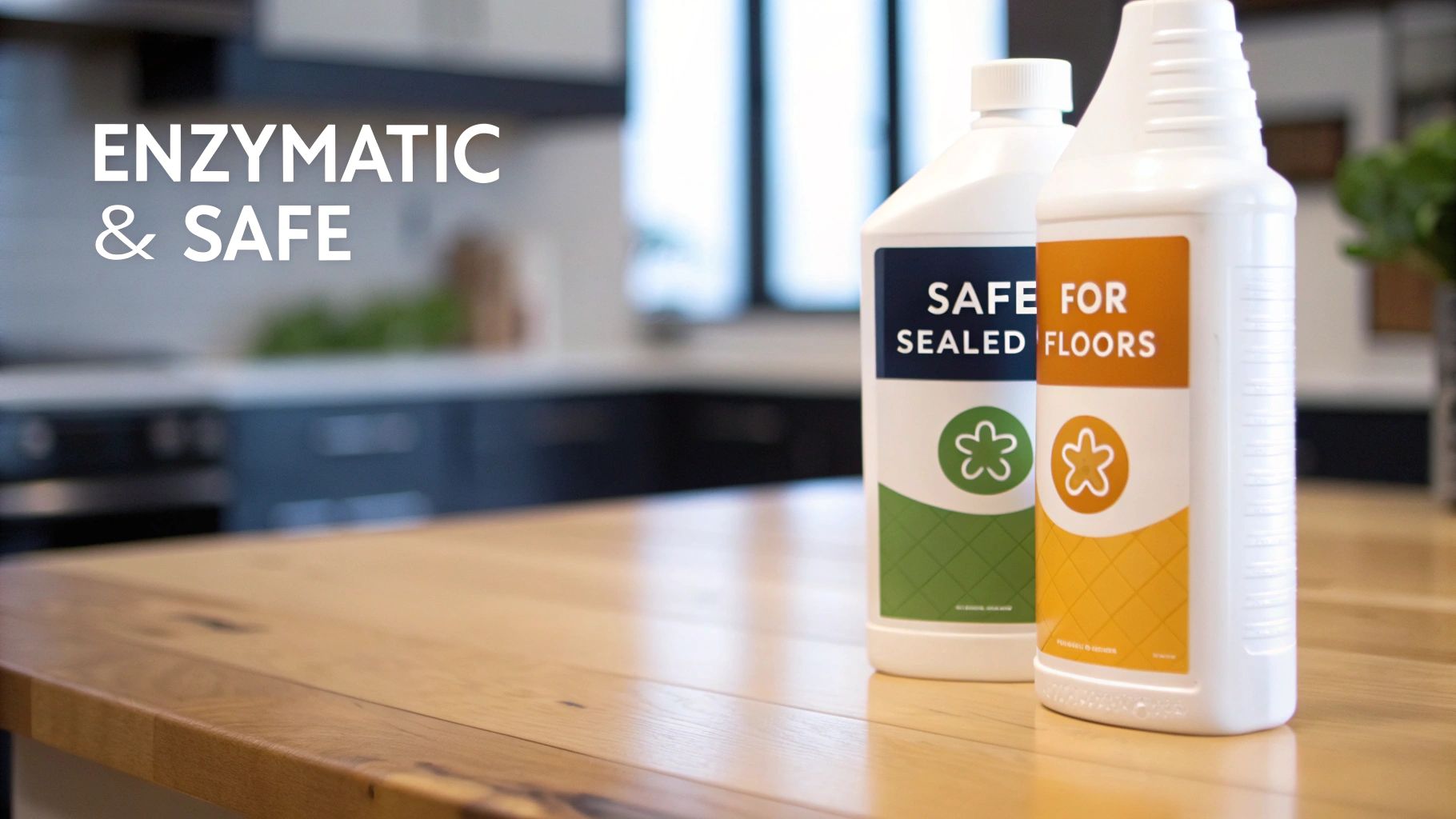
There are a few non-negotiables you have to look for on a product label. Get these right, and you're already halfway to solving the problem.
Decoding the Label: What to Look For
When you're scanning those shelves, your eyes need to be trained to spot three critical things. Think of these as the markers of a cleaner that will fix the issue without creating a bigger headache down the road.
-
Enzymatic Formula: This is the absolute most important feature. An enzymatic cleaner isn't just soap and water; it contains beneficial bacteria that produce enzymes specifically designed to break down and literally consume the uric acid crystals in pet urine. These crystals are the real source of those stubborn, lingering odors. Anything less is just masking the smell temporarily.
-
pH-Neutral Solution: Your hardwood floor’s finish is a delicate chemical barrier. Cleaners that are too acidic (like vinegar) or too alkaline (like ammonia) will slowly eat away at this protective layer. This is what leaves floors looking dull, hazy, and vulnerable to more damage. A pH-neutral formula is gentle enough to clean effectively without stripping the finish.
-
Clearly Labeled "Safe for Sealed Hardwood": This is your final green light. It confirms the manufacturer has formulated and tested the product specifically for floors like yours. If the bottle doesn't say it loud and clear, don't risk it.
What to Avoid at All Costs
Just as important as knowing what to look for is knowing what ingredients to run from. So many "all-purpose" cleaners contain harsh chemicals that are an absolute nightmare for wood.
A good rule of thumb is simple: if it’s a powerful disinfectant or a heavy-duty degreaser, it has no business being on your hardwood floors. These chemicals are designed to strip surfaces, and they will do the exact same thing to your floor's protective finish.
Steer clear of any product that lists:
- Ammonia
- Bleach
- Chlorine
- Hydrogen Peroxide (in high concentrations)
- Abrasive powders or creams
- Oil soaps (these are notorious for leaving a filmy residue that dulls the finish and actually attracts more dirt)
Using any of these can strip the finish, discolor the wood, and land you with a much bigger problem than you started with. A few extra seconds reading the ingredients can save you from a costly refinishing job.
To make it even simpler, here’s a quick checklist to help you vet any cleaner you’re considering.
Cleaner Safety Checklist for Your Hardwood Floors
| Feature / Ingredient | What to Look For (Safe) | What to Avoid (Damaging) |
|---|---|---|
| Cleaning Agent | Enzymatic or oxygen-based formulas | Bleach, ammonia, chlorine, vinegar |
| pH Level | pH-Neutral (around 7.0) | Highly acidic (pH 0-6) or highly alkaline (pH 8-14) |
| Labeling | "Safe for Sealed Hardwood Floors" | "All-Purpose," "Heavy-Duty Degreaser" |
| Residue | Leaves no film or haze | Oil soaps, waxes, or silicone-based products |
| Abrasives | Liquid, non-abrasive formula | Gritty powders, scouring creams |
Always default to what's safest for the finish. If you're ever in doubt, a quick spot test in an inconspicuous area (like inside a closet) is a smart move.
Concentrated vs. Ready-to-Use Formulas
You’ll also notice cleaners come in two main forms: ready-to-use sprays and concentrated liquids you dilute yourself.
Ready-to-use (RTU) sprays are incredibly convenient. You just grab, spray, and wipe. They're perfect for spot-treating a fresh accident the moment you find it.
Concentrated formulas are more economical for cleaning larger areas or for your regular floor maintenance. You get more cleaning power for your money, but you must follow the dilution instructions precisely. Using too much concentrate can leave a sticky, dirt-attracting residue.
For any pet owner, having an RTU enzymatic spray stashed under the sink for emergencies is a no-brainer. For your routine cleaning, a high-quality concentrate is a great, cost-effective choice. Understanding how to pick the right products is a key part of your overall floor care, and you can learn even more about how to maintain hardwood floors to keep them beautiful for years to come.
When DIY Cleaning Just Won't Cut It in Your Parker Home
You’ve done everything right. You blotted the accident immediately, sprayed the best enzymatic cleaner you could find, and waited, hoping for the best. But the stain is still there.
Sometimes, despite all your efforts, a pet accident seeps too deep for any store-bought product to fix. At this point, you’re not dealing with a simple surface mess anymore—you’re looking at physical damage to the wood itself. For homeowners here in Parker, knowing when to hang up the DIY gloves and call in a pro is the key to preventing permanent damage and protecting your home’s value. This is where a trusted Parker hardwood floor refinishing company utilizing a modern UV-Cure System becomes invaluable.
Recognizing Damage That’s Gone Too Deep
If you’re seeing any of the following, it’s a sure sign the problem has moved beyond a simple cleanup and requires professional hardwood floor refinishing.
- Stubborn Dark or Black Stains: This is the big one. A black stain isn't just discoloration; it’s a chemical burn. The ammonia in the urine has reacted with the tannins in the wood, permanently altering its color. No surface cleaner on earth can reverse that.
- An Odor That Won't Quit: Still catching a whiff of that tell-tale urine smell, especially on humid days? That means uric acid crystals are trapped deep inside the wood fibers or, even worse, have soaked into the subfloor.
- The Wood Itself is Changing Shape: Take a close look at the boards. Are they warping (bending), cupping (where the edges are higher than the center), or crowning (where the center bulges up)? This is a dead giveaway that moisture has penetrated the core of the wood.
When you see these issues, the damage has officially bypassed the protective finish and become part of the wood. This is where cleaning stops and restoration has to begin.
Why Professional Refinishing is the Only Real Fix
Once a pet stain has soaked into the wood, the only way to truly fix it is to physically remove the damaged layer. That’s exactly what our professional hardwood floor refinishing process does. Unlike cleaning, which only tackles the surface, refinishing gets straight to the root of the problem.
Imagine trying to save a beautiful old oak floor in a Parker home near the Cherry Creek Trail that’s seen a few too many accidents over the years. The challenge is more than just cosmetic.
The goal is to sand away the damaged wood without harming the healthy layers underneath. It takes specialized equipment and a skilled hand to get a perfectly flat, smooth surface that’s ready for a new, durable finish.
Here at J.R. Hardwood Floor Refinishing & Cleaning, our process delivers a one-two punch that DIY methods simply can't match.
Our Proven Restoration Process
First, we bring in our dust-free sanding system. This isn't just about keeping your house clean—our advanced equipment methodically sands away the top layer of your hardwood, physically removing the stained and damaged wood fibers. This step literally erases the black stains and gets rid of the source of that lingering odor for good.
Next, once we have a fresh, clean slate, we apply our advanced UV-Cure System. For pet owners, this is an absolute game-changer. Traditional floor finishes can take days to cure, filling your home with VOCs (volatile organic compounds) and leaving the floors vulnerable while they dry. Our UV finish, on the other hand, cures instantly under a special UV light.
What does this mean for you?
- Zero Downtime: You can walk on your floors and move furniture back the very same day. No waiting around.
- Incredible Durability: The instant cure creates an ultra-hard, non-porous barrier that’s exceptionally resistant to scratches and future spills.
- Completely Pet and Family Safe: With zero VOCs, there are no toxic fumes lingering in your home. It’s immediately safe for everyone, including your four-legged family members.
Deciding between a DIY attempt and calling a professional can be tough, but when pet damage runs deep, the choice becomes clear. You can learn more about the differences in our guide comparing DIY vs. professional hardwood floor refinishing. Ultimately, professional restoration is the only way to turn a potential disaster into a beautiful, resilient floor that looks and feels brand new.
Common Questions About Pet Urine and Hardwood Floors
Even with the best game plan, pet urine on hardwood floors can be a seriously tricky and frustrating problem. We get calls all the time from homeowners across Parker—from newer neighborhoods to more established areas—who are dealing with this exact headache. For definitive solutions, Parker hardwood floor refinishing with a UV-Cure System is the answer.
Here are the straight-up answers to the most common questions we hear, and we'll bust a few popular myths along the way.
Can I Use Vinegar and Baking Soda on Hardwood Floors?
This is probably the #1 DIY "hack" we see recommended online, but please, step away from the vinegar. It's a dangerous myth for your hardwood floors. While that combo might work wonders on a clogged drain, it’s a terrible idea for your floor's protective finish.
The problem is twofold. First off, vinegar is acidic. Over time, that acid will slowly eat away at the polyurethane finish on your floors, leaving them looking dull and hazy. More importantly, it weakens that crucial protective barrier, leaving the actual wood wide open to future moisture damage and stains.
Second, neither vinegar nor baking soda does anything to neutralize the uric acid crystals in pet urine. They might cover up the smell for a little while, but the odor-causing crystals are still there. That means the scent will come back, especially on humid days, and your pet will almost certainly be drawn back to the same spot.
Why Does My Pet Keep Urinating in the Same Spot?
If you've caught your pet returning to the scene of the crime, it's not a behavioral issue—it's a biological one. Pets are driven by their incredibly powerful sense of smell. When they urinate, they leave behind pheromones and uric acid that basically act as a giant flashing sign that says, "This is a bathroom."
Even if you've cleaned the spot with a standard household cleaner and can't smell a thing, your pet's sensitive nose can still pick up on those lingering scent molecules.
The only way to break this frustrating cycle is to completely destroy the odor at a molecular level. This is why finding the best hardwood floor cleaner for pet urine always means choosing an enzymatic cleaner. The active enzymes in these products physically break down and consume the uric acid crystals, eliminating the odor source for good. Once that scent is truly gone, your pet will no longer be drawn back to that area.
Will a Screen and Recoat Fix Pet Stains?
This is a great question, and it’s really important to understand the difference between our services to pick the right one. A screen and recoat is a fantastic, budget-friendly way to refresh floors with minor surface scratches and a dull finish. The process involves lightly buffing (or "screening") the top layer of polyurethane and applying a fresh coat.
However, a screen and recoat only deals with the finish—it doesn't touch the wood itself. If a pet stain has turned dark or black, it means the urine has already soaked through the finish and chemically burned the wood fibers. A screen and recoat will just seal that black stain under a new layer of polyurethane, making it impossible to fix later without a full sanding.
For those deep-set, dark stains, the only real solution is a full hardwood floor refinishing service that physically sands away the damaged layer of wood.
Is a UV-Cure Finish Safe for My Pets?
Absolutely. In fact, our advanced UV-Cure System is the best possible choice for households with pets and kids. Traditional oil- or water-based finishes can take days or even weeks to fully cure, releasing volatile organic compounds (VOCs) into your home's air that whole time. Those fumes can be harmful to both people and animals.
Our UV-curable finish, on the other hand, is cured instantly with a special UV light machine. The moment the light passes over the finish, it is 100% cured, hardened, and completely inert.
This instant process gives pet owners two massive benefits:
- Zero VOCs: Because the finish cures immediately, there is no off-gassing period. Your indoor air quality is protected, and your home is safe for your family and pets to return to the very same day.
- Unmatched Durability: The UV-curing process creates an incredibly hard, non-porous surface that is far more resistant to scratches, scuffs, and spills than traditional finishes. It's tailor-made for the wear and tear of daily life with pets.
For Parker homeowners needing professional hardwood floor refinishing, our UV-Cure System offers total peace of mind and superior protection.
Homeowners in Parker trust J.R. Hardwood Floor Refinishing & Cleaning to restore the natural beauty of their hardwood floors with our dust-free sanding system and advanced UV-curable finishes. Unlike traditional methods, our UV technology cures instantly, so you can move furniture back the same day with no lingering odor or downtime. Choose the perfect refinishing service to match your needs and home traffic. Our dust-free process ensures a clean, beautiful finish every time.
📞 Phone: 720-327-1127
🌐 Website: jrhardwoodfloorrefinishingandcleaning.com
📍 Service Area: Parker, Lone Tree, Castle Rock, Centennial, Highlands Ranch, and surrounding areas.
🎥 YouTube: https://www.youtube.com/channel/UCLaTAi6KxwT-g8QCKqKTQ8Q?sub_confirmation=1