 Skip to content
Choose engineered hardwood or a carefully selected domestic species, then control your indoor air. NWFA guidance calls for 60–80°F and 30–50% relative humidity year-round. Your three priorities: verify site moisture tests, let the flooring acclimate only after your HVAC is running at lived-in settings, and pick a durable finish or a professional installer who documents each step.
TL;DR:
- Engineered boards are usually safer over concrete or in intermittently occupied homes, but their real wood wear layers still respond to dry air.
- Very wide solid planks can gap more than narrower boards, and high density alone does not guarantee stability because species shrink at different rates.
- For concrete, ask whether the installer measured humidity inside the slab or tested surface emissions; wood subfloor readings should be compared with the flooring.
- Small gaps that close in summer are normal seasonal movement, while cupping, crowning, or buckling points to a moisture problem requiring diagnosis.
- A screen and recoat starts at $2.50 per square foot, while full sanding and refinishing costs $4.20–$5.50 when wear reaches bare wood.
Table of Contents
- Which hardwood species resist gaps and shrinkage in Colorado?
- Solid vs. engineered hardwood: which suits Colorado homes?
- How do you acclimate flooring and set up your home’s environment?
- What moisture tests and subfloor checks should you require?
- Which finishes and seasonal habits keep a Colorado floor lasting?
- How a Colorado specialist prevents seasonal movement
- How do finish costs and durability compare in Colorado?
- What ventilation and humidification tips protect hardwood in Colorado homes?
- My take: skip the species debate and fix the sequence
- How we help Colorado homeowners get hardwood that lasts
- FAQ
- Sources
Which hardwood species resist gaps and shrinkage in Colorado?
Wood is hygroscopic, which is a fancy way of saying it drinks and releases moisture with the air around it. In Colorado’s dry winters, it releases a lot. That is why species choice, board width and plank format matter more here than in a humid coastal state.
Here are the species and formats we point Colorado homeowners toward most often:
- White oak: A durable domestic choice with a long track record in dry-climate homes.
- Hickory: Very hard and wear-resistant, a good fit for busy households with pets and kids.
- Select maples: Handsome and tough, best in rooms where you can hold humidity steady.
- Engineered formats: A real wood wear layer over a layered core, which tends to move less than a single solid plank.
Density plays a trickier role than most people expect. Oklahoma State University Extension explains that species have their own tangential and radial shrinkage rates, and that higher density species generally shrink more as they lose moisture. So the hardest board is not automatically the most stable one. A very dense species cut into a wide plank can show bigger seasonal gaps than a moderately dense species in a narrower board.
Our practical selection rules:
- Lean toward domestic white oak or hickory when durability is your top concern.
- Skip very wide solid planks unless you are committed to strict humidity control and a full acclimation process.
- Choose narrower boards, or an engineered wide plank with a thick top layer, when you want a wider look without wider gaps.
- Think about sun exposure. Rooms with big south or west windows swing in temperature and humidity more, so a steadier format earns its keep there.
The NWFA Homeowner’s Handbook to Real Wood Floors describes species choice as a balance of lifestyle, budget and hardness. We would add a fourth weight on that scale: how well you can control your indoor environment.
Colorado sits at the dry end of the national map. North Carolina State University EMC data show Colorado stations among the lowest equilibrium moisture content values in the country, with Denver around 10% in sample months. In plain terms, wood installed here settles at a lower moisture level than in most states, so a floor milled and shipped from somewhere more humid will keep shrinking after it arrives.
Solid vs. engineered hardwood: which suits Colorado homes?
Both can work beautifully here. The difference comes down to construction.
Solid hardwood is a single piece of wood from top to bottom. Engineered hardwood pairs a real wood wear layer with a layered plywood or HDF core. Because those layers are glued in opposing directions, the board resists the side-to-side movement that opens gaps.
Engineered is usually the steadier choice in low-humidity air. But it is not a free pass. Colorado State University’s water knowledge resource points out that engineered wood is often more stable than solid, yet its real wood wear layer still reacts to arid Colorado conditions, so humidity control stays mandatory whichever you choose.
How we think through the decision:
- Slab-on-grade or concrete subfloors: Engineered is usually the safer pick, with the right moisture testing and vapor protection underneath.
- Variable occupancy, such as second homes, rentals or frequent travel: Engineered, because the thermostat and humidifier will not always be set the way you would like.
- Historic homes with consistent HVAC and an experienced installer: Solid can be a great fit with extra controls and a narrower plank.
- Wide plank looks: Engineered with a thicker wear layer gives you the style with less seasonal drama.
One more thing before you buy: read the manufacturer’s installation instructions. Moisture limits, subfloor requirements and testing steps are spelled out there, and they often tie directly to your warranty. If the paperwork says the subfloor must pass a particular test, you want to know that before the boxes show up, not after.
How do you acclimate flooring and set up your home’s environment?
Here is where Colorado floors are won or lost. The NWFA range is worth repeating: hold your home between 60–80°F and 30–50% relative humidity, as outlined in NWFA guidance. Stay inside that window and your boards have far less reason to move.
The idea underneath is equilibrium moisture content, or EMC: the moisture level wood settles at when it matches the surrounding air. Penn State Extension describes wood as hygroscopic, moving predictably with seasonal humidity swings, and notes that gapping in dry Colorado winters is often a natural response to low humidity. A handy rule of thumb from NC State’s BioResources is that EMC can be roughly estimated by dividing indoor relative humidity by five, so Colorado’s low winter humidity pulls EMC down and raises the odds of visible gaps if you do nothing.
Our acclimation checklist:
- Get the HVAC running first. Heating and cooling should be fully operational and set to the way you will actually live in the home.
- Stabilize the house. Let the indoor temperature and humidity settle into your target range before flooring arrives.
- Unpack the flooring in the room where it will be installed. Open the boxes or loosen the bundles so air reaches the boards.
- Check moisture readings, not the calendar. Acclimation time depends on site conditions, so a fixed number of days is not a promise. Our guide to hardwood floor acclimation time walks through how we judge readiness.
- Install only when the flooring and the environment agree. If the readings are not there yet, we wait.
Humidity control comes in three flavors. Portable humidifiers suit a single room or a modest budget. Whole-house humidifiers tie into your furnace and keep the entire home steady with less fuss. Digital hygrometers, which cost very little, tell you whether either one is doing its job. We suggest placing one in the room with the floor and another where you spend most evenings. Raise your target humidity setpoint gradually through winter as outdoor air gets drier, and trim it back when summer returns. If you want a sense of dehumidification costs for the opposite season, the U.S. Department of Energy’s Measure Guideline on supplemental dehumidification offers helpful context, though Colorado homeowners usually spend far more effort adding moisture than removing it.
Pro Tip: Never install before the HVAC and humidity have stabilized. Industry guidance from the Western Regional Climate Center’s Colorado climate narrative stresses that ambient conditions control success, and acclimation days alone cannot rescue a floor installed in a house whose HVAC is not yet operating.
What moisture tests and subfloor checks should you require?
You do not have to be a building scientist. You do have to know what to ask for. The NWFA inspection form lists the moisture tests, subfloor checks and documentation steps installers should complete before the first board goes down, and these records help support manufacturer warranties.
The testing methods, and what each is for:
- In-situ relative humidity (ASTM F2170): Probes inside a concrete slab measure the humidity within it.
- Calcium chloride (ASTM F1869): A slab surface test that measures moisture vapor emission.
- Moisture meter readings: For wood subfloors, taken in multiple spots and compared with the flooring’s own reading.
Manufacturers publish their own pass or fail thresholds, so ask which numbers apply to the product you chose and get the results in writing.
Next, the subfloor and crawlspace. We check, and you can request checks of:
- Vapor retarders in the crawlspace or over the slab
- Venting and airflow
- Standing water or signs of past leaks
- Insulation condition
- Documented moisture readings with dates and locations
A simple way to phrase it: “Please document your moisture readings and subfloor conditions before installation and give me a copy.”
Questions to ask any installer:
- Which moisture tests did you run, and what were the results?
- How are you handling acclimation, and how will you know it is done?
- What vapor barrier or underlayment are you using, and why?
- Is the HVAC running at normal settings before you start?
Red flags include “we don’t test, it’s always fine,” and any plan to install before the heating and cooling are running.
Why Colorado deserves stricter testing: The NC State EMC data put Denver near 10% EMC in sample months, with other Colorado stations lower. Wood shipped from wetter regions is sitting well above that, which is exactly why documenting site conditions up front pays off. Our installation workflow for durable Colorado floors shows how we sequence these steps.
Which finishes and seasonal habits keep a Colorado floor lasting?
Think of finish as sunscreen for your floor. It protects the wood from scratches, spills and daily wear, though it does not stop wood from responding to humidity. That job belongs to your indoor environment.
The two finish families you will meet most:
- Conventional polyurethane: A familiar, durable coating that cures over a longer window, so rooms stay out of service while it dries.
- UV-cured finishes: Cured with UV light for a fast turnaround and a hard surface. We apply an Instant UV-curable finish for a quick turnaround. Our explainer on UV-curable hardwood floor finish and our look at why Instant UV finish makes floors faster and harder go deeper.
Seasonal habits that make a difference:
- Winter: Run your humidifier and check the hygrometer through the driest weeks.
- Dry spells: Watch for small gaps opening between boards. Seasonal gapping that closes up in summer is normal wood behavior, not necessarily damage.
- Cleaning: Use products made for hardwood and avoid anything that leaves a film, since residue dulls the finish and complicates recoating later.
- Entry mats and felt pads: Cheap, simple, and surprisingly effective against grit and furniture scratches.
When should you call a pro? If the surface looks dull or worn but the boards are flat and tight, a screen and recoat usually brings it back. If you see deep scratches, graying, or finish worn to bare wood, a full sanding and refinish is the better move. If boards are cupping, crowning or buckling, the cause is moisture, so we diagnose that first before touching the finish. For longer reads, see our best practices for floor longevity in Colorado homes.
How a Colorado specialist prevents seasonal movement
On our projects, the order of operations does the heavy lifting. We test the site moisture, document the acclimation, install, and only then finish. We use eco-friendly products, apply Instant UV-curable finishes, and use dustless sanding, which our owner positions as part of keeping your home cleaner while the work happens.
Here is a common Colorado scenario, kept anonymous. A homeowner buys wide solid planks in the fall, the contractor is eager to start, and the furnace has only been running a few days. By February the boards have shrunk and gaps line the room. With testing and a stabilized house up front, the same flooring tends to settle in far more gracefully. Nothing exotic, just the sequence done in the right order.
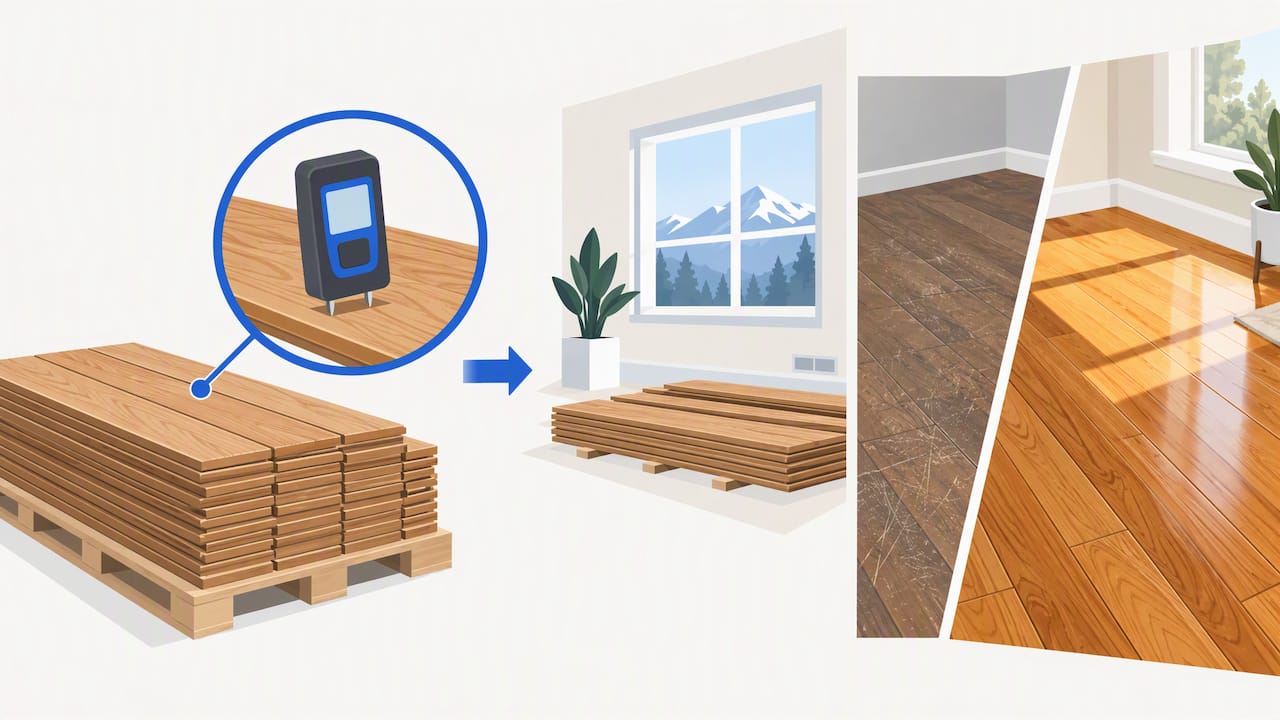
A stable indoor environment plus professional testing and acclimation can help reduce seasonal movement in a hardwood floor.
How do finish costs and durability compare in Colorado?
Cost and durability pull in different directions, so it helps to look at what each service does for you. A screen and recoat refreshes the top coat on a floor that is otherwise in good shape. We list it from $2.50 per sq. ft. on our services page, which makes it the lower-cost way to keep protection current. Full sanding and refinishing runs $4.20–$5.50 per sq. ft. and resets the floor to bare wood, which is the right call when wear has gone past the finish.
Where does the finish type fit? Conventional polyurethane and UV-cured finishes both protect well, and the difference shows up in how quickly you get your room back and how hard the surface feels afterward. UV-cured finishes use UV light to cure, which can help reduce the wait before walking on the floor. For a busy Colorado household that wants durability and minimal downtime, that is a compelling trade. Our guide to tough finishes for Colorado hardwood floors walks through the options, and we are happy to quote either route.
A thought on value: the cheapest finish is the one you do not have to redo early. Pairing a durable coat with a steady indoor climate stretches the time between recoats.
What ventilation and humidification tips protect hardwood in Colorado homes?
Start with measurement. Guessing is how floors get surprised.
Then work through the usual levers:
- Humidify in winter. Furnaces dry indoor air fast. A whole-house unit keeps everything steady, while portable units can cover a room or two. Keep them clean, since a dirty humidifier is a poor houseguest.
- Ventilate with intention. Run bathroom and kitchen exhaust fans to remove moist air at the source, and avoid venting dryer exhaust indoors.
- Mind the shoulder seasons. Spring and fall can swing quickly, so keep checking the hygrometer instead of assuming you are set.
- Seal the envelope. Drafty windows and doors pull in dry outdoor air and make humidification work harder. Our partners at One Day Doors & Closets share useful advice on winterizing your doors, which complements everything above.
- Watch the floor’s own signals. Small seasonal gaps are normal. Cupping or crowning points to a moisture source that needs a closer look.
Colorado’s character is low humidity and big temperature swings, as the CCU climate overview notes, so consistency matters more than any single gadget.
My take: skip the species debate and fix the sequence
Most hardwood advice for Colorado leans hard on species lists, and I think that is the least useful place to start. I would start somewhere else. Wood responds to the surrounding air, and Colorado’s air is dry and changeable. In our experience, floor problems can stem from timing and environment, such as installing before the HVAC is settled or without moisture testing or humidity control.
So here is what I would do first. Test the site. Stabilize the house. Confirm acclimation with readings, not a calendar. Then choose between solid and engineered based on how well you can hold humidity, and pick a species you love. Wide solid plank in a home with no humidification is a gamble no species can win. A narrow, well-acclimated white oak board in a controlled house is a quiet success story.
Species still matter for hardness and looks. They just rank behind process.
— J.R.
How we help Colorado homeowners get hardwood that lasts
We serve the Denver Metro Area and surrounding Colorado communities with hardwood installation, full sanding and refinishing, screen and recoat, wax removal, clean and buff, and Instant UV-curable finishing. You get a free over-the-phone quote from the owner, based on what you tell us and the photos you send, along with eco-friendly products and clear, predictable scheduling.
Not sure what your floor needs? Send us photos and we will talk through site conditions and a plan. Request your free quote on our services page.

FAQ
What type of flooring is best for living in a Colorado climate?
Engineered hardwood is usually the steadiest choice for Colorado’s dry, changeable air, while carefully chosen domestic species like white oak and hickory also perform well. Whichever you pick, you still need to hold indoor humidity near the NWFA-recommended 30–50% range.
What are the top hardwoods for dry climates?
White oak, hickory and select maples are our go-to domestic options for durability. Species differ in shrinkage rates, so board width and plank format matter as much as the name on the box.
What climate is Colorado in?
Colorado is known for low relative humidity, big daily temperature swings and high-elevation conditions, as the CCU climate overview describes. That combination is why wood floors here tend to settle at a lower moisture level than in most states.
Where can I find hardwood in Denver?
Local flooring showrooms and lumber suppliers across the Denver Metro Area carry hardwood, and we can talk you through species, format and installation planning when you call for a free quote. Ask any supplier for the manufacturer’s moisture limits and installation instructions before you buy.
Sources
- Ccu
- By Phil Mitchell North Carolina State University
- Dimensional Changes in Wood | Oklahoma State University
- Waterknowledge