 Skip to content
Flooring services in Arvada range from sandless screen-and-recoat work starting at $2.50 per square foot to advanced UV-curable finishes, including Diamond Traffic Plus at $5.50 per square foot. The right choice depends on whether your hardwood needs a surface refresh, a full restoration, or protection against demanding household traffic.
A typical Arvada living room tells the story. Muddy shoes collect grit near the entry, a dog's nails leave fine scratches along the hallway, and years of furniture movement dull the finish around the dining table. You may be wondering whether hardwood floor refinishing can restore the room or whether replacing the flooring would be more practical.
For many homes, restoration deserves a closer look first. Arvada has approximately 52,952 housing units, and 74.9% were owner-occupied during 2019–2023, according to the U.S. Census Bureau's Arvada profile. That owner-oriented market encourages long-term decisions about appearance, durability, and preserving existing materials.
Why Homeowners in Arvada Are Reviving Hardwood Floors
A homeowner in Olde Town Arvada might uncover original oak beneath a worn finish, while a family near Ralston Valley may have newer flooring marked by years of pet traffic. Those floors call for different decisions. Light scuffs and a dull surface may need cleaning and a fresh coat, while deep scratches or exposed wood may require dust-free sanding.
Arvada's growth from a small town into an established city helps explain why its homes contain such varied flooring and remodeling histories, as recorded on the City of Arvada's history page. Original hardwood, mid-century materials, later additions, and replacement sections can exist under one roof.
A mature housing market needs more than replacement
The city's housing inventory has a median age of 38.2 years, and the median value of owner-occupied homes is about $659,100, according to the Census Bureau. In a market where many residents own their homes, preserving usable flooring can make practical sense. Owners often weigh long-term appearance, durability, waste, and the character of the existing boards before choosing replacement.
Arvada's humidity swings add another question. Wood responds to moisture much like a sponge: it expands when indoor humidity rises and contracts as conditions dry. That movement can open gaps, raise board edges, or loosen a finish. Sanding before identifying the moisture source can make the floor look better briefly while leaving the underlying problem in place.
Refinishing also avoids some work tied to new flooring, including demolition, disposal, transition adjustments, and subfloor preparation. If the boards remain stable and have enough usable wear layer, restoration can preserve more original material. Homeowners comparing repair options may also find useful context in this resource on professional hardwood repair for Fort Collins, particularly when deciding whether damage is cosmetic or structural.
A floor inspection should answer four practical questions:
- Is the damage only in the finish? Dullness, light scuffing, and compatible surface wear may respond to cleaning or a screen and recoat.
- Is the wood itself damaged? Deep scratches, stains, exposed timber, or widespread finish loss can indicate full sanding.
- Is moisture causing movement? Cupping, crowning, and persistent gaps require investigation before sanding.
- Can the existing boards be preserved? If so, refinishing may retain the home's character with less waste than replacement.
Traffic Grade UV Finishes and What They Offer
A busy Arvada household can test a floor quickly. Shoes track grit through the entry, chairs shift across the dining area, and pets turn a hallway into a daily route. The finish is the floor's protective skin. The wood supplies the structure, stain shapes the appearance, and the finish absorbs much of the abrasion.
A UV-Cure System uses ultraviolet energy to initiate rapid curing after application. The process is similar to setting a coating with a controlled burst of energy instead of waiting for it to harden gradually. That can support a faster return to service, but surface preparation, coating compatibility, and application still affect the result.
The available traffic-grade options form a practical range:
| Finish Level | Price Per SqFt | Key Feature |
|---|---|---|
| Diamond Traffic Plus | $5.50 | UV-curing with nano wear and unmatched wear and scratch resistance |
| Platinum Traffic Plus | $4.80 | 2K water-based finish with nano wear oxide additive |
| Gold Traffic Plus | $4.50 | Scratch resistance with a 2K water-based finish |
| Silver Traffic Plus | $4.20 | Excellent wear resistance with a 1K water-based finish |
These rates are supplied through the Instant UV-Curable Finish service. The right tier depends on traffic, pets, furniture movement, and how long the owner expects to remain in the home. Arvada's high owner-occupancy makes that last point practical. A homeowner planning to stay may value longer wear life, while someone preparing a property for sale may prioritize appearance and a quick return to use.
Diamond Traffic Plus suits demanding settings, including busy family rooms, pet-heavy homes, rental turnovers, and selected commercial spaces. Its UV-curing and nano-wear technology target strong scratch and wear resistance.
Platinum Traffic Plus combines a two-component water-based finish with a nano wear oxide additive. It can fit property managers, realtors preparing a listing, and homeowners seeking added durability without choosing the highest tier.
Gold Traffic Plus uses a two-component water-based finish focused on scratch resistance. It may suit active homes with pets and frequent furniture movement when the floor does not need the Diamond specification.
Silver Traffic Plus uses a one-component water-based finish and emphasizes wear resistance. Bedrooms, guest rooms, and lighter-traffic areas may not need the cost or chemistry of a higher tier.
“Water-based” describes the carrier and chemistry. It does not mean every product has the same emissions, cure time, or performance. The EPA's Indoor AirPlus guidance recommends that at least 90% of interior hard-surface flooring materials, adhesives, and underlayments be certified as low-VOC or no-VOC emitting. Ask for product documentation and technical data before choosing a finish.
For cure mechanisms and product questions, see this instant UV-curable hardwood floor finish guide. A UV finish can improve the refinishing trade-off for a sound existing floor, but it cannot make unstable boards or moisture damage disappear.
How Full Sanding Differs From Screen and Recoat
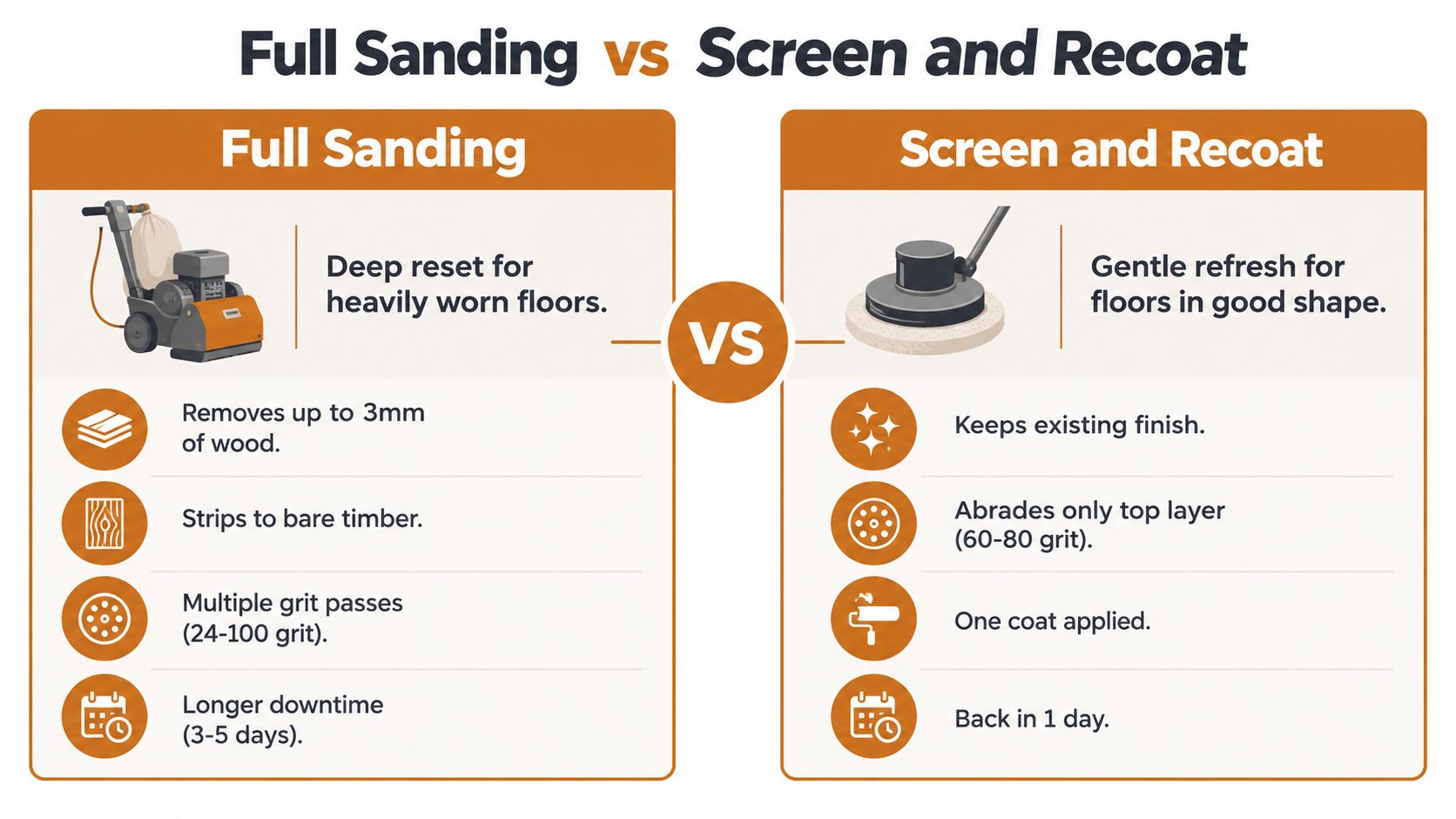
Full sanding and screen and recoat solve different problems. Think of full sanding as resetting a heavily worn surface, while screen and recoat is closer to refreshing the protective layer before the underlying wood becomes vulnerable.
Full sanding for deeper wear
A full sanding project may involve inspection, preparation, dust-controlled sanding, several abrasive passes, edge work, stain if selected, and new finish coats. The process removes the existing finish and enough surface material to address deeper scratches, uneven coloration, and areas where raw wood is exposed.
It's the more suitable direction when:
- Scratches reach into the timber: A new coat alone can't hide damage that has cut below the existing finish.
- The finish has failed broadly: Peeling, severe wear, or incompatible old coatings may require removal.
- The color needs to change: Staining generally requires a properly prepared bare-wood surface.
- Boards need leveling: Uneven wear may require more substantial preparation than a light abrasion.
The full sanding and refinishing service is designed for this deeper restoration route. Before sanding, a professional should still check for loose boards, moisture-related movement, and areas too thin for aggressive removal.
Screen and recoat for sound wood
Screen and recoat lightly abrades the existing finish, cleans the surface, and applies a compatible new coat. It doesn't remove substantial wood, so it's a better fit when the boards are stable and the problem is surface dullness, minor scuffing, or early wear.
The service starts at $2.50 per square foot, while wood floor cleaning starts at $1.50 per square foot, according to the screen and recoat service information and clean and buff service information. Wax removal starts at $2.50 per square foot, and it may be necessary before applying a compatible finish, as described in the hardwood wax removal service.
Practical rule: If the finish is tired but the boards are stable, start with the least aggressive treatment that can solve the actual problem.
The sandless screen and recoat approach can reduce disruption, but it won't correct cupping, rot, deep gouges, or a moisture problem beneath the floor.
Refinishing Hardwood Versus Installing New Flooring
An Arvada homeowner may see scratched, faded boards and assume replacement is the practical answer. In a high owner-occupancy market, however, the better choice often depends on how long the household plans to stay, how the floor is built, and whether the damage reaches below the finish.
Refinishing keeps the original material in place. It can preserve the character of an older Arvada home, limit demolition, and make use of boards that still have service life. The compromise is clear: sanding cannot correct every structural defect, and the final color and texture depend on the wood species and its existing condition. Seasonal humidity swings also matter because a floor that looks acceptable in one season may show movement or gaps later.
Replacement with LVP or laminate deserves closer consideration when:
- Water exposure is routine: Entry areas, laundry rooms, and zones with recurring moisture may suit a different flooring material.
- The subfloor needs correction anyway: Removing the old floor creates access for repairs and preparation before the new surface goes down.
- The existing boards cannot be stabilized: Rot, severe movement, or widespread failure may make restoration impractical.
- A uniform new look matters: New material can produce a consistent appearance across additions, remodeled rooms, and older areas.
Compare the full project, not only the material
An honest comparison includes preparation, demolition, disposal, transitions, trim, repairs, finish chemistry, curing time, and household disruption. A low material cost can rise after subfloor correction and installation work are included. Refinishing may cost more in finish preparation, while replacement may add removal and disposal work.
The same reasoning applies to rentals and commercial spaces. Water resistance can help in a wet zone, yet structurally sound hardwood may remain the better long-term choice when it can be repaired. Durability matters, but it does not decide the project by itself. Moisture exposure, repair requirements, turnover timing, appearance goals, and expected service life all belong in the comparison.
For new material, review installation requirements and emissions documentation before choosing. The hardwood floor installation service covers hardwood, LVP, and laminate options, allowing homeowners to discuss the substrate and room conditions before committing to a surface.
Managing Moisture and Climate in Colorado Homes
A homeowner in Arvada may see gaps appear during a heated winter, then watch them narrow when indoor moisture rises. Hardwood works like a bundle of narrow drinking straws: boards exchange moisture with the surrounding air and change size across their width. In this dry, high-altitude setting, seasonal indoor-air changes can contribute to gaps, cupping, crowning, or stress at the joints.
The NWFA installation guidelines identify a controlled post-occupancy environment of approximately 30% to 50% relative humidity and 60°F to 80°F. Keeping the home near that range year-round limits repeated dimensional cycling after installation or refinishing. For owner-occupants, that routine care can help preserve an existing floor and may support refinishing instead of premature replacement.

Measure before choosing a treatment
A comfortable room can still conceal different moisture levels in the floor and subfloor. Before installation, NWFA guidance recommends at least 20 moisture readings per 1,000 square feet, with results averaged. The same guidance generally allows a wood-to-subfloor difference of no more than 4 percentage points for solid strip flooring under 3 inches wide and 2 points for flooring 3 inches or wider.
A professional moisture survey therefore gives better direction than appearance alone. It should review:
- HVAC operation: Confirm that heating and cooling systems are working normally.
- Humidity readings: Measure indoor relative humidity instead of relying on comfort.
- Moisture mapping: Check exterior walls, plumbing zones, entries, and other risk areas.
- Acclimation: Let flooring adjust to normal occupied conditions before fastening or finishing.
A high-end renovation also benefits from coordinating flooring with ventilation, heating, and finish schedules. This guide for luxury home clients provides broader planning context.
A finish can protect a stable floor. It can't repair a moisture source underneath it.
Use removable runners at entrances and busy routes, as recommended in National Park Service guidance for historic interiors. Select coverings that do not trap moisture or have abrasive backing. Seasonal gaps that open and close may reflect normal movement. Persistent cupping or crowning points to a condition that should be inspected before refinishing or replacing the floor.
Trusted Local Flooring Experts in Arvada and Beyond
Arvada homeowners often weigh refinishing against replacement differently from short-term property owners. With high owner-occupancy, preserving original hardwood can protect a home's character for years, while replacement may make sense when boards are too damaged, loose, or mismatched for practical restoration.
A local flooring team should identify whether the problem is worn finish, wax buildup, deep abrasion, loose boards, or movement related to Arvada's humidity swings. That diagnosis works like sorting a surface stain from damage beneath the wood. The remedy changes with the cause.
J.R. Hardwood Floor Refinishing & Cleaning has handled red oak restoration in Denver, oak refinishing in Parker, and home projects in Castle Rock. Its services include dust-free sanding, screen and recoat, deep cleaning, wax removal, full refinishing, installation, and Instant UV-Curable Finish services. Product selection should match the floor and household, with ventilation and product documentation reviewed during composite flooring installation and finishing.
Homeowners coordinating several projects can also use streak-free window cleaning Arvada. For local floor conditions and service options, review this hardwood floor refinishing near Arvada resource.
Documented workmanship is available through flooring project videos, customer testimonials, and the company's YouTube channel.
Frequently Asked Questions About Floor Care
Does every worn floor need full sanding?
A family-owned Arvada home may have worn finish without damaged wood. Deep cleaning, wax removal, buffing, or a screen and recoat can refresh that surface. Full sanding makes more sense when scratches, stains, or finish failure reach into the boards. The right choice protects usable wood and avoids unnecessary removal.
Can pets stay in the home?
Pet access depends on the coating, ventilation, preparation, and curing requirements. Ask about re-entry before work begins, then follow the manufacturer's technical data sheet. A local owner-occupant may prefer a faster system, but curing requirements still control when rooms are ready.
How should hardwood be maintained?
Use entry runners, remove grit promptly, clean with a product approved for the finish, and keep standing moisture off the boards. Removable coverings and compatible protective treatments can help protect wood interiors, while unnecessarily harsh cleaning can cause damage.
Can refinishing fix movement?
Refinishing cannot correct movement caused by moisture imbalance. Cupping, crowning, or stressed joints need investigation first. Check indoor humidity, plumbing zones, exterior walls, and subfloor conditions before sanding, especially through Arvada's changing humidity.
J.R. Hardwood Floor Refinishing & Cleaning provides evaluations and quotes through its website, serving Arvada, Denver, Wheat Ridge, Westminster, and nearby Colorado communities. Its services include dust-free sanding and UV-curable finishes, with product and re-entry details confirmed for each home. Phone: 720-327-1127.