 Skip to content
TL;DR:
- Refinishing hardwood floors offers a cost-effective way to restore appearance and increase home value, often saving thousands compared to full replacement. However, it is unsuitable for floors with structural damage, thin veneer, or severe wear, requiring professional assessment for accurate evaluation. Properly understanding refinishing types and limitations ensures homeowners avoid costly mistakes and maximize the lifespan of their floors.
Deciding whether to refinish or replace your floors is one of those home improvement questions that seems simple on the surface but gets complicated fast. The pros and cons of refinishing aren’t always obvious, and making the wrong call can cost you thousands of dollars or leave you with results that don’t match your expectations. Whether you’re a homeowner trying to freshen up aging hardwood or a property investor weighing costs before a sale, understanding exactly what refinishing can and cannot do for your floors is the smartest place to start.
Table of Contents
- Key takeaways
- What floor refinishing actually involves
- The refinishing benefits worth knowing
- The disadvantages of refinishing floors
- Refinishing vs. replacement: how to decide
- My honest take on what most homeowners miss
- See what refinishing can do for your floors
- FAQ
Key takeaways
| Point | Details |
|---|---|
| Refinishing saves money | Refinishing costs about one-third of full replacement and delivers visually similar results. |
| Not every floor qualifies | Thin engineered veneer and structurally damaged floors are poor candidates for refinishing. |
| Two main refinishing types exist | Screen-and-recoat suits minor wear; full sanding is required for color changes or deeper damage. |
| High ROI at resale | Refinishing ranks among the top improvements for value according to the National Association of Realtors. |
| Professional assessment matters | Misreading finish damage as structural damage is one of the most costly homeowner mistakes. |
What floor refinishing actually involves
Before you can weigh whether refinishing is right for your situation, you need to understand what the process actually looks like. Think of refinishing as a full spa day for your floors. The old, tired surface gets stripped back, refreshed, and sealed up with a protective new coat that makes the wood look years younger.
There are two main types of refinishing, and the difference between them is significant.
Screen-and-recoat is the lighter option. It buffs the existing finish with a fine abrasive screen and applies a fresh topcoat without sanding down to bare wood. This works beautifully when your floors are just dull or lightly scratched but the finish layer is still intact. Screen-and-recoat costs around $1.50 to $3 per square foot, making it a budget-friendly refresh for floors that don’t need major work.
Full sanding and refinishing is a more intensive process. Crews make three sanding passes with progressively finer grits to strip the floor back to bare wood, then apply stain (if desired) and multiple coats of polyurethane or another finish. This is the right approach when you want to change the stain color, address deeper scratches, or restore floors with significant wear. It typically costs $3 to $8 per square foot, so a standard 300-square-foot room runs between $1,200 and $2,400.
| Refinishing type | Best for | Approx. cost per sq ft | Typical duration |
|---|---|---|---|
| Screen-and-recoat | Minor dullness, light surface wear | $1.50 to $3 | 1 to 2 days |
| Full sanding and refinishing | Deep scratches, color change, major wear | $3 to $8 | 3 to 5 days |
One thing many homeowners don’t account for is time. Full sanding projects typically take 3 to 5 days including dry times between coats, and you’ll need to stay off those floors while finishes cure. Planning around that disruption is part of making the project go smoothly.
Pro Tip: Get a square footage measurement before calling for a quote. Knowing your room dimensions lets you have a more productive conversation with any flooring professional and gives you a realistic budget baseline before the first visit.
The refinishing benefits worth knowing
Let’s talk about why refinishing has remained one of the most popular home improvement decisions for decades. The refinishing pros are real, practical, and financially significant.
Cost savings are the biggest draw. Full floor replacement runs $8 to $15 per square foot installed, compared to $3 to $8 for professional refinishing. That’s roughly one-third of the cost for results that often look identical to a brand-new floor. For a 1,000-square-foot home, the difference between refinishing and replacing could be $5,000 to $10,000.
The return on investment is excellent. Refinishing hardwood floors is consistently cited by the National Association of Realtors as one of the highest-ROI home improvements, often recovering 100% or more of the project cost at resale. If you’re a property investor, that math is hard to argue with.
Refinishing also gives you the chance to hit the reset button on your floor’s appearance without starting from scratch. You can change the stain color entirely, going from a golden oak to a rich espresso, or choose a new finish sheen from matte to glossy. That flexibility is something replacement offers too, but at three times the price.
There’s also an environmental angle worth considering. Keeping your existing hardwood floors means keeping thousands of board feet of wood out of a landfill. For homeowners who care about sustainability, refinishing is the more responsible choice.
Solid hardwood floors can typically be refinished multiple times over their lifespan, making the long-term cost of ownership significantly lower than replacement-focused approaches. That’s a financial advantage that compounds over decades.
Finally, refinishing is a similar story for other surfaces in your home. Cabinet refinishing, for example, has been shown to deliver up to 96% ROI in comparable home improvement scenarios, reinforcing the broader principle that restoring is almost always more cost-effective than replacing.
The disadvantages of refinishing floors
Now for the honest side of the conversation. Knowing the disadvantages of refinishing is just as important as knowing the benefits, and skipping this part is how people end up disappointed.
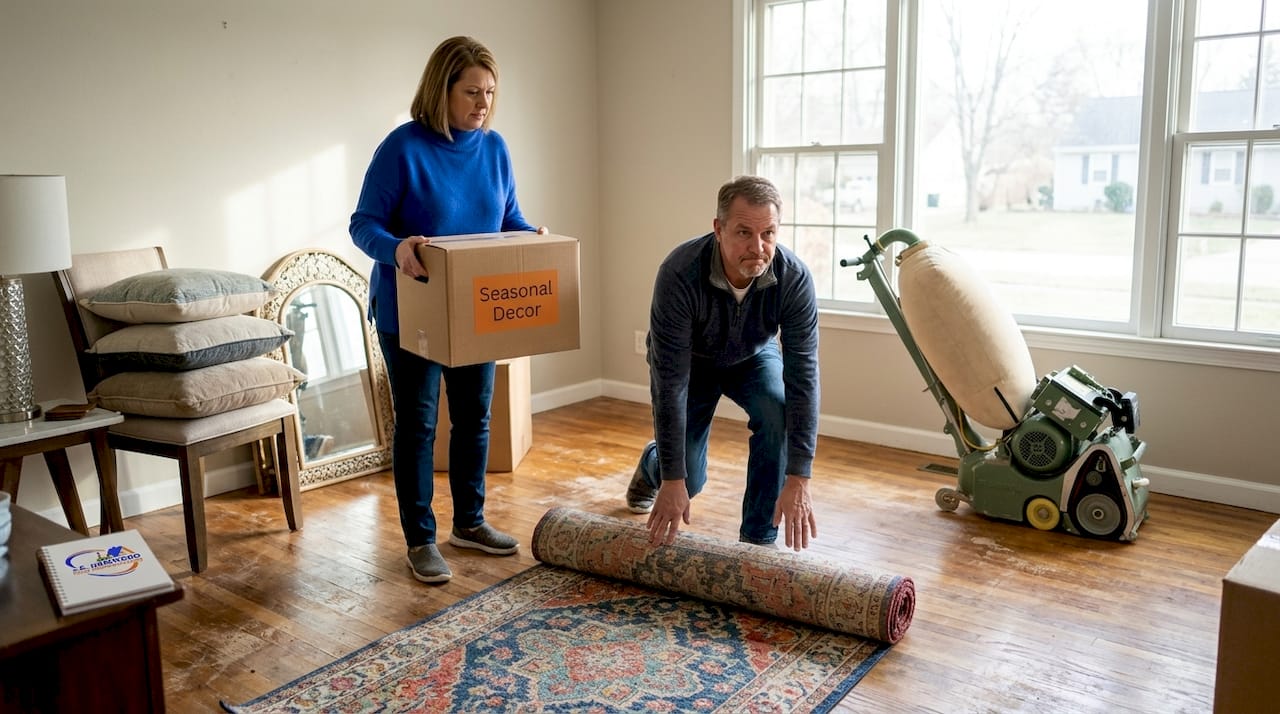
Thin engineered hardwood is often a no-go. This is the one that catches the most homeowners off guard. Engineered hardwood with a veneer below about 2 mm is generally unsuitable for sanding. If you sand through the veneer, the floor is irreparably damaged and must be replaced entirely. Thicker veneer of 3 to 6 mm may allow for several refinishes over the floor’s life, but you need to know your product’s specifications before committing to anything.
Here’s a quick look at when refinishing runs into trouble:
- The floor has structural problems like warping, buckling, or significant cupping
- Water damage or termite damage has compromised the wood beneath the finish
- The floor has already been refinished multiple times and has little wood thickness remaining
- The veneer on engineered hardwood is too thin to sand safely
- Boards are severely cracked, split, or have large gaps that sanding won’t fix
Refinishing cannot fix structural damage like warped or buckled boards. If the problem is underneath the finish, no amount of sanding and sealing is going to solve it. You’d be putting a fresh coat of paint on a cracked wall.
DIY refinishing carries significant risk. Yes, you can rent a drum sander and try to do this yourself, and yes, DIY can cut costs by over 50%. But drum sanders are powerful tools that require real skill. Improper technique creates visible gouges, uneven surfaces, and swirl marks that a professional then has to correct, often costing more than hiring a pro from the start. Applying polyurethane evenly is also harder than it looks.
Pro Tip: If you’re seriously considering DIY refinishing to save money, our guide on DIY vs. professional refinishing breaks down exactly where homeowners run into trouble and how to decide which route makes sense for your specific project.
The project also means real disruption to your home. You’ll need to empty rooms, stay off floors for days, and deal with dust and finish fumes. For families with young children, pets, or anyone with respiratory sensitivities, that’s a practical concern worth planning around carefully.
Refinishing vs. replacement: how to decide
This is where everything comes together. The question “should I refinish or replace?” really comes down to one core assessment: is your floor’s problem in the finish layer, or is it in the wood itself?
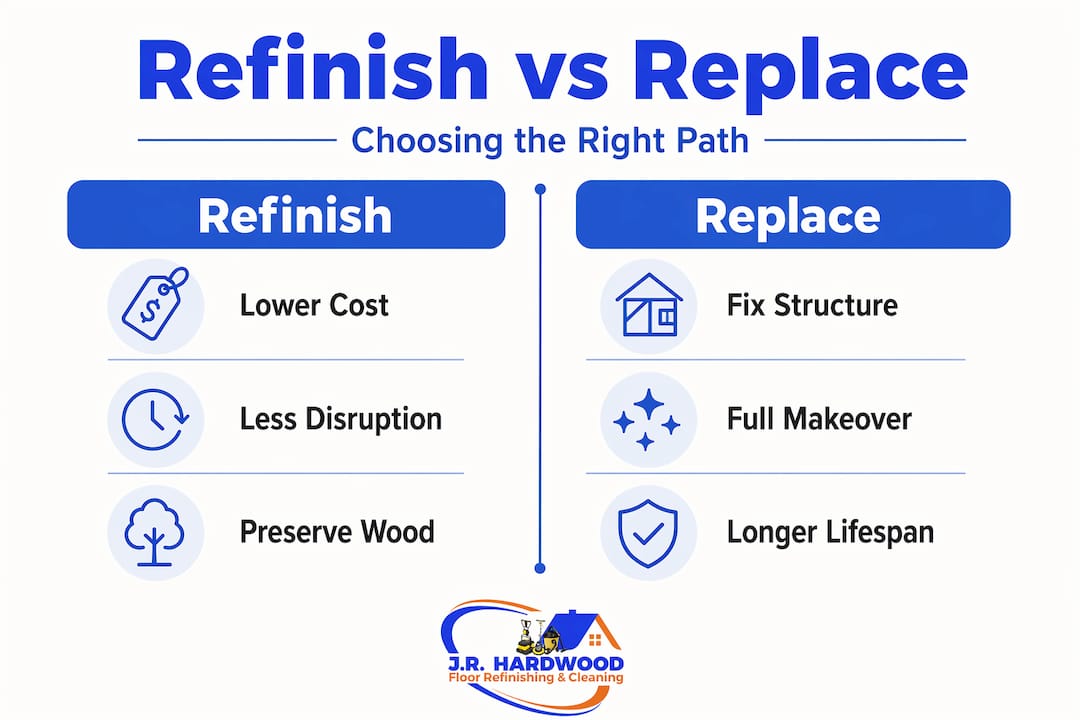
If the damage is limited to the surface finish, scratches, dullness, sun fading, or light discoloration, refinishing is the right call. The wood underneath is sound, and refinishing can fully restore the appearance at a fraction of replacement cost. This is the scenario where refinishing shines brightest.
If the damage is structural, think warping, widespread cupping, severe water damage, or termite destruction, refinishing is not going to solve your problem. You may need partial board replacement combined with refinishing, or in serious cases, full floor replacement.
Here’s a practical comparison to guide your thinking:
| Scenario | Best choice | Why |
|---|---|---|
| Scratches, dullness, light wear | Refinishing | Damage is finish-level; wood is sound |
| Want to change stain color | Full sanding/refinishing | Surface must be stripped to bare wood |
| Engineered wood, thin veneer | Replace or screen-and-recoat only | Sanding risks sanding through veneer |
| Warped, buckled, or water-damaged boards | Replacement or partial repair | Structural issue refinishing cannot fix |
| Multiple prior refinishes, thin wood | Replace | Not enough wood thickness left to sand |
| Minor surface dullness only | Screen-and-recoat | Cost-effective and low disruption |
Timing and home disruption also matter. A refinish vs. replace decision for a property you’re about to sell looks different from the same decision for a home you’ll live in for 20 more years. For investors, refinishing before a sale often makes the most financial sense. For long-term homeowners, replacement might be worth considering if the floor is near the end of its refinishing life.
The most reliable way to make this call is a professional assessment. Successful refinishing depends on careful evaluation of wood species, finish type, veneer thickness, and existing damage. A few minutes with a qualified flooring professional can save you from an expensive misstep in either direction.
My honest take on what most homeowners miss
I’ve walked through hundreds of homes where the homeowner was convinced their floors were ruined. Nine times out of ten, what looked like serious damage was finish wear, not wood damage. Most visible floor damage is actually in the finish layer, and that changes the whole conversation. Refinishing can restore what looks like a destroyed floor to near-perfect condition for a fraction of replacement cost.
What I’ve learned is that the decision often gets made too early, before anyone actually looks closely at the wood. People see dull, scratched, gray-looking floors and assume the wood is gone. But pull up a floor vent cover, look at the wood underneath the finish layer, and you’ll often find perfectly healthy wood just waiting for a fresh start.
The other thing I see is phased refinishing gone wrong. Phasing refinishing by room sounds like a smart way to manage costs and disruption. And it can be. But rooms done at different times with different batches of stain often don’t match perfectly, and you end up with a patchwork floor that looks worse than before. If your floors are interconnected, doing them all at once is almost always the better call, even if it means waiting a little longer to save up.
The bottom line is this: get a real assessment before you decide anything. Don’t rely on what the floor looks like from standing height. The difference between a floor that needs refinishing and one that needs replacement is in the details, and getting that wrong is an expensive mistake in either direction.
— J.R.
See what refinishing can do for your floors
If you’ve been weighing whether refinishing is worth it, the best next step is a real conversation about your specific floor’s condition. At Jrhardwoodfloorrefinishingandcleaning, we offer free over-the-phone quotes based on verbal information and photos, so you can get expert guidance without scheduling an in-home visit just to find out where you stand.
We serve homeowners and property investors across the Denver Metro Area, from Parker and Castle Rock to Boulder and Colorado Springs. Whether you need a full sanding restoration or a quick screen-and-recoat to freshen up before a sale, we’ll help you figure out what your floor actually needs. Explore our complete refinishing guide to go deeper on processes and pricing, or check out our breakdown of DIY vs. professional service to decide which approach fits your project.
FAQ
How much does professional floor refinishing cost?
Professional refinishing typically costs $3 to $8 per square foot for full sanding, and $1.50 to $3 per square foot for a screen-and-recoat. A standard 300-square-foot room runs between $1,200 and $2,400 depending on the scope of work.
Can engineered hardwood floors be refinished?
It depends on the veneer thickness. Engineered hardwood with a veneer below about 2 mm is generally not a good candidate for sanding, while thicker veneer of 3 to 6 mm may allow for several refinishes over the floor’s life.
Is refinishing worth it before selling a home?
Yes, in most cases. Refinishing floors can recover 100% or more of the project cost at resale and makes a strong first impression on buyers. It’s one of the highest-ROI improvements you can make before listing a property.
What is the difference between screen-and-recoat and full sanding?
Screen-and-recoat refreshes the existing finish without sanding to bare wood and works best for minor surface wear. Full sanding strips the floor entirely and is required for color changes, deeper scratches, or significant damage.
When should I replace floors instead of refinishing them?
Replace your floors when you have structural damage like warping, buckling, or termite damage, when the wood is too thin from previous refinishes, or when your engineered veneer is too thin to sand safely. Refinishing cannot fix problems that exist beneath the finish layer.