 Skip to content
Installed LVP in Denver typically costs a moderate to higher price per square foot depending on material grade and subfloor complexity, resulting in a range that can significantly increase once removal, stairs, or subfloor repairs are included.
TL;DR:
- Most Denver LVP projects cost more when subfloor repair, removal of old flooring, or stairwork are included, often adding to the initial per-square-foot estimate.
- Higher-grade LVP with thicker wear layers or rigid cores costs significantly more but offers better resistance to dents, moisture, and high traffic, which is crucial in Denver’s climate.
- Subfloor issues caused by Denver’s low humidity and temperature fluctuations are common and often require leveling, increasing both material and labor costs.
- Proper inspection and clear communication about included scope items are essential to avoid unexpected expenses and ensure a reliable, comprehensive quote.
- Phasing installation room by room can reduce upfront costs and disruption but may incur additional mobilization fees, while continuous projects are more cost-effective overall.
Table of Contents
- Detailed Cost Breakdown: What You’re Paying For In Denver
- Sample Project Estimates For Common Denver Home Sizes
- What Actually Drives Your Final Price Up
- Why Denver’s Climate Changes The Installation Math
- How To Get A Quote You Can Actually Trust
- What Local Experience Looks Like In Practice
- Where Homeowners Get This Wrong
- Ready For Your Free Denver Flooring Quote?
- Sources
- FAQ
Detailed Cost Breakdown: What You’re Paying For In Denver
Once you see a quote broken into pieces, the number stops feeling random. Two things drive the price: the material you pick, and the labor it takes to get it on your floor.
On the material side, entry-level LVP with a thin wear layer and no attached pad sits at the bottom of the range. Step up to a rigid SPC core with a thicker wear layer, or a WPC plank with attached underlayment, and you’re paying more per box, but you’re also buying a floor that shrugs off dents and moisture better. A mid-grade plank with a 20 to 30 mil wear layer tends to be the sweet spot for Denver homes dealing with pets, kids, and the occasional muddy boot.
Labor is the other half of the equation, and it’s where a lot of homeowners get surprised. A local Denver cost guide estimates installation labor at a base rate starting near $1.59 per square foot, with typical upper ranges somewhat higher depending on job specifics. That labor figure usually covers layout planning, cutting and fitting planks around obstacles, installing transitions, and a basic cleanup, but it’s worth confirming exactly what’s included before you sign anything.
Here’s what typically shows up in a material and labor quote:
- Plank material: priced per square foot, varies by wear layer thickness and core type (SPC, WPC, or standard).
- Installation labor: covers layout, cutting, fitting, and basic finishing around the room’s edges.
- Underlayment: sometimes built into the plank, sometimes a separate line item if you need extra sound dampening or moisture protection.
- Trim and transitions: quarter round, thresholds between rooms, and reducer strips at doorways.
- Waste allowance: extra material to cover cuts and mistakes, not wasted money.
That last point deserves its own explanation, because it trips up a lot of first-time buyers. Boxes of LVP cover a set square footage, but you never install exactly what a room measures. The Denver guide advises budgeting extra material to account for cuts and waste, typically on the order of a small percentage increased for straightforward rooms, with higher allowances for complex layouts. Skip this step and you’ll either run short mid-install or scramble to match a discontinued batch later, neither of which is a fun Tuesday.
Trim and transition pieces add up faster than people expect too. Every doorway, every spot where your new LVP meets tile or carpet, and every staircase needs a transition strip or threshold to look finished and stay safe underfoot. None of this is padding on your invoice. It’s the difference between a floor that looks like a photo shoot and one that curls at the edges within a year.
Sample Project Estimates For Common Denver Home Sizes
Numbers get real once you apply them to your own square footage. Here’s how the math typically plays out for the project sizes we see most often around Denver.
- 900 to 1,000 square feet (a typical main living area): entry-level installations fall within an affordable to moderate range. Mid-grade material installations cost more, with premium plank selections increasing the total further.
- 1,500 to 2,000 square feet (most or all of a single-story home): entry-level material installation costs range somewhat higher, mid-grade options cost more accordingly, and premium selections add further to the total, especially if additional preparation is required.
- Small rooms (a bedroom or home office around 150 to 200 square feet): pricing per square foot may appear higher due to minimum labor charges and waste, with total costs varying depending on material grade and room complexity.
If your budget is tight, phasing the project room by room is a completely reasonable approach. It spreads out the cost and lets you live in part of the house while the rest waits its turn, though it does mean paying a separate labor mobilization cost each time a crew comes back. For most homeowners, one continuous install is cheaper overall, but phasing beats putting the whole project on a credit card.
What Actually Drives Your Final Price Up
The base per-square-foot number is the easy part. The line items that follow are where budgets get stretched, and understanding them ahead of time keeps you from feeling blindsided.
- Old flooring removal: pulling up carpet is usually the cheapest to remove, while tile and old glued-down flooring cost more because they take longer to break up and haul away, often priced per square foot or as a flat per-job fee.
- Subfloor leveling: uneven plywood or concrete needs patching or a self-leveling compound before new LVP can go down flat, and this is one of the most commonly underestimated costs in the entire project.
- Stairs: expect per-step pricing or a bundled stair package, since risers, nosing profiles, and tighter cuts make stairs far more labor-intensive than open floor space.
- Thresholds and transitions: every doorway and material change needs its own trim piece, and these add up room by room.
- Door trimming: doors often need to be shaved down slightly so they clear the new flooring height.
Subfloor prep is the one that catches Denver homeowners most often. According to vinyl flooring cost guidance, installers frequently find that plywood subfloors or concrete slabs need leveling before installation can proceed, and this work is commonly excluded from the initial per-square-foot quote because it depends entirely on what the inspection turns up.
Hidden costs can lurk underneath old flooring too. Old adhesive residue, small patches of mold from a past leak, or soft spots from water damage sometimes surface only after the demolition crew pulls up the existing floor. A reputable installer will pause, show you what they found, and give you options rather than just billing you after the fact.
Pro Tip: Ask for a written allowance for subfloor repair before the job starts, even if it’s “$0 expected,” so there’s no ambiguity if something turns up once the old floor comes out.
Why Denver’s Climate Changes The Installation Math
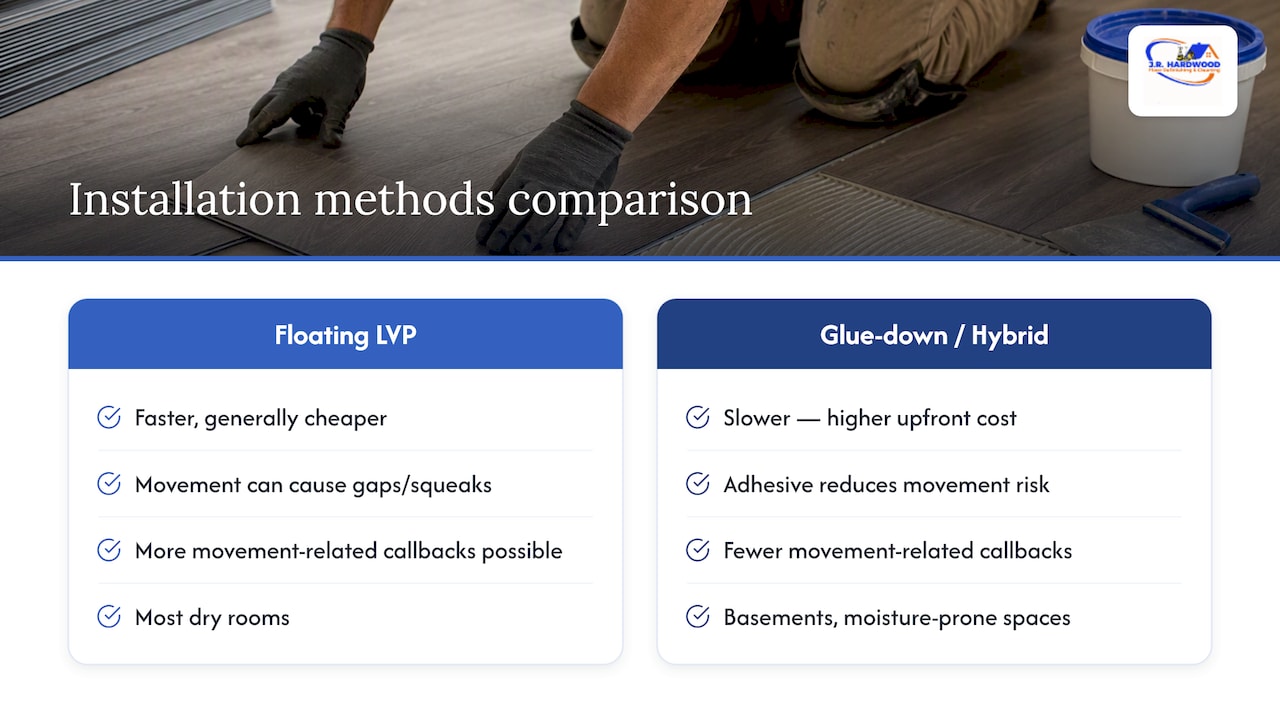
Denver sits at high altitude with low humidity and big seasonal swings, and that combination does something to wood-based subfloors that flatter climates don’t have to deal with. Plywood subfloors expand and contract more here than in humid regions, and that movement can telegraph through a floating LVP floor as gaps, squeaks, or slight ridges if the prep work wasn’t thorough.
Denver’s climate cycles are a recurring reason installers here budget for subfloor leveling as a near-default line item rather than an occasional add-on, according to local installation guidance, which notes that temperature and humidity swings commonly cause the subfloor issues that drive this extra cost.
This is part of why some installers lean toward glue-down or hybrid installation methods in certain rooms, especially basements or spaces with a history of moisture, even though floating floors are generally faster and cheaper to install. The adhesive costs more upfront but can reduce movement-related callbacks down the road.
Timing matters too. Late spring through early fall tends to be the busiest season for Denver flooring crews, since it overlaps with home sales, remodels, and good weather for material delivery. Booking in the shoulder months, like late winter, can sometimes mean more scheduling flexibility, though material costs themselves don’t typically shift with the seasons.
How To Get A Quote You Can Actually Trust
The fastest way to end up overpaying, or underpaying and then getting nickel-and-dimed later, is comparing quotes that aren’t measuring the same thing. A little prep before you call installers fixes that.
Before you reach out, gather this:
- Room-by-room measurements, including closets and any awkward angles.
- Photos of your current flooring, especially any visible damage, stains, or uneven spots.
- Photos of transitions between rooms and any staircases involved.
- Door clearances, since new flooring height can affect how doors swing.
- Notes on anything you already know is a problem, like a squeaky spot or a past leak.
Once you’re talking to installers, these questions separate the professionals from the guessers:
- “What’s included in your per-square-foot price, and what’s billed separately?”
- “Do you test for moisture or check the subfloor before quoting, or only after removal?”
- “What’s your warranty on labor, separate from the manufacturer’s material warranty?”
- “How do you handle change orders if you find subfloor damage mid-job?”
- “What’s your typical timeline from start to finish for a project this size?”
Watch for a few red flags too. A quote given over the phone with zero site visit or photo review for a home with known issues is a gamble. So is vague warranty language, or a deposit that feels disproportionate to the job size. A trustworthy installer puts the scope in writing, explains their change-order policy upfront, and doesn’t flinch when you ask detailed questions.
What Local Experience Looks Like In Practice
A local hardwood floor refinishing and cleaning company serves the Denver Metro Area and surrounding Colorado communities, handling LVP and laminate installation alongside hardwood refinishing and repair work. That range matters because a lot of LVP jobs uncover a subfloor issue that a generalist installer might not know how to solve without tearing everything back out.
The team operates with a focus on quality and transparency, maintaining positive customer reviews and providing video documentation of installation and refinishing processes. They also emphasize the use of eco-friendly products in their finishing steps.
On a typical scope-discovery scenario: an installer pulls up old flooring and finds the plywood underneath has more dips than expected. Rather than installing over it and hoping for the best, a careful inspection catches this before planks go down, adding a leveling step to the quote instead of leaving you with a floor that shows every flaw within a year.
Where Homeowners Get This Wrong
The conventional advice on LVP pricing treats it like a single number you can shop for, and that’s the mistake. The material price is the easy part to compare. What actually separates a good outcome from a frustrating one is how thoroughly an installer inspects your subfloor before quoting, because Denver’s dry, high-altitude climate makes subfloor movement a real and recurring issue, not a rare exception.
If you take one thing from this guide, let it be this: don’t chase the lowest per-square-foot number without asking what it excludes. A quote that skips subfloor inspection isn’t cheaper, it’s incomplete, and the difference usually shows up as an unpleasant surprise a few months after the crew leaves. Prioritize an installer who wants to see your space, asks about past moisture issues, and puts a real scope in writing. The plank you choose matters less than the floor it sits on.
— J.R.
Ready For Your Free Denver Flooring Quote?
Getting a number you can actually plan around starts with a conversation, not a guess. The company offers free over-the-phone quotes based on the measurements and photos you send over, so you get a realistic estimate before a single tool touches your floor.

To make that call as productive as possible, have your room measurements ready along with a few clear photos of your current flooring, any problem spots, and your stairs or transitions if you have them. From there, scheduling is straightforward, and you’ll get guidance tailored to your specific floor rather than a generic estimate pulled from a national average.
If LVP turns out not to be the right fit once we talk through your space, or if your existing hardwood just needs new life instead of replacement, we’ll tell you that too. Check out the LVP and laminate installation page for more on what’s included, or visit our main site to reach out and get your free quote started.
FAQ
How much does it cost to have 1,000 square feet of LVP installed?
A 1,000 square foot LVP installation in Denver typically runs within a moderate to higher price range depending on material grade and subfloor complexity. These costs cover material and installation labor but can rise with subfloor repairs, stairs, or old flooring removal.
How much does 2,000 square feet of LVP flooring cost?
At 2,000 square feet, the cost varies by material grade from entry-level to premium, with the total significantly influenced by subfloor condition and additional removal or stair work.
What is the best LVP flooring brand?
There isn’t one universal best brand, since the right choice depends on your household’s traffic, budget, and whether you need a thicker wear layer for pets or kids. Focus on wear layer thickness and core type, SPC for rigidity or WPC for cushioning, rather than chasing a specific brand name, and ask your installer which options perform best in Denver’s climate.
Why do LVP quotes vary so much between installers?
Quotes often vary because installers include different scope items, some bundle subfloor prep and removal into the price while others quote them separately after inspection. Getting two or three written, line-itemized estimates makes it much easier to compare apples to apples.
Does Denver’s climate really affect LVP installation cost?
Yes, Denver’s low humidity and temperature swings can cause subfloor movement that installers need to address with leveling or patching before installation, and this is a common reason quotes end up higher than initial estimates. Asking about subfloor inspection upfront helps you budget accurately from the start.