 Skip to content
Screening and recoating a gym floor typically runs $2 to $4 per square foot, while a full sanding and refinish lands closer to $3 to $6 per square foot, and premium restoration work with repairs and custom graphics can push $5 to $16 or more per square foot, according to cost breakdowns compiled from industry sources. The Maple Flooring Manufacturers Association (MFMA) backs up the maintenance rhythm behind those numbers, and here at Jrhardwoodfloorrefinishingandcleaning we see the same pattern play out on courts across Colorado every season: floors that get annual attention stay in the cheaper bucket for years longer than floors that don’t.
If your finish looks dull but the wood underneath is sound, you’re a recoat candidate, and that job usually wraps within a few days. If you’re seeing deep gouges, water stains, or a finish that’s peeling in sheets, you’re looking at a full refinish, with about a week or more of downtime more realistic.
Here’s the fast version before we get into the weeds:
- Screen & recoat: Choose this when the finish is worn but the wood shows no deep damage. Downtime: 1 to 3 days.
- Full sand & refinish: Choose this when you see gouges, water damage, or it’s been 8 to 12 years since the last full refinish. Downtime: 7 to 10 days.
- Premium restoration: Choose this when board replacement, moisture repair, or custom graphics are part of the scope. Downtime: 10 to 14 days or more.
Key Takeaways
Gym floor refinishing cost typically runs $2 to $4 per square foot for a recoat and $3 to $6 per square foot for a full sand and refinish, with premium restoration reaching $16 or more.
| Point | Details |
|---|---|
| Recoat pricing | Budget $2 to $4 per sq ft for an annual screen and recoat with 1 to 3 days of downtime. |
| Full refinish pricing | Budget $3 to $6 per sq ft for a complete sand and refinish with 7 to 10 days of downtime. |
| Refinish interval | Plan a full sand and refinish every 8 to 12 years, per MFMA guidance, with annual recoats in between. |
| Watch for escalation | Deep scratches, water stains, or a decade-plus since the last sanding signal it’s time for a full refinish, not another recoat. |
| Work with Jrhardwoodfloorrefinishingandcleaning | Request a free over-the-phone quote with itemized scope, finish details, and timeline before committing to a contractor. |
Collect at least three itemized bids before deciding, and start logging your gym’s sanding history now if you haven’t already.
Table of Contents
- What Drives Gym Floor Refinishing Cost Up or Down
- Gym Floor Refinishing Cost Per Square Foot: A Breakdown
- What You’re Actually Paying For
- Screen and Recoat vs. Full Refinish: Which Does Your Floor Need?
- Add-Ons That Change Your Final Invoice
- How Long Does a Gym Floor Refinishing Project Take?
- How Often Should You Refinish a Gym Floor?
- Getting Accurate Gym Floor Refinishing Quotes
- What Surprises Facility Managers Most About This Process
- Ready to Get a Real Number for Your Gym Floor?
- Sources
What Drives Gym Floor Refinishing Cost Up or Down
Two gyms of identical square footage can get quotes thousands of dollars apart, and the reason almost always traces back to a handful of variables contractors price into every bid.
Floor size matters, but not in a straight line. Smaller jobs (under roughly 2,000 to 3,000 square feet) often carry a higher per-square-foot rate because contractors have fixed setup, equipment transport, and minimum crew costs to cover regardless of size. A 10,000 square foot gym typically sees a lower per-foot price than a 1,500 square foot practice gym, even though the total bill is larger.
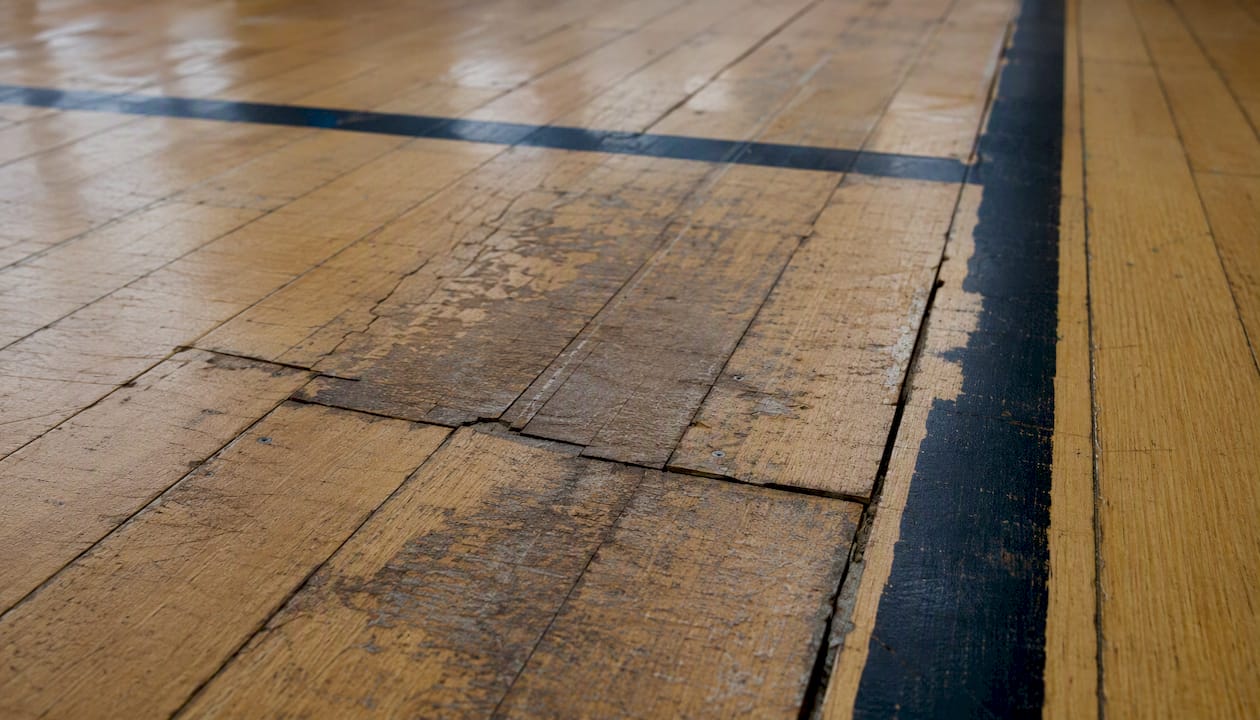
Condition and repairs needed is the biggest wildcard. A floor with cupped boards, water stains near the baseline, or soft spots from a roof leak needs board replacement before anyone can sand it, and that can add several dollars per square foot just for the repair phase.
Finish type shifts cost noticeably. Water-based polyurethane, oil-modified polyurethane, and UV-cured finishes all price differently, and we break down those tradeoffs in the next section.
Court graphics add up fast. A single center-court logo, extra game lines for volleyball or pickleball overlays, and any custom lettering all get quoted separately from the base refinish.
Access and logistics affect labor time. A gym with a loading dock and wide double doors moves equipment in faster than one buried in a school hallway with narrow entry points and stairs.
Season and timing matter because most schools and rec centers want work done during summer break or extended closures, and that demand spike can tighten contractor availability and push prices up during peak months.
Local labor rates vary by region and by how competitive the local contractor market is.
Warranty and maintenance plan terms can be bundled into the quote or billed separately, and that changes the upfront number even when the underlying work is identical.
Pro Tip: Many contractors have a minimum job fee that kicks in below 2,000 to 3,000 square feet, regardless of the quoted per-square-foot rate. If your gym is on the smaller side, ask upfront whether a minimum applies, and get the total dollar figure in writing, not just the per-square-foot number, so you’re not surprised by a “surcharge” line item later.
Gym Floor Refinishing Cost Per Square Foot: A Breakdown
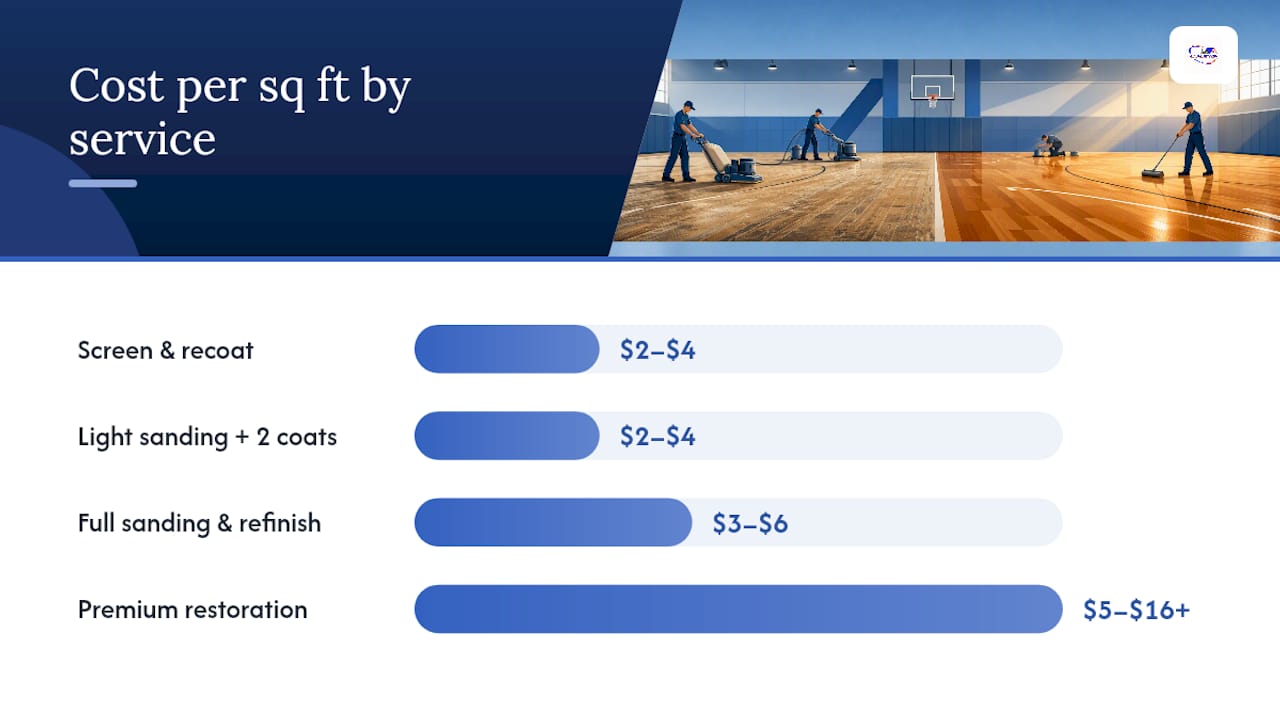
Here’s how the numbers stack up across the range of services you’ll typically be quoted, from a light seasonal touch-up to a full ground-up restoration.
| Service Level | Cost Per Sq Ft | What’s Included |
|---|---|---|
| Screen & recoat | $2 to $4 | Light screening, dust removal, one new topcoat |
| Light sanding + 2 coats | $2 to $4 | Partial sand, two finish coats, minor spot repair |
| Full sanding & refinish | $3 to $6 | Complete sand to bare wood, stain (if needed), 2 to 3 finish coats, game lines |
| Premium restoration | $5 to $16+ | Board repair/replacement, custom graphics, multiple coats, moisture remediation |
These ranges echo what Robbins Sports Surfaces cites in its own contractor Q&A on gymnasium refurbishing, which puts a standard sand-and-refinish job at roughly $2.00 to $3.75 per square foot before accounting for paint detail or unusual site conditions.
Screening/recoat rows include light abrasion and a single fresh topcoat, nothing more. The full refinish row assumes standard game lines are repainted as part of the job, since sanding removes the old lines entirely. Once repairs, custom logos, or extensive graphics enter the picture, most contractors shift from a flat per-square-foot bid to a line-itemized proposal, because the labor hours become harder to predict from square footage alone.
Sample job totals help translate these ranges into real budget numbers:
- Small gym (2,000 sq ft): Recoat runs roughly $4,000 to $8,000. A full refinish runs $6,000 to $12,000. Premium restoration can reach $10,000 to $32,000+ if repairs are extensive.
- Medium gym (5,000 sq ft): A Floor Chem Depot cost breakdown puts a typical high school gym in this size range at $10,000 to $24,000 for recoat, $15,000 to $36,000 for full refinish, and $25,000 to $48,000+ for extensive restoration.
- Large gym (10,000 sq ft): Expect $20,000 to $40,000 for a recoat, $30,000 to $60,000 for a full refinish, and $50,000 to $160,000+ for premium restoration involving significant board work or multi-court graphics.
The biggest swing factor at every size is the condition of the subfloor and joists underneath the wear layer. A gym that’s been well maintained will land at the low end of every one of these ranges.
What You’re Actually Paying For
When a quote lists a single number, it’s easy to wonder what’s baked into it. Breaking apart the components makes it much easier to spot a lowball bid or an inflated one.
Assessment and prep covers the walkthrough, moisture testing, and any furniture or equipment moving before sanding starts. Sanding is the labor and machine time to remove the old finish down to bare wood, plus dust containment, which matters more than most people expect since uncontained dust can shut down HVAC systems in attached spaces. Repairs or board replacement get priced separately once damage is confirmed, often after the first sanding pass reveals what’s underneath the old finish. Finish materials are the actual product cost: the polyurethane, sealer, or UV-cured coating itself. Line painting and logos cover stencil work, paint, and the extra coats needed to seal graphics into the finish. Labor and site protection includes wall padding, HVAC covers, and any protective barriers for adjacent spaces. Hauling and ventilation covers dust and debris removal plus fans or air scrubbers to speed curing. Final buffing and cure testing is the last step before a contractor certifies the floor safe for athletic use.
Finish type is one of the most consequential choices you’ll make, and it’s worth understanding the tradeoffs before signing off:
- Water-based polyurethane dries faster, has lower odor, and is the most common choice for schools working around tight closure windows. It typically sits in the middle of the cost range but may need recoating slightly sooner in very high-traffic gyms.
- Oil-modified polyurethane tends to be more affordable per coat and produces a warmer amber tone, but it has stronger fumes during application and a longer cure time, which extends your closure window.
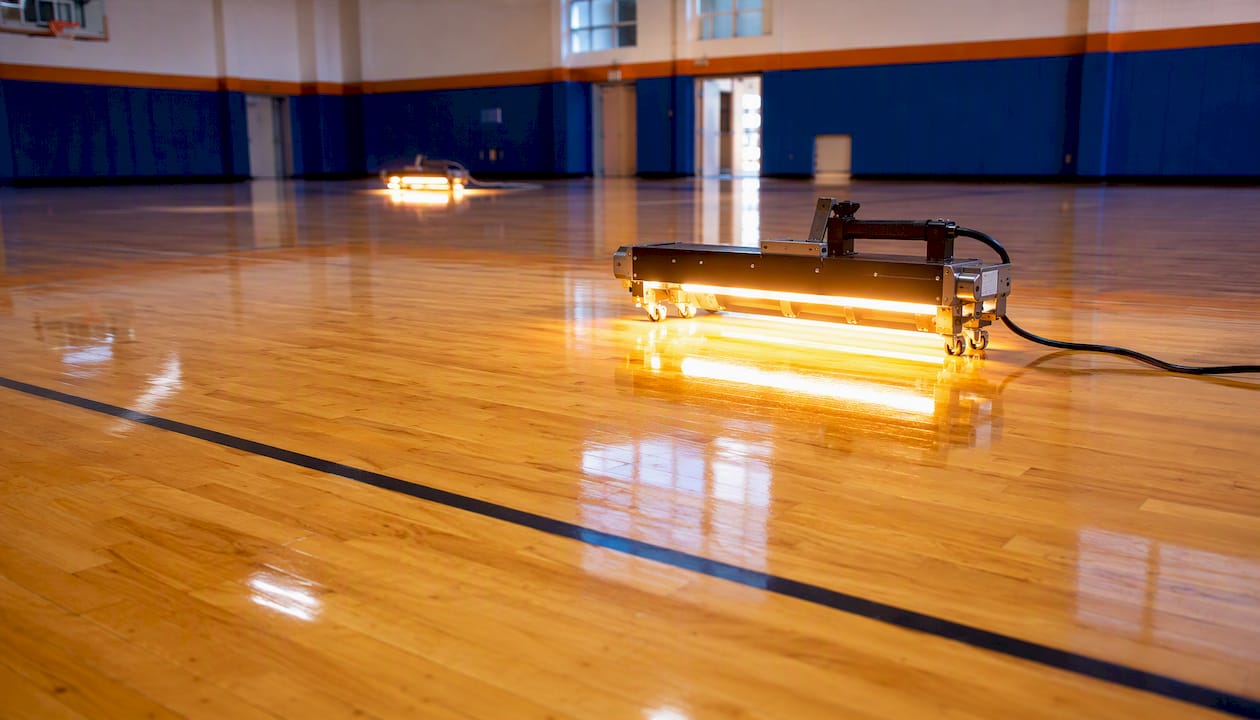
- UV-cured finishes, like the Instant UV-curable finishing option we offer, cure almost immediately under UV light rather than air-drying over days. That speed comes at a higher material cost per square foot, but it can cut your downtime dramatically, which matters enormously for gyms that can’t afford a 10-day shutdown.
Pro Tip: Always ask contractors to separate materials cost from labor cost on the written quote. If one bid is dramatically lower than the others but doesn’t break down materials, ask what finish brand and how many coats are included. A cut-rate bid often means fewer coats or a bargain finish product that won’t hold up past year three.
Screen and Recoat vs. Full Refinish: Which Does Your Floor Need?
Screening and recoating is a light maintenance pass: an Aacer Sports care guide describes it as a quick abrasion of the existing topcoat followed by a fresh coat, usually scheduled once a year during a break in the facility calendar. A full refinish sands all the way down to bare wood, which is a longer, dustier, more expensive process, but it’s the only way to fix damage that’s gone below the surface.
Here’s how the two compare directly:
- Cost per sq ft: Recoat costs $2 to $4; full refinish costs $3 to $6 (more with repairs).
- Downtime: Recoat takes 1 to 3 days; full refinish takes 7 to 10 days.
- Lifespan extension: Recoat buys roughly one more year before the next service; a full refinish resets the clock for another 8 to 12 years.
- When it’s appropriate: Recoat suits a floor with surface wear only; full refinish suits a floor with deep scratches, gouges, discoloration, or one that hasn’t been sanded in over a decade.
Three signs it’s time to stop recoating and schedule a full refinish:
- Visible finish wear that recoating won’t fix, such as bare wood patches showing through in high-traffic lanes.
- Deep scratches or board damage, including cupping, splintering, or dark water stains that suggest moisture got under the finish.
- It’s been longer than 8 to 12 years since the last full sanding, even if the floor looks decent on the surface.
Waiting too long carries a real cost risk. According to Corlew and Perry’s guidance on screening versus refinishing, a floor left exposed to moisture or debris after the finish has broken down can require board replacement or full replacement instead of a straightforward refinish. What would have been a $30,000 job can turn into a $60,000 or $80,000 job if you wait through one more season of foot traffic on bare, unprotected wood.
Add-Ons That Change Your Final Invoice
Base refinishing rarely tells the whole story on a real invoice. Most gyms want at least one or two extras, and those line items can meaningfully shift your total.
- Center-court logos: $500 to $2,000 depending on size, color count, and complexity.
- Additional game lines (for multi-sport courts): $300 to $800 per line.
- Color staining or tinting: Adds a modest per-square-foot premium over a clear finish, since staining requires an extra step and drying time.
- Logo restoration on existing graphics: Priced similarly to new logos when the old artwork has faded or peeled.
- Moisture barrier installation: Can add several dollars per square foot if a vapor barrier needs to go in under the new finish.
- Board replacement: Priced per board or per square foot of affected area, and this is where “surprise” costs most often show up after sanding reveals hidden rot or cupping.
A sample invoice makes the pattern clear. A 5,000 square foot gym quoted at a mid-range per-square-foot rate for a full refinish starts at a substantial amount. Add a center-court logo and extra game lines, and the total rises significantly due to add-ons.
Moisture barrier work and board replacement are the two add-ons most likely to delay your schedule, since both often require extra drying or curing time before sanding can proceed. Custom multi-color logos can also add a day or two, since each color needs to dry before the next is applied.
How Long Does a Gym Floor Refinishing Project Take?
Timelines vary by scope, but here’s a realistic breakdown for the two most common project types.
| Project Type | Duration | What Happens |
|---|---|---|
| Screen & recoat | 1 to 3 days | Day 1: clean and screen. Day 2: apply topcoat. Day 3 (if needed): light buff and inspection |
| Full sand & refinish | 7 to 10 days | Days 1 to 2: sanding down to bare wood. Day 3: repairs and spot leveling. Day 4: stain (if applicable). Days 5 to 7: finish coats with dry time between. Days 8 to 10: cure, line painting, final buff |
Cure time depends heavily on the finish. Water-based polyurethane typically allows light foot traffic within 24 hours and full athletic use within 3 to 5 days. Oil-modified polyurethane needs longer, often 5 to 7 days before full athletic use, because the solvents take more time to fully evaporate. UV-cured finishes cure almost instantly under the light, which is why some facilities choose that option specifically to shrink their closure window.
Seasonal scheduling shapes almost every project timeline. Schools overwhelmingly book full refinishing work for summer break, since a 7 to 10 day closure is far easier to absorb in July than during a basketball season. That seasonal demand spike is also why booking early, sometimes four to six months ahead, gets you better contractor availability and pricing than trying to schedule in May for a June start.
How Often Should You Refinish a Gym Floor?
The MFMA’s guidance is the industry benchmark here: full sanding and refinishing is commonly recommended every 8 to 12 years, while seasonal screening and recoating on an annual basis extends the interval between full refinishes. Combined with consistent daily and weekly care, that maintenance rhythm can help a well-installed maple floor reach a 50- to 70-year service life.
A practical maintenance schedule looks like this:
- Daily: Dust mop or use a microfiber dust control system to remove grit before it scratches the finish.
- Weekly: Damp mop with a cleaner formulated for athletic wood floors; never use standard household cleaners, which can leave a film that affects traction.
- Monthly: Inspect for scuffs, loose boards, or early signs of finish wear near high-traffic zones like free-throw lines and baselines.
- Annually: Schedule a professional screen and recoat, ideally during a scheduled closure window.
Pro Tip: Keep a simple sanding log for your facility, noting the date and depth of every full sand. Standard 25/32 inch maple flooring typically supports 4 to 6 full sandings over its 50 to 70 year service life before the wear layer is too thin to sand again safely. Tracking this over decades tells you, years in advance, when you’re planning your last refinish before replacement becomes the only option.
Getting Accurate Gym Floor Refinishing Quotes
Comparing bids only works if every contractor is quoting the same scope. Vague requests get vague, incomparable numbers back.
Ask every bidder these questions:
- Can you provide an itemized cost breakdown separating labor, materials, and any add-ons?
- What finish brand and product line do you use, and how many coats are included?
- What dust containment method do you use during sanding?
- What’s the realistic project timeline, including cure time before we can use the space?
- What warranty do you offer on the finish and the workmanship?
- Are you insured and bonded, and can you provide proof?
- Can you share references from similar-sized gym or school projects?
- What does your final walkthrough and cleanup include?
A simple checklist you can paste into a bid request email:
- Total square footage and current floor condition (attach photos)
- Scope requested: recoat, full refinish, or restoration
- Requested finish type and number of coats
- Desired start date and any hard deadline for reopening
- Request for itemized pricing, not a single lump sum
- Request for proof of insurance and bonding
- Request for two to three references from comparable facilities
Watch for these red flags in any quote: a bid that’s dramatically lower than every other one you received, vague language like “standard finish” with no brand or product named, no mention of insurance or bonding, and a single lump-sum number with no itemization at all. If you’d like a sense of how a well-run refinishing job should be scoped and executed, our guide comparing DIY and professional refinishing walks through what a legitimate contractor’s process actually looks like from start to finish.
What Surprises Facility Managers Most About This Process
The surprise almost never comes from the sanding or the finish. It comes from what’s underneath the finish once we get down to bare wood. On more gyms than I can count, a facility manager has told us the floor “looked fine” right up until the first sanding pass revealed a water stain near an exterior wall that had been quietly working its way into the subfloor for years.
One school gym we worked on had a small, barely noticeable discoloration near a doorway that turned out to be moisture damage tracing back to a roof flashing issue nobody had caught. We flagged it immediately, brought in the board replacement as a clearly itemized add-on rather than a surprise change order, and got the gym reopened on the original schedule anyway.
That’s really the whole philosophy: no guessing games, no vague line items, and no surprises you didn’t sign off on. We offer free over-the-phone quotes based on your photos and a quick conversation about your floor’s condition, so you get real numbers before we ever set foot on-site, and we serve facilities throughout the Denver Metro Area and the surrounding Colorado communities.
Ready to Get a Real Number for Your Gym Floor?
Every range in this guide is a starting point. Your actual gym floor refinishing cost depends on your square footage, your floor’s condition, and what you want on the finish, and the only way to know for sure is to get eyes on it, even if those eyes start with a phone call and a few photos.

When you reach out to Jrhardwoodfloorrefinishingandcleaning, your quote includes:
- An itemized scope covering sanding, repairs, finish, and any add-ons
- The specific finish brand and number of coats we’ll apply
- A realistic project timeline, including cure time before your gym reopens
- A site protection plan for adjacent hallways, walls, and equipment
- Clear warranty information on both materials and workmanship
We start with a free over-the-phone quote based on the details and photos you share, and we’ll schedule an onsite estimate if your floor needs a closer look before we finalize pricing. Whether you’re managing a school gym in Parker, a rec center court in Castle Rock, or a commercial facility anywhere from Denver to Boulder or Colorado Springs, reach out through our full sanding and refinishing service page or give us a call to get your gym floor refinishing cost estimate started this week.
Sources
- Sanding & Sealing | Maple Flooring Manufacturers Association
- Ask the expert: A Q&A on refurbishing your hardwood gymnasium floor – Robbins Sports Surfaces
- Gym Floor Refinishing Guide | Cost, Process & Timing for Schools
- SECTION 09642-Wood Gymnasium Flooring (Aacer Sports general care PDF)
- Gym Floor Refinishing Cost: What Affects Prices and How to Budget – Floor Chem Depot