 Skip to content
Tile and natural stone win for pure efficiency, but engineered hardwood and rigid-core LVP hold their own when the product spec sheet says so. The rule that matters more than any material choice: confirm the flooring is explicitly rated for radiant heat, then let a floor-sensor thermostat, not a wall thermostat, keep the surface under its rated temperature.
TL;DR:
- Only flooring explicitly rated for radiant heat should be used, with tile and natural stone offering the fastest response due to high thermal conductivity.
- Rigid-core LVP, especially SPC, provides a good balance of durability and heat transfer when its maximum surface temperature is kept below 85°F using a floor sensor.
- Engineered hardwood is preferable over solid hardwood for radiant systems, as its multi-layer core resists movement caused by temperature fluctuations.
- Laminate, cork, and carpet can work with radiant heat but only if they meet strict manufacturer ratings and proper installation protocols, with temperature limits carefully monitored.
- Proper installation involves embedded floor sensors, gradual ramp-up schedules, and substrate moisture testing to prevent failures like warping or gapping.
Table of Contents
- What’s the Best Flooring for Radiant Heat by Room and Priority?
- Tile and Natural Stone: Why They Perform Best
- LVP and Rigid-Core Flooring: What to Verify Before You Buy
- Engineered Hardwood vs. Solid Hardwood Over Radiant Heat
- Laminate, Cork, and Carpet: Where the Limits Kick In
- Installation Rules That Protect Your Floor and Your Warranty
- Choosing Your Flooring: A Step-by-Step Checklist
- What Installers See Fail, and How to Prevent It
- Balancing Performance, Comfort, and Style
- How J.R. Hardwood Handles Radiant-Heat Flooring Projects
- Sources
- FAQ
What’s the Best Flooring for Radiant Heat by Room and Priority?
Every material conducts heat differently, and that difference decides how fast a room warms up and how much your system has to work to get there. Tile and stone sit at the top because they’re dense and barely insulate at all, so heat moves through them quickly. Wood and vinyl behave more like light sweaters. They warm up slower and hold onto some of that warmth, which feels cozier underfoot but blunts efficiency slightly.
Here’s how the major families stack up:
- Porcelain tile and natural stone: highest thermal conductivity, fastest response, best for baths, entries, and basements.
- Rigid-core LVP/LVT (SPC preferred): strong middle ground, waterproof, good for kitchens and living areas when explicitly rated.
- Engineered hardwood: warm, traditional look with better stability than solid wood, best for bedrooms and living rooms.
- Solid hardwood: possible but riskier due to movement; needs narrow boards and tight moisture control.
- Laminate: acceptable only when the specific product carries a radiant-heat rating.
- Cork: comfortable and stable, but only in product lines approved for radiant use.
- Carpet: workable with the right low-resistance pad, though it’s the least efficient option.
Most manufacturers that formally approve their products for radiant systems concentrate in the tile, stone, SPC, and engineered-wood categories. This tells you where the safest bets live.
Tile and Natural Stone: Why They Perform Best
Porcelain tile and natural stone carry a thermal conductivity around 1 to 2.5 W/m·K, roughly five to ten times higher than wood or vinyl. That density lets heat pass through almost unimpeded, which is why tiled radiant floors can deliver up to 150 watts per square meter under design conditions and why bathrooms warm up noticeably faster than carpeted bedrooms on the same system.
The trade-off shows up when the system is off. Stone and tile feel cold the moment the heat cuts out, since they don’t hold residual warmth the way wood does. That’s a fair swap in bathrooms, entries, and basements, where efficiency and moisture resistance matter more than a cozy feel underfoot.
Installation quality decides whether that performance holds up over time.
- Use thinset over a proper mortar bed or an uncoupling membrane rated for radiant systems.
- Confirm substrate flatness before setting tile, since gaps between the heating element and the tile create uneven hot spots.
- Match adhesive to manufacturer specs. Not every thinset is rated for the temperature swings a radiant system produces.
Pro Tip: Ask your installer for the tile manufacturer’s spec sheet before the job starts. Some porcelain lines specify a maximum grout width or adhesive type for radiant applications, and skipping that step is a common reason tile cracks years later.
LVP and Rigid-Core Flooring: What to Verify Before You Buy
Rigid-core vinyl has become one of the more popular choices for radiant systems, but not all rigid-core products behave the same way under heat. SPC (stone plastic composite) cores tend to hold their shape better than WPC (wood plastic composite) cores when temperatures climb, which makes SPC the safer default for anyone installing over hydronic or electric radiant systems.
Before you commit to a plank, check these three things:
- The manufacturer’s maximum surface-temperature rating, typically somewhere around 80 to 85°F.
- Whether the installation instructions require a floor-embedded probe rather than an air-sensing thermostat.
- Whether the product is approved for glue-down, floating, or both, since some radiant-rated lines restrict the installation method.
Electric mats retrofit easily under LVP because they add minimal height, while hydronic tubing suits larger, whole-house installations where the up-front labor pays off over a bigger footprint. Hybrid rigid-core and waterproof wood collections are increasingly marketed as tile alternatives, and they can perform well as long as the specific line is rated for radiant use.
Engineered Hardwood vs. Solid Hardwood Over Radiant Heat
If you want a wood look, engineered hardwood is almost always the smarter call. Its multi-layer core resists the expansion and contraction that solid wood experiences under fluctuating heat, which means fewer gaps opening up between boards each winter.
Solid hardwood isn’t automatically off the table. Some research on wood performance across different climates suggests solid wood can hold up reasonably well depending on insulation and building construction, but you’re stacking the odds in your favor by sticking to narrower boards, generally 3 to 4 inches or less, and choosing quarter-sawn or rift-sawn cuts that resist cupping.
A few habits protect either type:
- Keep indoor relative humidity between 35% and 55% year-round, not just during heating season.
- Follow a slow ramp-up schedule when the system first turns on each fall.
- Review our acclimation and moisture-testing guidance before ordering material, since acclimation time changes with radiant subfloors.
Laminate, Cork, and Carpet: Where the Limits Kick In
These three options work over radiant heat, but only within tighter boundaries than tile or LVP.
- Laminate: Only use products explicitly rated for radiant systems. Standard laminate over a concrete slab risks moisture-driven warping that a rated product is engineered to resist.
- Cork: A dimensionally stable, comfortable option, but it has to be a line the manufacturer has tested and approved for radiant use, installed exactly per that spec.
- Carpet: Combined carpet and pad resistance should stay under roughly 2.5 TOG for standard systems, and closer to 1.5 TOG if you’re running a heat pump, since heat pumps produce lower water temperatures and need less insulating resistance in the way.
A low-TOG underlay paired with low-pile carpet preserves far more heat transfer than a standard thick cushion pad, a detail a lot of carpet buyers never think to ask about.
Installation Rules That Protect Your Floor and Your Warranty
The single most important number in this entire topic is the maximum surface temperature. Manufacturers set it, warranties depend on it, and it’s non-negotiable regardless of how good the flooring looks on a showroom floor. NWFA guidance commonly treats 80°F as a sensible ceiling for wood, with some product lines allowing up to 85°F.
A wall-mounted air thermostat cannot enforce that limit. You need a sensor embedded in the floor itself, wired to a controller that reads the actual surface temperature and shuts the system down before it exceeds spec.
- Ramp new systems up gradually, roughly 5°F per day, rather than jumping straight to a target temperature.
- Choose low-TOG underlay and radiant-approved adhesives so the heating layer isn’t fighting the flooring above it.
- Test slab moisture with ASTM F2170 before installing anything, and confirm substrate flatness meets the flooring manufacturer’s tolerance.
Pro Tip: If your installer can’t tell you where the floor sensor goes or how the ramp-up schedule works, that’s a sign to ask more questions before signing anything. A missing sensor plan is one of the fastest ways to void a flooring warranty.
Choosing Your Flooring: A Step-by-Step Checklist
- Match the material to the room and the system. Tile for baths and basements, engineered wood or LVP for living spaces, carpet only where comfort outweighs efficiency.
- Pull the manufacturer’s spec sheet. Confirm the radiant-heat rating and the maximum surface temperature in writing, not just from a sales conversation.
- Ask your installer three direct questions. Where does the floor sensor go? What’s the ramp-up schedule? What’s the substrate prep, and does it match warranty requirements?
- Watch for red flags. No published temperature spec, a thick insulating underlay pitched as “universal,” or no clear plan for a floor probe are all reasons to pause and ask more.
What Installers See Fail, and How to Prevent It
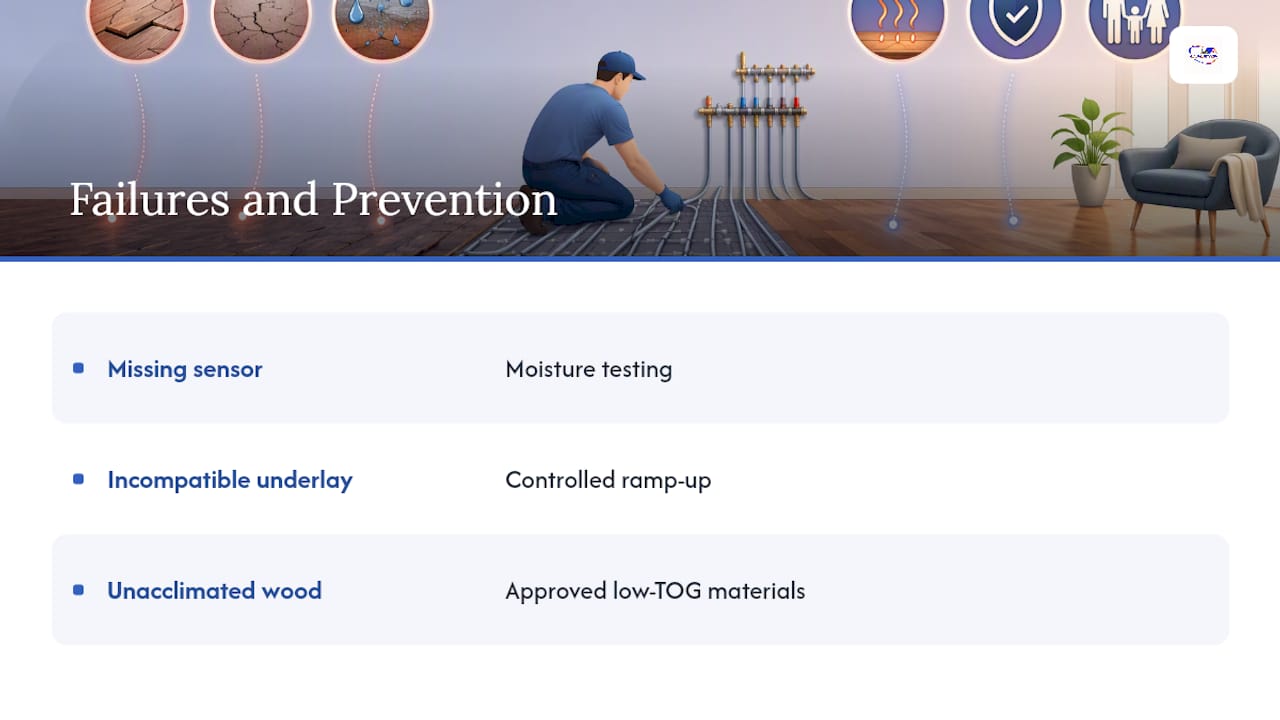
Most radiant flooring failures trace back to the same handful of causes: overheating from a missing floor sensor, incompatible underlay trapping heat, or wood installed without proper acclimation. Moisture testing, a controlled ramp-up, and approved low-TOG materials prevent nearly all of them. Our team handles LVP, laminate, and engineered hardwood installation with exactly this radiant-specific prep built in.
Balancing Performance, Comfort, and Style
Tile and stone win when efficiency is the priority. Engineered wood and LVP win when you want warmth underfoot and a softer look. Either way, hire a professional for the moisture testing, sensor placement, and ramp scheduling. That’s not a place to save money by guessing.
— J.R.
How J.R. Hardwood Handles Radiant-Heat Flooring Projects
Jrhardwoodfloorrefinishingandcleaning is the alternative to guessing your way through a radiant flooring install: we handle the acclimation, moisture testing, and product verification that keep a warranty intact, work most Denver Metro homeowners never think to check until a floor cups or gaps a year later.

Whether you’re installing rigid-core LVP over a new hydronic system or replacing aging hardwood that’s finally ready for an upgrade, our team walks through the material’s radiant rating, the substrate prep, and the sensor setup before a single plank goes down. We handle LVP and laminate installation alongside engineered hardwood work, and if you’re refinishing existing floors around a new system, our refinishing and UV-curable finishing services get you a same-day walk-on finish without the fumes of a traditional coat.
Call the company for an over-the-phone quote and expert advice tailored to your flooring system and needs. Get started on our hardwood flooring services page to request your evaluation.
Sources
- Best Flooring for Underfloor Heating: Complete UK Guide 2026
- Install hardwood floors over radiant heat (HardwoodInfo)
- Best Flooring Options for Radiant Heating Systems (MSI Surfaces)
FAQ
What Type of Flooring Is Best Over Radiant Heat?
Porcelain tile and natural stone perform best because their high thermal conductivity lets heat pass through quickly and evenly. Engineered hardwood and SPC rigid-core LVP are strong runner-ups when the specific product is rated for radiant use.
What Flooring Works With Underfloor Heating Besides Tile?
Engineered hardwood, SPC-based rigid-core LVP, cork, and even carpet can work, as long as each product carries a manufacturer radiant-heat rating. Carpet needs a combined carpet and pad resistance under roughly 2.5 TOG, or 1.5 TOG for heat-pump systems.
Can You Put Flooring Over Radiant Heat Without Special Products?
No. Standard, unrated flooring risks warping, cracking, or voiding its warranty once temperatures climb. Always confirm the product’s radiant-heat rating on the spec sheet before installation, and pair it with a floor-sensor thermostat rather than a wall unit.
Can Radiant Heat Go Under Vinyl Plank Flooring?
Yes, and it’s one of the more common combinations today. SPC rigid-core LVP handles heat better than WPC, and most manufacturers cap surface temperature around 80 to 85°F, enforced through a floor-embedded probe.
Does Jrhardwoodfloorrefinishingandcleaning Install Radiant-Compatible Flooring?
Yes, the team installs LVP, laminate, and engineered hardwood with radiant-specific prep, including moisture testing and acclimation. Pricing for LVP and laminate installation is available on request through the hardwood flooring services page.