 Skip to content
Expect to pay between $1 and $8 or more per square foot for commercial hardwood refinishing in Colorado, depending on whether your floor needs a simple recoat or a full sand and refinish. A 1,500 square foot office might cost from a few thousand dollars for a light buff to significantly more for a complete restoration. The smartest first move is booking an on-site assessment so a professional can measure your wear layer and give you a real number instead of a guess.
TL;DR:
- Full sanding and refinishing cost in Colorado ranges from $3 to $8 per square foot, with Denver-area projects tending toward the higher end due to local costs.
- Recoating costs between $1 and $3 per square foot and is suitable when the finish wears but the wood remains intact.
- An on-site assessment is essential to accurately determine costs, especially for damaged floors or complex layouts, rather than relying on phone estimates.
- Using faster curing finishes or scheduling work outside business hours can significantly reduce project disruption for occupied commercial spaces.
Table of Contents
- Typical cost ranges for commercial hardwood refinishing
- Recoating vs full sanding: how pros choose the right approach
- Major cost drivers: a practical checklist for facility managers
- Sample commercial budgets and scenarios
- How to get an accurate commercial quote
- Timeline, disruption, and fast-cure options for commercial sites
- Maintenance and recoating schedule to lower lifetime cost
- Additional costs: permits, insurance, and bonding for commercial jobs
- Professional refinishers vs. specialized commercial contractors
- Warranty coverage and service after the job is done
- Regional pricing variations across Colorado
- First-person note from J.R.: how we estimate commercial jobs
- Ready for a free quote? Here’s what to have on hand
- Sources
- FAQ
Typical cost ranges for commercial hardwood refinishing
Full sanding and refinishing for commercial spaces in Colorado typically runs $3 to $8 per square foot, and Denver-area jobs often land toward the upper half of that range because of local labor and logistics costs. If your floor just needs a fresh top coat rather than a full sand, recoating (also called screening and buffing) usually costs $1 to $3 per square foot, a fraction of a full refinish.
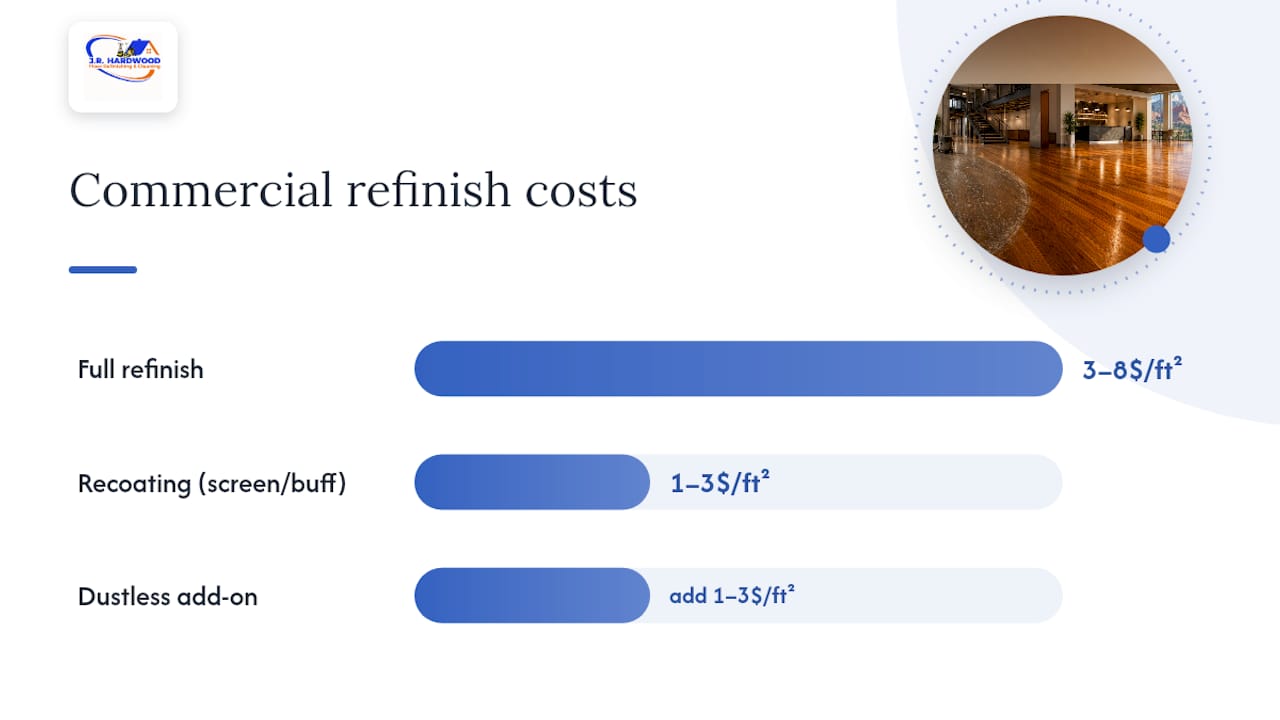
Dustless sanding systems, which pull dust straight into a containment unit instead of letting it settle across your dining room or retail floor, typically add $1 to $3 per square foot to the total. For a business that cannot afford a cloud of sawdust drifting into inventory or seating areas, that premium usually pays for itself in faster cleanup and fewer complaints.
Beyond the base square footage rate, several add-ons tend to show up on commercial quotes:
- Board repair or replacement for water-damaged or structurally compromised sections.
- Custom staining to match existing floors or a new design scheme.
- Furniture and fixture moving, especially in retail or restaurant layouts.
- Disposal fees for old finish, sanding dust, and damaged boards.
A full commercial refinish typically costs $3 to $8 per square foot, meaning a straightforward job stays affordable while heavy damage or custom finishes push costs toward the top of that band. Our own Denver-area cost breakdown walks through how these numbers apply to specific commercial footprints.
Recoating vs full sanding: how pros choose the right approach
A screen and recoat lightly abrades the existing finish and applies a fresh top coat without removing wood. A full sand and refinish strips the floor down past the old finish and, often, into the wood itself before restaining and resealing. The National Wood Flooring Association recommends recoating whenever the finish is worn but the wood underneath is not exposed, saving both money and wear-layer thickness for later.
Deciding between the two comes down to three checks:
- Wear-layer thickness: the NWFA notes that a wear layer under about 3/32 of an inch is generally not safe to sand again.
- Finish type: wax coatings, standard polyurethane, and factory-applied UV-cured finishes each respond differently to abrasion, and some UV finishes need manufacturer sign-off before recoating.
- Visible damage: deep scratches, gouges, or discoloration usually mean the finish has worn through, which points toward a full refinish.
Engineered wood floors complicate things further, since their thinner veneer allows far fewer sandings over the floor’s lifetime than solid wood.
Major cost drivers: a practical checklist for facility managers
A handful of factors move a commercial quote up or down more than anything else, and knowing them ahead of time helps you read a bid with confidence.
- Square footage and layout: a maze of small offices costs more per square foot than one open floor plan, since edging and detail work eat up labor hours.
- Finish choice: waterborne polyurethane, oil-based coatings, and commercial-grade UV finishes all carry different price points and cure times.
- Repair scope: water stains, structural damage, or boards that need replacing add labor and materials beyond the base refinish.
- Dust control and staging: dustless equipment costs more upfront but often reduces cleanup labor and protects inventory or furnishings nearby.
- Scheduling around your business: after-hours or phased work keeps your doors open but adds labor hours, since crews work in shorter shifts.
Pro Tip: Ask your contractor for a line-item quote broken out by labor, materials, and repairs so you can see exactly which driver is pushing your total up.
Sample commercial budgets and scenarios
Turning per-square-foot ranges into real numbers makes budgeting far less abstract. These examples assume standard polyurethane finish and moderate wear unless noted.
- 500 square foot boutique or small office: light wear with an intact finish usually calls for a recoat, running roughly $500 to $1,500. If the floor needs a full refinish instead, expect $1,500 to $4,000, more if custom staining is added.
- 1,500 square foot open-plan office: a full refinish typically runs $4,500 to $12,000. Adding dustless sanding tacks on another $1,500 to $4,500, a worthwhile bump for offices that stay partially occupied during the work.
- 3,000 square foot restaurant or showroom: phased, off-hours work to keep the business running typically pushes totals to $9,000 to $24,000 or higher, largely because crews work in shorter overnight or weekend shifts rather than one continuous stretch.
Every scenario assumes moderate wear and no major structural repairs. Water damage, deep gouges, or a switch to premium finishes can move any of these numbers well past the high end.
How to get an accurate commercial quote
Photos and a square footage estimate get you a ballpark, but an on-site assessment is what turns that ballpark into a real number. A technician measures wear-layer thickness, checks for moisture issues, identifies the existing finish type, and flags any board damage that a phone call simply cannot catch.
Before you sign anything, run every bidding contractor through the same checklist:
- Confirm they carry current licensing and liability insurance for commercial work.
- Ask which dust control method they use and whether it is included in the quoted price.
- For any building constructed before 1978, confirm they test for lead-based finishes and follow EPA lead-safe renovation rules.
- Get a written timeline, including drying and cure times.
- Ask what warranty covers the finish and the workmanship, and request references from other commercial clients.
A quote worth trusting itemizes labor, materials, repairs, mobilization, and cleanup separately, not as one lump figure.
Timeline, disruption, and fast-cure options for commercial sites
Recoating usually finishes in a day or two, since there is no sanding dust to clear and drying times are shorter. A full sand and refinish for a mid-size commercial space typically takes several days once you factor in sanding, staining, multiple coats, and drying time between each step.
A few choices can shrink that window without cutting corners:
- Off-hours or weekend scheduling keeps your business open but stretches the calendar timeline.
- Phased work, section by section, lets part of the space stay in use while another section cures.
- Instant UV-curable finishes cure almost immediately after application, allowing walk-on access far sooner than traditional oil-based coatings.
For occupied spaces, ask about VOC levels in whatever finish is used, since lower-VOC and UV-cured options tend to be more comfortable for staff and customers on site during the work.
Maintenance and recoating schedule to lower lifetime cost
Recoating on a regular schedule is the single best way to stretch the life of a commercial floor and avoid an expensive emergency resand. The NWFA frames recoating as standard maintenance that heads off excessive wear well before it reaches the wood itself, especially in high-traffic retail and office spaces.
A few habits make a real difference between recoats:
- Use cleaners recommended for your specific finish, never generic all-purpose sprays.
- Place walk-off mats at every entrance to cut down on grit that scratches the finish.
- Add furniture protectors under desks, display fixtures, and seating that gets moved often.
Consistent upkeep like this is covered in more detail in our Colorado maintenance guide, and it is the difference between a $1,500 recoat every few years and a $10,000 emergency refinish.
Additional costs: permits, insurance, and bonding for commercial jobs
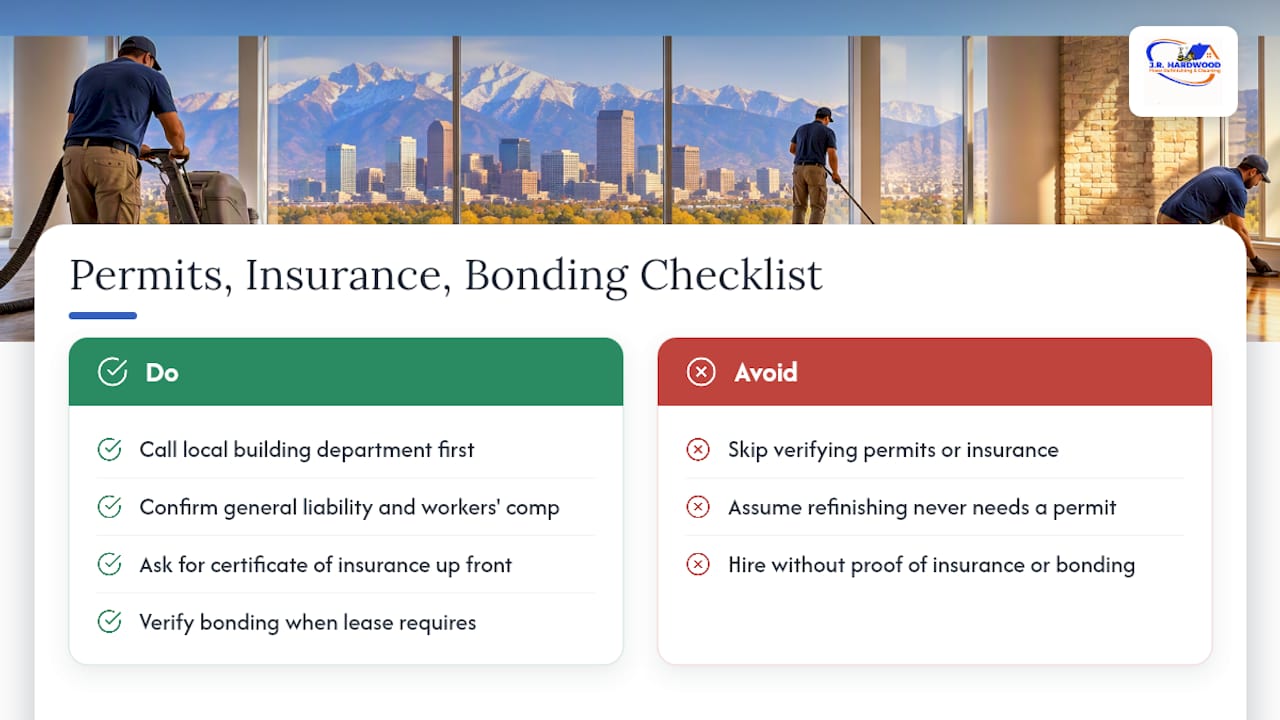
Refinishing itself rarely requires a building permit, since it does not alter structure or square footage, but some Colorado municipalities require permits for larger commercial renovation projects that bundle flooring work with other changes. It is worth a quick call to your local building department before work begins, particularly for multi-tenant properties or historic buildings.
Insurance is the bigger line item to confirm. Any contractor working in your building should carry general liability coverage and, ideally, workers’ compensation insurance, protecting your property if equipment damages a wall or a worker is injured on site. Some commercial leases or property management agreements also require contractors to be bonded, guaranteeing the job gets finished even if something goes wrong midway through.
Larger commercial properties, especially those managed through a property management company or a homeowners’ or business association, sometimes require proof of insurance before a contractor is allowed on site at all. Ask your contractor for a certificate of insurance up front rather than after the quote is accepted, since that document is standard and any established company should hand it over without hesitation.
None of this typically adds a large amount to your total budget, but skipping the verification step can leave a property owner liable for damage or injury that a properly insured contractor would have covered.
Professional refinishers vs. specialized commercial contractors
Plenty of general flooring companies handle residential refinishing well but rarely touch commercial jobs, and the cost difference between the two often comes down to equipment and scheduling flexibility rather than raw skill. A residential-focused crew may quote a lower hourly rate but lack the dustless equipment or off-hours availability a business needs to stay open during the work.
Specialized commercial refinishing contractors tend to price jobs slightly higher per square foot, but that premium usually buys phased scheduling, dustless systems suited to occupied spaces, and familiarity with the insurance and documentation commercial clients require. For a single-family home, a general residential refinisher is often the more economical choice. For a retail space, restaurant, or multi-tenant office, the operational fit tends to matter more than shaving a dollar off the per-square-foot rate.
Our own comparison of DIY, general, and professional refinishing breaks down what separates a general handyman-style refinish from a crew built specifically around commercial timelines and dust control needs.
Warranty coverage and service after the job is done
A solid commercial refinishing job should come with two separate warranties: one covering the finish itself against premature wear or peeling, and one covering workmanship, meaning the contractor stands behind the sanding, staining, and coating work performed. Ask exactly what voids each warranty, since aggressive cleaning chemicals or missing scheduled recoats can sometimes cancel finish coverage.
Post-refinishing service matters just as much as the initial warranty. A contractor who offers a written recoating schedule, follow-up inspections, or a maintenance plan is setting your floor up to avoid the kind of deep wear that leads to another full refinish years earlier than necessary. Ask whether the company that did your refinish also handles routine maintenance, since staying with one provider tends to keep your floor’s history and finish type consistent over time.
Regional pricing variations across Colorado
Denver-area commercial refinishing costs tend to sit at or above national averages, largely due to regional labor and logistics costs that run higher in a dense metro market. Mountain towns often see additional premiums layered on top, driven by longer material delivery times, seasonal labor shortages during ski season, and the simple cost of getting crews and equipment up the highway.
A commercial property in downtown Denver, Boulder, or Colorado Springs typically sees pricing closer to the middle of the national $3 to $8 per square foot range for full refinishing. In smaller mountain communities, expect quotes toward the higher end of that range or slightly above it, since fewer local contractors mean less competition and higher travel costs get built into the bid.
Suburban markets like Parker and Castle Rock tend to land in between, benefiting from proximity to the Denver labor pool without the density-driven overhead of downtown commercial buildings. Whatever the location, an on-site assessment remains the only reliable way to know where your specific project falls within these ranges.
First-person note from J.R.: how we estimate commercial jobs
Commercial jobs are estimated by a real look at your floor, not a guess from a phone call alone. Eco-friendly products are used and straightforward answers given about what your floor actually needs. Quotes can start free, over the phone, from photos and a few details about your space.
— J.R.
Ready for a free quote? Here’s what to have on hand
Getting a number for your project starts with a quick call, and having a few details ready speeds things up considerably. Our hardwood flooring services page lists everything from Full Sanding & Refinishing to Screen & Recoat, so you can see what fits your floor before you even call.

Before you reach out, gather these details so we can give you the most accurate free quote possible:
- Approximate square footage of the area needing work.
- A few clear photos of the floor, including any damaged or worn spots.
- The building’s approximate age, especially if it was built before 1978.
- How much foot traffic the space sees daily.
- Any finish preference, or whether you would like our recommendation.
We back every job with eco-friendly products, clear scheduling, and the kind of 5-star reviews that come from doing the work right the first time.
Sources
- Maintenance | National Wood Flooring Association | NWFA
- Hardwood floor refinishing costs | HomeAdvisor
- Lead: Renovation, Repair and Painting Program | EPA
- Clarke technical guidance (factory-finished floors recoating considerations)
FAQ
How much does commercial floor refinishing cost per square foot in Colorado?
Full sanding and refinishing typically runs $3 to $8 per square foot, while a lighter recoat usually costs $1 to $3 per square foot. Dustless sanding adds a premium on top of either service, and Denver-area jobs tend to sit toward the higher end of these ranges.
What is the difference between recoating and full refinishing?
Recoating lightly abrades the existing finish and applies a new top coat without removing wood, while full refinishing sands down into the wood before restaining and resealing. The NWFA recommends recoating whenever the finish is worn but the wood beneath it is not exposed.
Do I need a permit to refinish commercial hardwood floors in Colorado?
Refinishing alone rarely requires a permit since it does not change the building’s structure, but some municipalities require one for larger renovation projects that combine flooring work with other changes. Check with your local building department and confirm your contractor carries current liability insurance before work begins.
How long does a commercial refinishing project take?
A recoat typically finishes in a day or two, while a full sand and refinish for a mid-size commercial space usually takes several days once drying time between coats is included. Off-hours scheduling, phased work, or instant UV-curable finishes can shorten the disruption to your business without cutting into the finish quality.
Can J.R. Hardwood Floor Refinishing & Cleaning give me a quote without an in-person visit?
Yes, J.R. Hardwood Floor Refinishing & Cleaning offers free over-the-phone quotes based on verbal details and photos, though an on-site assessment gives the most accurate number for larger commercial jobs. The company serves the Denver Metro Area along with Parker, Castle Rock, Boulder, and Colorado Springs.