 Skip to content
Paint your walls first, then refinish your floors, in almost every remodeling scenario. The reason comes down to a simple trade-off: dried paint splatters wipe or sand off a floor easily, but sanding dust that settles into fresh paint can ruin the finish and force a repaint. Exceptions exist, especially when floors are brand new or already finished, and we’ll walk through those below.
TL;DR:
- Refinishing floors before painting is generally riskier because dust from sanding is harder to remove from wet paint than paint drips are from finished floors.
- Using advanced dust-control equipment and curing finishes quickly enables more flexible sequencing, especially with modern UV-cure options.
- Protecting floors thoroughly during painting is essential to prevent damage and requires careful masking and sealing, regardless of order.
- It is more efficient to paint first in most scenarios unless the floors are already finished, fully cured, or if minimizing dust and seeing the wood tone beforehand take priority.
- The overall project scope and specific finish cure times should guide the sequence choice more than tradition or strict rules.
Table of Contents
- Should You Paint Walls or Refinish Floors First?
- What Are the Benefits of Refinishing Floors First?
- How Do You Decide the Right Sequence for Your Project?
- What’s the Best Workflow for Common Renovation Scenarios?
- How Do You Protect Floors and Walls During Either Order?
- What Do Professional Refinishers Actually Do Differently?
- What We’d Prioritize If We Were Starting Over
- When Should You Call In a Professional?
- Sources
- FAQ
Should You Paint Walls or Refinish Floors First?
The standard rule of thumb, backed by The Spruce, is paint first. Wet paint drips are cheap and quick to fix. A drop of latex on an unfinished floor wipes away or sands out in seconds. But if you refinish first and then paint, a stray splatter of primer on a fresh coat of polyurethane can leave a permanent mark that requires re-sanding a whole section.
Here’s why the sequence favors paint first in most homes:
- Mistakes are cheaper. Paint splatter on bare or protected subfloor is a non-issue; paint splatter on a cured floor finish is a real problem.
- Sheen affects cleanup. Flat wall paint holds onto sanding dust like a magnet, while eggshell and semi-gloss sheens wipe clean with a damp cloth, according to The Spruce.
- It fits new construction perfectly. When there’s no flooring installed yet, paint has nowhere to drip onto and no dust to worry about.
- Touch-ups don’t need the full sequence. If you’re just repainting a room with floors that are already finished, this whole debate barely applies. Protect the floors well and paint away.
What Are the Benefits of Refinishing Floors First?
Plenty of experienced remodelers flip the order, and they have good reasons. Sanding kicks up an enormous volume of fine dust, and that dust is far easier to vacuum off bare drywall and studs than to scrub out of a freshly painted wall. Slappe Painting notes that this dust doesn’t just settle and stay put. It hangs in the air for hours and drifts into every corner of a room, which is exactly why some pros prefer to get the messiest job over with before anything else goes on the walls.
There’s also a design perk nobody talks about enough:
- You get to see the real wood tone before choosing paint. Wood stain color can shift depending on the wood species, the finish sheen, and even the room’s lighting. Seeing the finished floor first, as Angi points out, means you’re matching paint to reality instead of guessing from a sample chip.
- Dust management is simpler on bare surfaces. Unfinished walls don’t hold onto grit the way paint does.
- The trade-off is real risk to your new floor. Paint drips, scuffed boot prints, and dropped tools can all mar a finish that just cured. This only works if you protect the floor aggressively.
How Do You Decide the Right Sequence for Your Project?
Every project has its own personality, so run through this checklist before you commit to an order:
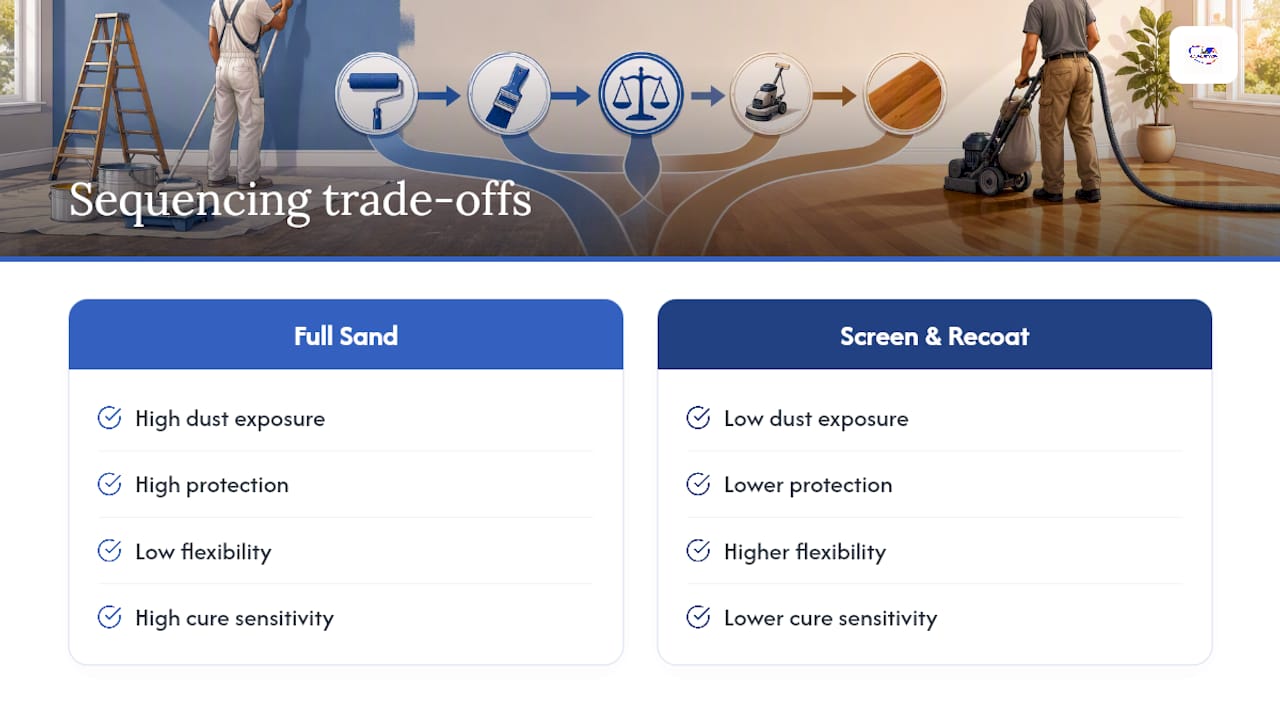
- Define the scope. A full sand-and-refinish creates far more dust than a simple screen-and-recoat, which barely disturbs the surface.
- Check your walls. If baseboards are missing or trim is getting painted too, that changes how much floor protection you’ll need during painting.
- Look at your schedule. Dustless sanding systems cut airborne particles dramatically, which opens up more flexibility on sequencing than traditional sanding does.
- Factor in cure times. Water-based floor finishes dry fast and often allow foot traffic within a day; oil-based finishes need much longer before you can safely walk on them, let alone set up ladders and paint trays.
- Apply the rule of thumb. Paint first, refinish second, unless your floors are already finished and only the walls need work.
Pro Tip: If your timeline is tight, ask your painter to apply just the first coat or primer before floor work starts, then come back for the final coat once the floors are done curing. It’s a common workaround that splits the risk instead of betting everything on one order.
What’s the Best Workflow for Common Renovation Scenarios?
Different projects call for different playbooks. Here’s how the sequence shifts depending on what you’re working with.
- Full remodel with old floors and old paint: Sand the floors, clean up every trace of dust, apply stain and sealer, let it cure fully, then paint the walls. Give water-based finishes about 24 hours before light foot traffic and several days before rugs or furniture go back down; oil-based finishes often need closer to a week.
- New construction with unfinished floors: Paint the walls completely first, then bring in the flooring crew to install and finish. There’s no existing floor to protect, so this is the lowest-risk order available.
- Partial repaint with floors already finished: Skip the debate. Protect the floors thoroughly and paint carefully, since resequencing isn’t realistic once flooring is done.
- Hybrid approach for tight schedules: Apply a primer or first coat before floor work begins, then return for the final coat once sanding, staining, and sealing are complete. This keeps the room usable while spreading out the mess.
Curious what a full refinishing job actually involves start to finish? Our complete guide to hardwood floor refinishing breaks down each stage in detail.
How Do You Protect Floors and Walls During Either Order?
Good prep work is what actually determines whether your chosen sequence goes smoothly. A few materials and habits make a bigger difference than the order itself.
- Control the dust at the source. Dustless sanding systems paired with HEPA vacuums capture the bulk of airborne particles before they ever reach a wall or windowsill.
- Seal off the space. Cover HVAC vents and doorway gaps with plastic sheeting and tape so dust doesn’t migrate into rooms you’ve already painted.
- Skip the slippery plastic on floors. Canvas drop cloths and rosin paper with taped seams grip better and hold up to foot traffic far longer than thin plastic sheeting.
- Mask trim and baseboards properly. Quality painter’s tape on baseboards, or removing them entirely when practical, saves a lot of touch-up work later.
- Respect cure times before walking on new finish. Water-based polyurethane usually allows light traffic within a day; oil-based finishes often need several days to a week before they can handle foot traffic and equipment.
Pro Tip: Never rely on your nose to tell you dust has settled. Run a white paper towel along a windowsill or baseboard 24 hours after sanding. If it comes back gray, wait another day before painting.
Our hardwood floor sanding workflow walks through exactly how we control dust on the jobsite, if you want the full picture.
What Do Professional Refinishers Actually Do Differently?
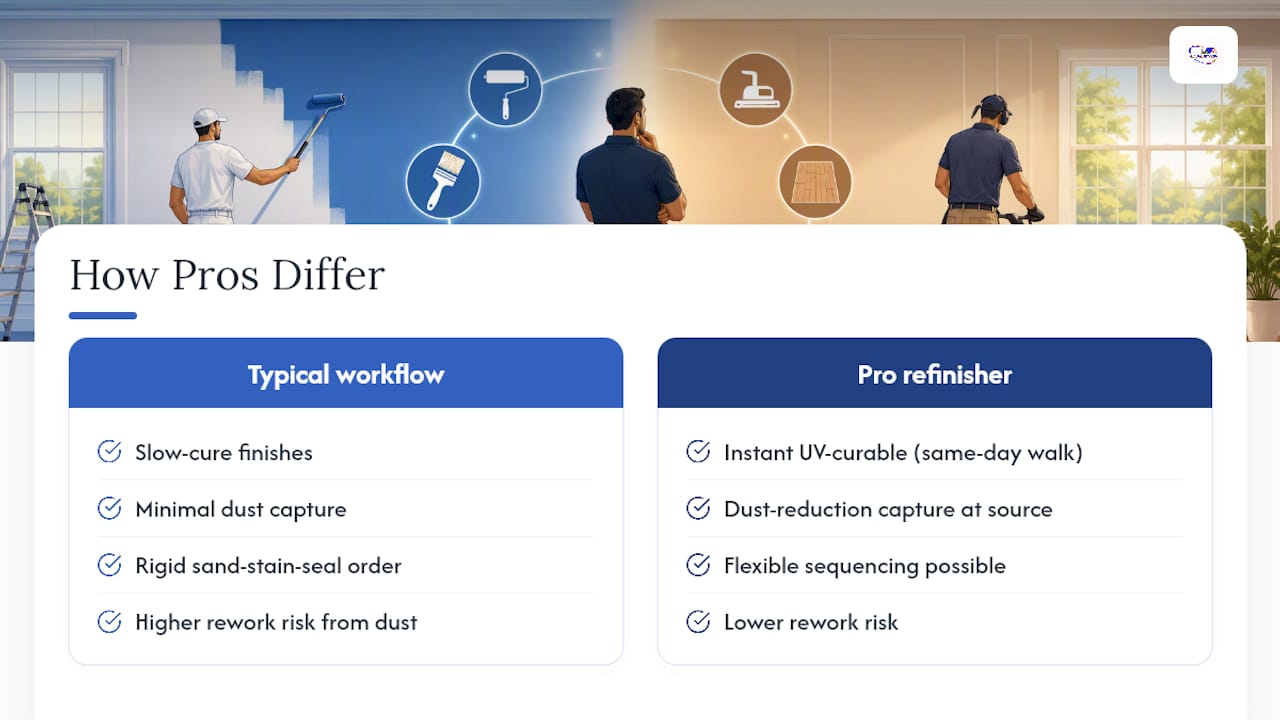
On most jobs, we push clients toward paint first, because it removes the single biggest source of rework: dust settling into wet or freshly cured paint. Stairwells and open-concept living spaces are the trickiest, since dust travels farther than homeowners expect and drips are harder to keep contained across a big open sightline.
What changes the math is equipment. Dust-reduction sanding systems capture most particles at the source, and Instant UV-curable finishes can be walked on the same day, which shrinks the window where floors are vulnerable to paint splatter. That combination lets us sequence jobs more flexibly than a traditional sand-stain-seal timeline ever allowed.
What We’d Prioritize If We Were Starting Over
Most articles on this topic present paint-first as gospel and treat refinish-first as the reckless alternative. That’s an oversimplification. The honest answer is that scope matters more than sequence. A screen-and-recoat creates a fraction of the dust a full sand job does, and treating both jobs the same way wastes effort protecting against a risk that barely exists in the lighter case.
Where conventional advice really falls short is cure time. Plenty of guides tell you to “let the floor dry” without specifying how long, and oil-based finishes can take several times longer than water-based ones to fully cure. Guessing wrong here is what leads to scuffed floors, not picking the wrong order.
If you take one thing from this, prioritize matching your protection level to your actual sanding volume, and get a real cure-time number for your specific finish before you schedule painters. The order matters less than most guides suggest. The execution is where projects actually go wrong.
— J.R.
When Should You Call In a Professional?
There are ways to manage this sequence yourself with careful masking and patience, but a professional refinish removes most of the guesswork entirely. We bring dust-reduction sanding equipment that captures airborne particles most DIY sanders can’t touch, and our Instant UV-curable finishing option means same-day walk-on capability instead of waiting through a multi-day cure window that can throw off your painter’s schedule.

Our hardwood flooring services cover full sanding and refinishing, screen and recoat, wax removal, and cleaning, all handled personally to ensure quality workmanship. If you’re planning a remodel and want an estimate on floor care options, free over-the-phone quotes are available. Just describe the floor and send a few photos, and we’ll tell you exactly what to expect before you schedule a single painter.
Sources
This guide draws on floor-and-paint sequencing advice from The Spruce, Angi, and Slappe Painting, alongside our own hardwood floor finish guide.
- Should You Paint or Refinish Floors First? — The Spruce
- Should I paint walls or refinish floors first? — Angi
- Refinish floors or paint walls first? Expert advice — Slappe Painting
FAQ
Can I Paint Immediately After Sanding Floors?
Not right away. Fine sanding dust stays airborne for hours and settles onto wet paint, so it’s best to vacuum thoroughly, let the air clear, and confirm surfaces are dust-free with a wipe test before painting, as Slappe Painting recommends.
Should I Paint Walls Before or After Refinishing Floors?
Paint your walls first in most cases, since dried paint drips are far easier to clean off a floor than sanding dust is to remove from wet paint, per The Spruce. The main exception is when floors are already finished and only need protecting during a repaint.
What Is the Correct Order to Paint and Refinish a Room?
The general sequence is paint the walls, protect the floors, then sand and refinish them, allowing full cure time before moving furniture back in. New construction flips this slightly, since floors often get installed and finished after the walls are painted.
What Are Common Mistakes People Make When Refinishing Floors?
Skipping proper dust control, using the wrong sanding grit sequence, and rushing cure times before walking on the finish are frequent errors that lead to visible defects and rework. Improper prep is also a major cause of adhesion failures on the new finish.
How Long Should I Wait Before Walking on Refinished Floors?
Water-based finishes typically allow light foot traffic within about a day, while oil-based finishes usually need several days longer to cure fully before regular use. Our Instant UV-Curable Finish option shortens that wait to the same day in many cases.