 Skip to content
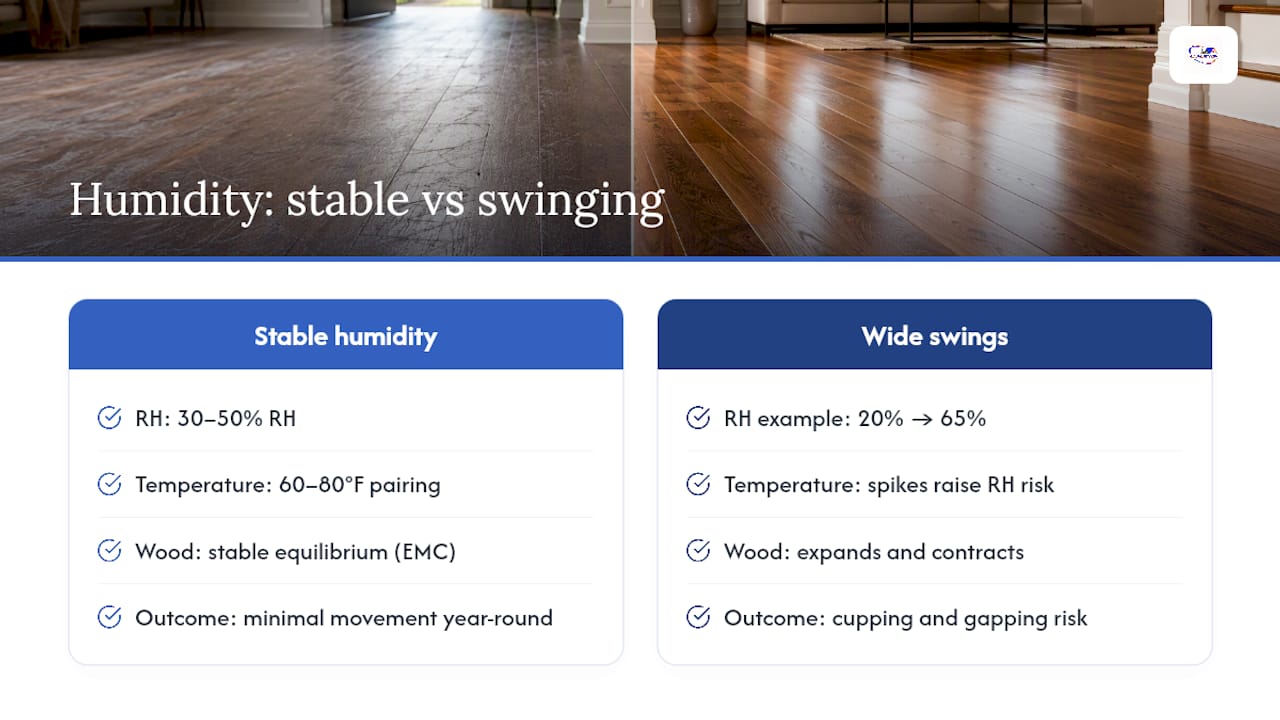
Keep your indoor relative humidity between 30% and 50%, paired with a room temperature of about 60 to 80°F. That’s the range the National Wood Flooring Association recommends for protecting solid and engineered hardwood year-round. Stray outside it for long stretches, and your floor starts telling you about it through gaps, cupping, or worse.
TL;DR:
- Maintaining indoor relative humidity between 30% and 50% year-round helps prevent hardwood floor damage caused by swelling, shrinking, and warping.
- Consistency in humidity levels throughout the year is more important than achieving perfect conditions on any single day.
- Signs of humidity-related damage include cupping, crowning, gapping, and buckling, each indicating different levels and types of moisture issues.
- Using multiple digital hygrometers and logging readings regularly provides the best way to monitor and manage subtle humidity fluctuations.
- Proper acclimation, moisture testing, and professional inspection are crucial before installing new hardwood flooring to minimize future movement and damage.
Table of Contents
- What Is the Ideal Humidity for Hardwood Floors?
- How Does Humidity Damage Hardwood Floors?
- How Do You Monitor Humidity for Hardwood Floors?
- Managing Humidity Season by Season
- What Should You Know Before Installing New Hardwood?
- When Should You Call a Flooring Professional?
- What I’ve Learned Fixing Colorado Floors for Years
- Get Expert Help Protecting Your Hardwood Floors
- Sources
- FAQ
What Is the Ideal Humidity for Hardwood Floors?
Wood is a sponge with good manners. It absorbs moisture from the air when humidity climbs and releases it when the air dries out, and it does this constantly, whether you’re paying attention or not. That back-and-forth is called equilibrium moisture content, or EMC, and it’s the reason the 30–50% relative humidity target actually matters instead of being an arbitrary number someone picked out of a hat.
Most hardwood arrives from the mill dried to a moisture content generally in the low single-digit to low double-digit percent range, which typically corresponds with the common 30–50% RH band. When your home’s air matches those conditions, your floor sits at a stable equilibrium and barely moves. When humidity swings wildly, so does the wood.
Temperature plays a supporting role here too. Warmer air holds more moisture, so a spike in temperature without a matching bump in ventilation or dehumidification can quietly push RH into damaging territory. That’s why the 60–80°F pairing matters as much as the humidity number itself.
Here’s the part homeowners often miss: perfection on any single day matters less than consistency across the year. A floor that lives at 38% RH every day of the year outperforms one that bounces between 20% in January and 65% in July, even if the yearly average lands in the “ideal” zone. Depending on your climate, you may need to lean toward the low end (drier winters) or the high end (humid summers) of that 30–50% window. Stability is the real goal.
How Does Humidity Damage Hardwood Floors?
Humidity swings show up on your floor in a handful of recognizable ways, and each one points to a different cause. Learning to read these signs early saves you from a much bigger repair bill later.
- Cupping happens when board edges rise higher than the center, giving the floor a slightly concave, wavy look. It usually means the wood absorbed moisture from below or the room’s humidity spiked, often from a leak, high indoor RH, or a damp crawlspace.
- Crowning is the opposite shape: the center of the board sits higher than the edges. It typically shows up after a cupped floor was sanded flat while still wet, and then the wood dried and shrank unevenly.
- Gapping appears as visible lines between boards, most common in winter when heated indoor air dries out and the wood shrinks slightly. Small seasonal gaps that close up again by summer are normal.
- Buckling is the most severe reaction: boards actually lift off the subfloor, sometimes by inches. This almost always traces back to serious, sustained moisture exposure, like standing water or a burst pipe.
The general rule from Woodfloors holds true across all four: wood swells in humid conditions and shrinks in dry ones, and a stable indoor environment is what keeps cupping and gapping from ever becoming a problem in the first place. If your gaps close when the seasons turn, relax. If a gap or cup lingers no matter what the calendar says, that’s your cue to look closer, and our guide to fixing cupped floors walks through what usually comes next.
How Do You Monitor Humidity for Hardwood Floors?
You can’t manage what you don’t measure, and guessing at humidity is how small problems turn into refinishing jobs. Here’s a simple system that works for most homes:
- Buy at least one digital hygrometer. These run cheap and give you a real-time RH and temperature reading instead of a guess based on how “dry” your skin feels.
- Place sensors where conditions vary most. A living room reading tells you little about a basement or a room against an exterior wall, so put a hygrometer in each zone that worries you.
- Log readings over time instead of reacting to one bad day. Tracking trends, ideally with a daily or weekly log or an inexpensive data logger, tells you far more than a single spike ever will, a point monitoring specialists at Onset make repeatedly in their work with flooring installers.
- Know when to check moisture content directly. RH tells you about the air; a pin or pinless moisture meter tells you about the wood itself. If a floor looks or feels off, a moisture meter reading is worth more than another glance at the hygrometer.
Pro Tip: Check your hygrometer right after any major HVAC change, like switching from AC to heat in the fall. That’s when RH swings fastest, and catching it early gives you a head start on adjusting.
Managing Humidity Season by Season
Colorado’s dry winters and monsoon-adjacent summer humidity make seasonal humidity control less optional than it might be elsewhere. The good news: the fixes are straightforward once you know which season you’re fighting.
Winter is a shrinking problem. Furnace heat dries indoor air fast, sometimes dropping RH into the teens if you’re not watching it. A humidifier, whether a portable unit for one problem room or a whole-home model tied into your HVAC system, adds moisture back and keeps gaps from opening wider than they need to. One caution worth repeating: don’t overcorrect.
Summer flips the script. Humid air pushes RH up, and your floor absorbs that moisture and swells. Air conditioning does most of the heavy lifting here, and it’s already dehumidifying as a side effect of cooling. If your home runs warm and humid despite the AC, a standalone dehumidifier in the worst-affected room closes the gap.
A few small habits help in any season:
- Run the bathroom fan during and after showers to keep humidity from drifting into hallways and bedrooms.
- Pull up wet doormats and bath mats promptly instead of letting them sit on the floor.
- Check crawlspaces and basements periodically for standing water or musty air, since moisture problems often start below the floor you’re standing on.
Pro Tip: If you already own a whole-home humidifier with a humidistat, set it to hold steady rather than adjusting it manually. Steady beats “close enough” every time.
What Should You Know Before Installing New Hardwood?
Acclimation means letting new flooring adjust to your home’s actual indoor conditions before it goes down, and skipping this step is one of the most common (and expensive) installation mistakes. Wood that gets nailed or glued down while still adjusted to a warehouse’s humidity level will move once it reaches equilibrium in your living room, and that movement shows up as gaps or buckling within months.
NWFA guidance points to target moisture content in the 6% to 9% range for most species, with an acceptable difference between the flooring and the subfloor of roughly 2 to 4 percentage points, depending on board width. Wider boards need tighter tolerances because they move more per percentage point of moisture change.
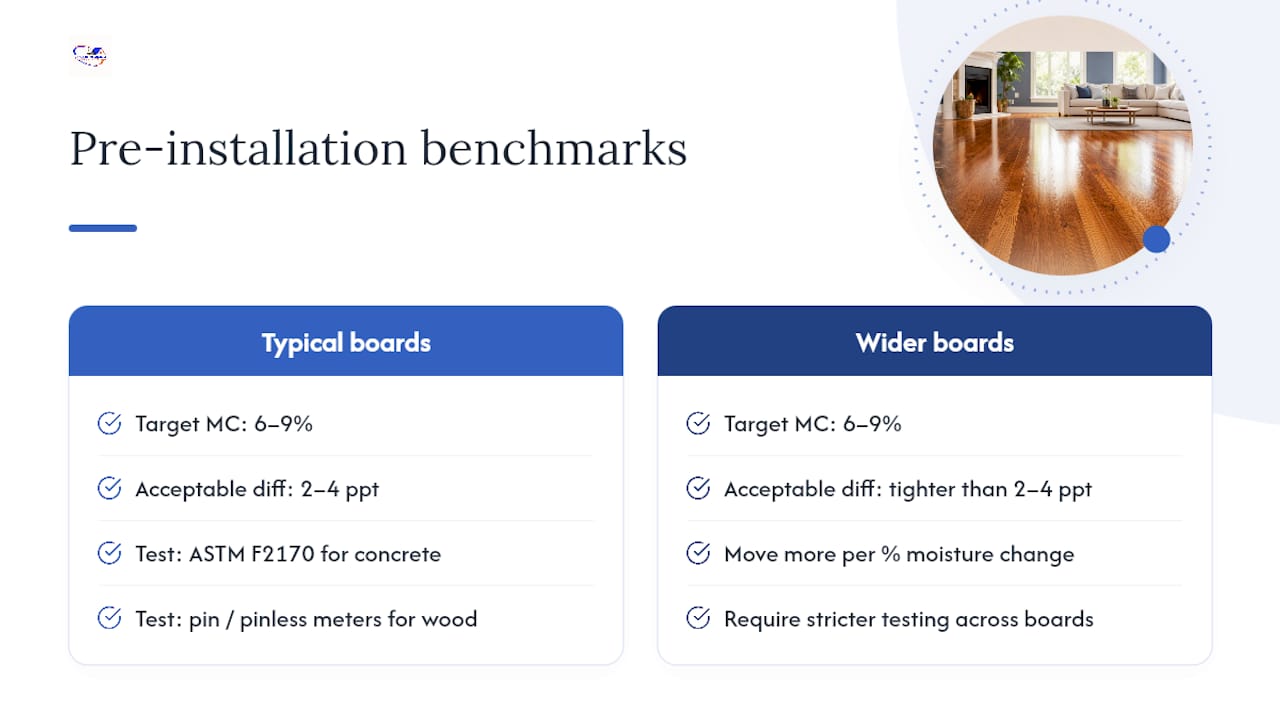
Reputable installers test for this instead of assuming it. Concrete slabs get checked with an ASTM F2170 probe test for internal relative humidity, while wood subfloors and the flooring itself get checked with pin or pinless moisture meters across multiple boards, not just one. Acclimation timeframes vary by product and season, and a good installer may cross-stack material with spacers to speed the process rather than rushing installation before the wood is ready.
When Should You Call a Flooring Professional?
Some humidity damage is a homeowner fix. Some isn’t. Small seasonal gaps that open in winter and close by summer need nothing more than your attention. Persistent large gaps that never close, visible buckling, cupping across a wide area, or any sign of an active leak or mold growth are red flags that call for a professional inspection.
In the meantime, document what you’re seeing with photos dated by week, stop any humidity swings you can control, and dry out the area if moisture is the obvious cause. A professional typically follows up with moisture content mapping across the floor and subfloor, a check for the underlying source, and then targeted repair, refinishing, or replacement depending on how far the damage has spread. Our guide to hardwood floor gaps breaks down which gap patterns are normal and which aren’t.
What I’ve Learned Fixing Colorado Floors for Years
Most humidity damage I see didn’t start as an emergency. It started as a gap someone decided to watch “for a while,” or a slight cup they figured would go away on its own. It often does, until the season it doesn’t. Buy the hygrometer, check it monthly, and call a professional the moment a change in your floor outlasts a season. Small, early actions save real money later.
— J.R.
Get Expert Help Protecting Your Hardwood Floors
A local flooring specialist can give Denver Metro homeowners something a humidity chart can’t: a real set of eyes on your actual floor. If you’ve spotted cupping, stubborn gaps, or a finish that’s starting to look tired from moisture exposure, we handle the inspection, the moisture testing, and the repair work in one call instead of three separate contractors.

Our team offers full sanding and refinishing for floors that have already cupped or gapped beyond a simple fix, along with targeted repairs, screen and recoat services, and an Instant UV-curable finish that lets you walk on the floor the same day. We use eco-friendly products and a dust-minimizing sanding process throughout, so the work doesn’t turn your home upside down while it’s happening. Every quote starts as a free conversation over the phone, based on what you tell the team and a few photos, so you know what you’re dealing with before you commit to anything. If your floor has been sending you signals, request your free quote and let’s figure out what it’s actually telling you.
Sources
This guide draws on the NWFA Homeowner’s Handbook, woodfloors.org’s problem prevention resources, and Onset’s monitoring research, plus our own guide on protecting floors from moisture damage.
FAQ
What Humidity Is Too High for Hardwood Floors?
The NWFA recommends staying within 30–50% RH year-round, and readings well above that for extended periods usually point to a ventilation or moisture-source problem worth investigating.
How Do You Pull Moisture Out of Hardwood Floors?
Start by running a dehumidifier or your air conditioning to lower ambient humidity, since the wood will release moisture back into drier air over time. If cupping or dampness persists after several days of stable, drier conditions, the moisture is likely coming from below the floor, and that calls for a moisture content check and possible subfloor inspection.
Is 70% Humidity Too High for a House?
Homes should stay closer to the 30–50% RH range that protects both flooring and indoor air quality.
How Long Should Wood Flooring Sit in a House Before Installation?
Acclimation timeframes vary by product, but most solid hardwood needs several days to two weeks in the home’s actual living conditions before installation, and engineered products often need less. A qualified installer confirms this with a moisture meter rather than relying on a fixed number of days, checking that the flooring’s moisture content sits close to the subfloor’s.