 Skip to content
Most whole-house hardwood refinishes take 3 to 5 crew days on-site, with a single room wrapped up in 2 to 3 days and a full home running 5 to 7 days or more. You can walk in socks about 24 hours after the final coat, move furniture back (with felt pads) at 48 to 72 hours, but rugs need to wait for full cure: roughly 14 days for water-based finish and 21 to 30 days for oil-based. The finish you choose is the single biggest lever on your schedule.
TL;DR:
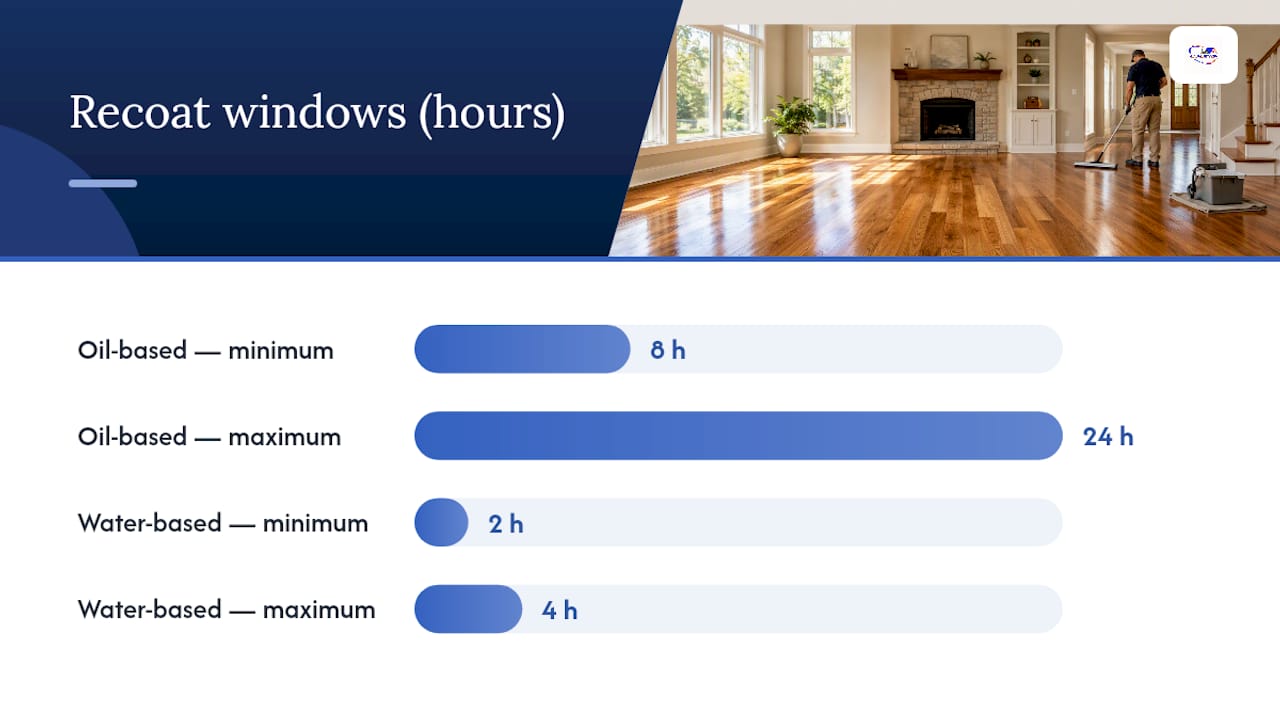
- Water-based finishes typically allow recoat windows of 2 to 4 hours and full cure in about 7 to 14 days, making the timeline faster than oil-based options.
- Oil-based finishes require 8 to 24 hours between coats and extend the full cure period to 21 to 30 days, often adding 2 to 3 extra crew days to the project.
- Larger open-plan floors can be sanded in about 4 to 6 hours, but the overall process, including multiple zones, often takes 5 to 7 days on-site.
- Additional job duration factors include floor condition, stain application, finish chemistry, humidity levels, and room access issues.
- Using UV-curable or water-based systems can significantly reduce total project time and enable faster re-entry, especially in occupied homes.
Table of Contents
- What Is a Realistic Refinishing Timeline for Hardwood Floors?
- The Day-by-Day Breakdown of a Hardwood Refinishing Project
- What Actually Changes Your Hardwood Refinishing Duration?
- Water-Based vs. Oil-Based vs. UV: How Finish Choice Shapes Your Schedule
- How to Plan and Prepare for Your Refinishing Project
- Contractor Tips to Shorten the Job Without Cutting Corners
- A Contractor’s Notes on What Actually Trips Up Refinishing Schedules
- Get a Predictable Refinishing Schedule Booked With J.R. Hardwood
- Sources
- FAQ
What Is a Realistic Refinishing Timeline for Hardwood Floors?
Sanding and finish work follow a predictable rhythm once a crew starts, but the total refinishing timeline for hardwood depends heavily on which finish product goes down last. Here’s the milestone breakdown most contractors work from.
| Milestone | Water-Based Finish | Oil-Based Finish | What It Means |
|---|---|---|---|
| Recoat window | 2–4 hours | 8–24 hours | How soon the next coat can go on |
| Walk in socks | ~24 hours | ~24 hours | Safe to walk without shoes |
| Furniture back (felt pads) | 48–72 hours | 48–72 hours | Weight won’t dent the finish yet |
| Rugs down | ~14 days | 21–30 days | Full cure before trapping moisture |
| Full cure | 7–14 days | 21–30 days | Finish is fully hardened |
For a typical 1,000 square foot project, expect 4 to 5 working crew days plus roughly two weeks of cure time before life goes back to normal in those rooms. Odor runs strongest during sanding and the first coat, then fades fast with water-based products and lingers longer with oil-based ones. Plan to vacate the finished rooms, not necessarily the whole house, for the on-site portion.
The Day-by-Day Breakdown of a Hardwood Refinishing Project
A standard 3 to 5 day refinish moves through a set sequence. Here’s what actually happens on each day, and why the waiting isn’t wasted time.
- Day 1: Prep and first sanding pass. Furniture gets cleared, floor vents and doorways get taped, and the crew runs a coarse sanding pass to strip old finish and level the wood. On an open 1,000 square foot layout, that first pass alone can take 4 to 6 hours because it’s removing years of old poly and surface damage.
- Day 2: Intermediate and final sanding, plus repairs. The crew moves through progressively finer grits, hits edges and corners with an edger, and handles minor board repairs or squeak fixes. Vacuuming and a tack pass finish the day, leaving bare, smooth wood ready for stain or finish.
- Day 3: Stain application (if used) or first finish coat. If you’re changing the wood’s color, stain goes down and needs a full overnight dry before any finish touches it. Jobs staying with a natural or existing tone skip straight to the first coat of finish here.
- Days 4–5: Finish coats. This is where water-based and oil-based diverge sharply. Water-based poly often allows two coats in a single day, while oil-based generally allows only one coat per day. That single difference commonly adds 2 to 3 extra crew days to an oil-based job on the same square footage.
Whole-house jobs rarely run this on a single calendar. Crews stage work in zones, finishing bedrooms and hallways while a kitchen or main living area is still being sanded elsewhere, so the total on-site window stretches to 5 to 7 days without every room being off-limits at once. Ask your contractor which zone finishes first if you need one bathroom or bedroom back sooner than the rest.
What Actually Changes Your Hardwood Refinishing Duration?
Every home is a little different, and these are the variables that push a job longer or let it wrap up faster than the baseline.
- Square footage and layout. An open floor plan sands faster per square foot than a home chopped into small, separated rooms because the crew isn’t constantly repositioning equipment.
- Floor condition going in. Loose boards, old nail heads, water damage, or multiple stacked coatings from a previous refinish all add repair time before sanding can even start.
- Stain versus no stain. A color change adds at least one full overnight drying day that a natural-tone refinish skips entirely.
- Finish chemistry and coat count. Water-based, oil-based, 2K, and UV-cured systems all cure on different clocks, and more coats means more waiting between each one.
- Temperature and humidity. High indoor humidity slows every dry time in the schedule, sometimes by a full day or more on a muggy week.
- Access and logistics. Narrow staircases, tight hallways, and rooms packed with furniture that has to be hand-carried out all eat into productive crew hours.
Pro Tip: Ask your contractor to walk the floor with you before scheduling. Irregular plank widths and old repairs are often invisible until the old finish comes off, and catching them in the estimate call avoids a surprise extra day mid-job.
Oil-based systems typically need 8 to 24 hours between coats compared to water-based’s 2 to 4 hour window, and that gap compounds fast on a multi-coat job.
Water-Based vs. Oil-Based vs. UV: How Finish Choice Shapes Your Schedule
Think of your finish choice like choosing a paint that dries in an hour versus one that needs overnight. Both end up beautiful, but they run on completely different clocks.
- Water-based finish recoats in 2 to 4 hours, often allowing two coats in one day, with full cure landing around 7 to 14 days. Low odor makes it the go-to for occupied homes with kids or pets.
- Oil-based finish needs 8 to 24 hours between coats, usually one coat per day, with full cure stretching to 21 to 30 days and a noticeably stronger odor during application.
- 2K and UV-curable systems compress the timeline further, with some UV-curable finishes offering same-day turnaround, at a higher product cost.
Fast-drying waterborne formulas can be recoatable in as little as 1 to 2 hours in some products, while traditional oil-based finishes stay tacky far longer. If you’re matching an existing amber, aged look, oil-based still wins on color; if speed and low odor matter more, water-based or a 2K system is the better trade.
How to Plan and Prepare for Your Refinishing Project
Getting your hardwood refinishing schedule right starts well before the crew shows up with sanders.
- Pick a low-humidity window. Avoid scheduling during the muggiest stretch of summer if you can help it; running your HVAC and a dehumidifier during the job keeps dry times predictable.
- Clear the rooms completely. Move furniture, breakables, and electronics out of every room on the work list, not just the main areas, since dust travels.
- Confirm the exact product and cure windows with your contractor. Get the finish brand, coat count, and recoat schedule in writing before day one so there’s no ambiguity about when rugs or furniture return.
- Plan for the household. Pets and small kids often do best with a few nights elsewhere or in an unaffected part of the house while sanding dust and finish odor settle.
Contractor Tips to Shorten the Job Without Cutting Corners
A few smart choices can trim real days off your calendar without touching finish quality.
- Choose water-based, 2K, or UV-curable finish when you need to keep living in the house during the job.
- Clear every work zone and confirm furniture staging before the crew’s truck pulls up.
- Get the finish specification and manufacturer recoat guidance in writing, and check it against the polyurethane cure guide for your specific product.
Pro Tip: Schedule finish coats on consecutive dry days whenever possible, and run dehumidification overnight between coats. That single habit keeps recoat windows tight and prevents the schedule from sliding by a day or two on humid weeks.
A Contractor’s Notes on What Actually Trips Up Refinishing Schedules
A standard 1,000 square foot main floor usually runs the full 4 to 5 day arc: sanding, maybe a stain day, then finish coats. A single 200 square foot bedroom can wrap in two days flat, sanding one morning and coats the next. The size difference matters less than most homeowners expect; the finish chemistry is what actually moves the calendar.
The mistake we see most often isn’t scheduling. It’s homeowners putting rugs back down at day 10 because the floor “looks dry.” Oil-based finish can still be off-gassing solvents at that point, and trapping them under a rug can leave a permanent mark. We build cure windows into the schedule up front, zone the work so families aren’t displaced from the whole house at once, and tell you the exact date it’s safe, not an estimate.
— J.R.
Get a Predictable Refinishing Schedule Booked With J.R. Hardwood
If a compressed schedule matters more than anything else, Jrhardwoodfloorrefinishingandcleaning is the option built for exactly that. Where oil-based jobs can leave a household waiting a month for full cure, our Instant UV-curable finishing option and water-based 2K systems get floors walkable and living rooms back to normal far faster than a traditional oil-based refinish, without you guessing at drying windows.

Every quote starts with a free over-the-phone estimate based on your description and a few photos, so you get a real timeline before a crew ever sets foot in your home. You’ll receive the exact finish specification, the cure schedule, and a move-back plan mapped to your household, not a generic range. If you’re weighing whether to hire a pro or handle prep yourself, our breakdown of DIY versus professional refinishing lays out where each approach actually saves time. Call or request a quote today and get a firm start date on the calendar.
Sources
The schedule and cure figures in this guide come from contractor and manufacturer references that track real recoat and cure data, not rough estimates.
- Oil-Based vs Water-Based Polyurethane for Hardwood Floors (DMV, 2026) | Potomac Floors
- How Long Does Hardwood Refinishing Take? | USA Pro Floors
- How long does polyurethane take to dry? (Bob Vila)
FAQ
How long does it take to refinish 1,000 square feet of hardwood floors?
Expect about 4 to 5 working crew days on-site, plus roughly two weeks of cure time before rugs go back down, depending on the finish used.
What is the typical timeline for refinishing hardwood floors?
A single room usually takes 2 to 3 days, an average home runs 3 to 5 days, and a whole house can stretch to 5 to 7 days or more with zoned scheduling.
How long after refinishing hardwood can you walk on it?
You can walk in socks about 24 hours after the final coat, but furniture shouldn’t go back for 48 to 72 hours and rugs need full cure, 14 days for water-based finish or 21 to 30 days for oil-based.
How much does it cost to refinish 2,000 square feet of hardwood floors?
Cost varies by floor condition, finish type, and repairs needed, so a phone or photo-based estimate from a local contractor like J.R. Hardwood is the most accurate way to get a firm number for your specific floors.